The Antikythera Mechanism Reveals Ancient Mechanical Astronomy
Corroded fragments from a shipwreck preserve a sophisticated device for representing celestial cycles.
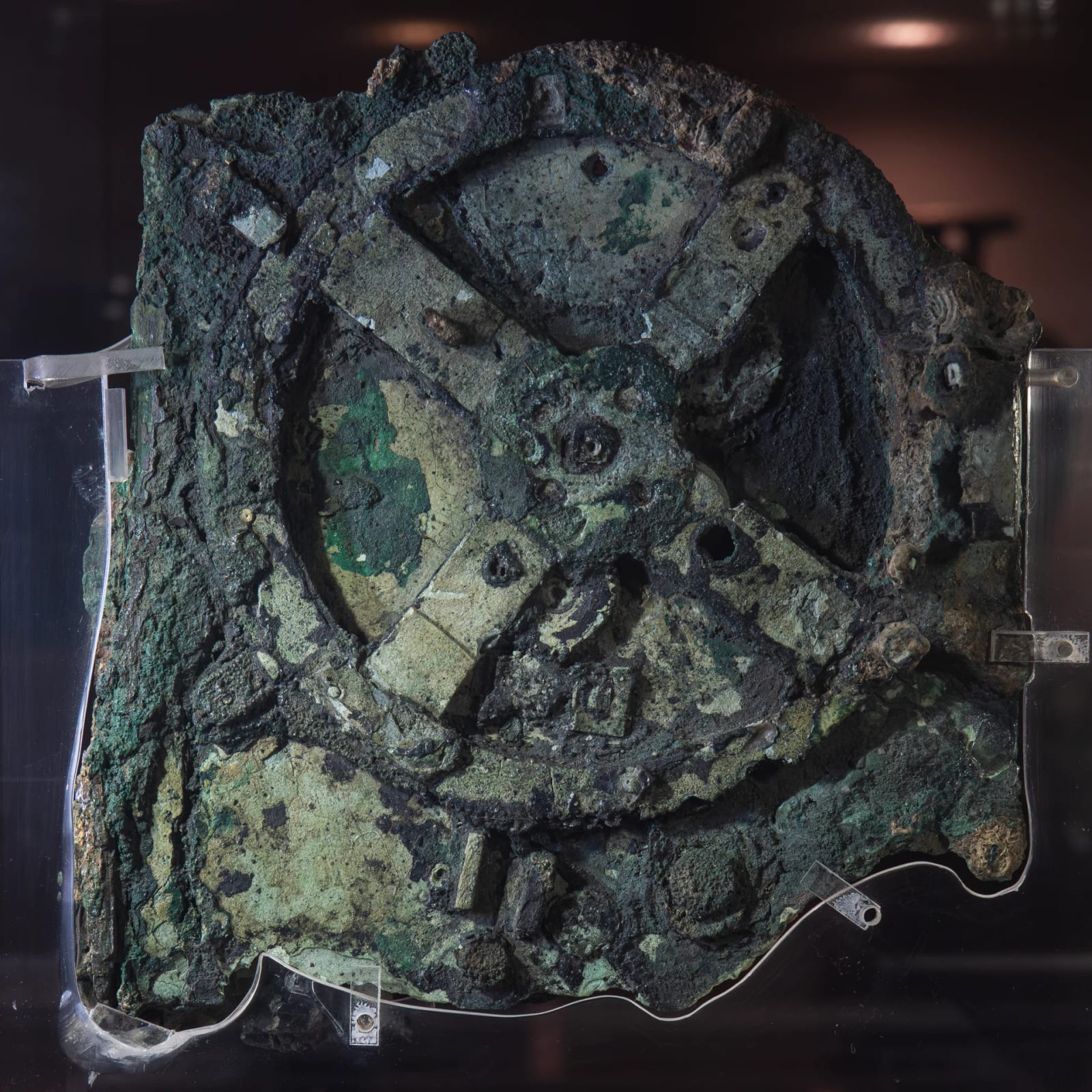
In 1900, sponge divers working off Point Glyphadia near the Greek island of Antikythera came upon the wreckage of a Roman cargo ship resting at a depth of forty-five metres. During recovery operations carried out with the Hellenic Royal Navy through 1901, the salvage team brought up bronze and marble statues, glassware, pottery, coins, and a corroded lump of bronze and wood. Transferred to the National Archaeological Museum in Athens, this unpromising cluster went largely unexamined for months as conservators concentrated on restoring conspicuous art pieces. In May 1902, archaeologist Valerios Stais and politician Spyridon Stais inspected one of the drying remnants and identified a gear wheel set within the mineralised crust. The bronze components had altered into atacamite, cracking and shrinking once removed from the marine environment.
Initial evaluations met widespread scepticism, as most scholars deemed a complex geared instrument anachronistic for a wreck dated to around 70 to 60 BCE. Philologist Albert Rehm proposed early on that the assembly served as an astronomical calculator, yet detailed physical investigation languished until science historian Derek J. de Solla Price began examining it in 1951. Decades later, non-destructive imaging transformed scholarship on the artefact. In 1971, Price collaborated with nuclear physicist Charalampos Karakalos to produce X-ray and gamma-ray images. Further study using computer X-ray tomography and high-resolution scanning revealed internal gearing and deciphered faint texts covering the bronze sheets, demonstrating that the eighty-two surviving fragments belonged to an intricate, hand-cranked orrery.

Keep reading in Yester
Coming soon to the App Store
Keep following the story
Sources
Image: Logg Tandy