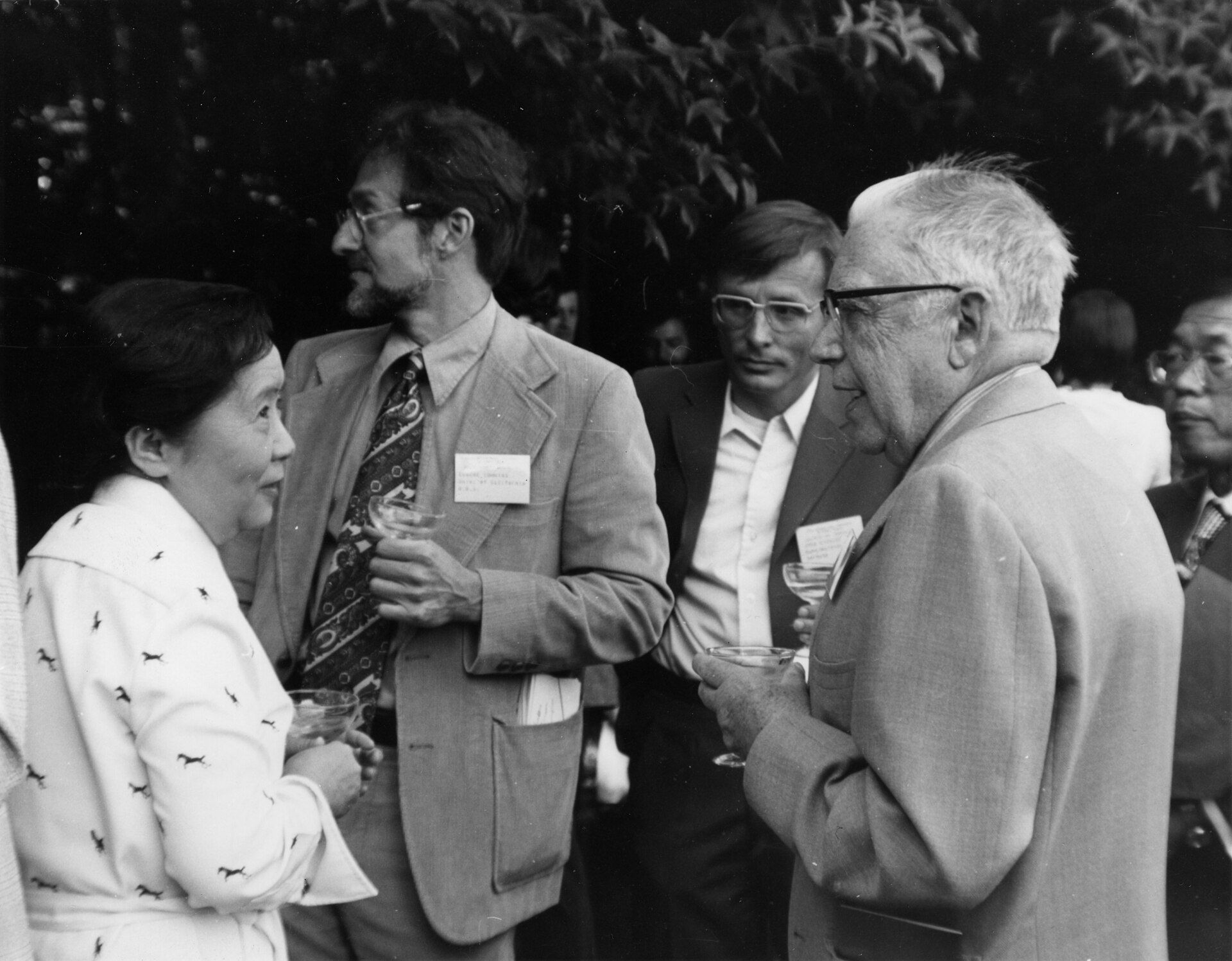
Chien-Shiung Wu Helps Overturn a Symmetry in Physics
An experiment using cobalt nuclei tested an assumption about nature that had seemed fundamental.
In 1927, Eugene Wigner formalized the conservation of parity, expressing mathematically the long-standing intuition that nature treats left and right symmetrically. Under this principle, the laws of physics were expected to predict identical behaviors in a system and its exact mirror image. While parity conservation had been verified in electromagnetic and strong nuclear interactions, puzzling measurements involving subatomic kaons emerged in the mid-1950s. Known as the tau-theta puzzle, two seemingly identical kaon varieties exhibited identical properties yet decayed into different numbers of pions with differing parities. This conflict suggested that either two distinct particles existed or the long-held assumption of parity conservation did not hold universally.
Examining the literature on fundamental interactions, theoretical physicists Tsung-Dao Lee and Chen-Ning Yang concluded that existing experimental data neither proved nor disproved parity conservation in the weak interaction, which governs beta decay. In the summer of 1956, they approached experimentalist Chien-Shiung Wu, an authority on beta decay spectroscopy, to discuss possible tests. Deciding to evaluate the directional properties of beta decay in cobalt-60 nuclei, Wu canceled planned travels to Europe and the Far East to pursue the experiment immediately, even though many prominent colleagues, including theoretical physicist Wolfgang Pauli, viewed parity nonconservation with severe skepticism.

Keep reading in Yester
Coming soon to the App Store
Keep following the story
Sources
Image: Credit Line: AIP Emilio Segrè Visual Archives, Segrè Collection