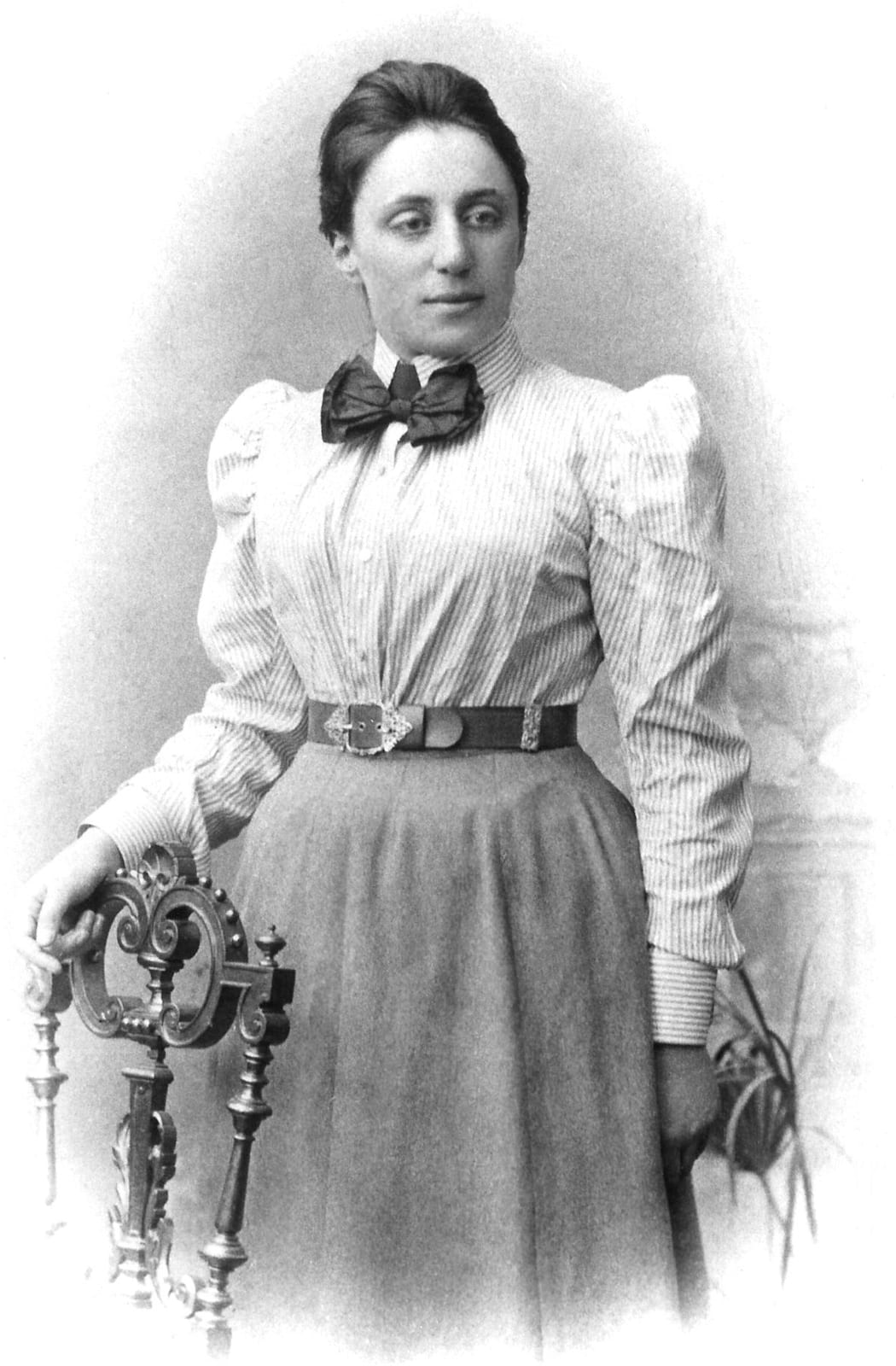
Emmy Noether Connects Symmetry with What Nature Conserves
A mathematical theorem linked continuous symmetries to conservation laws. Its significance reaches beyond one equation and beyond the barriers Noether faced in academic life.
In 1918, the mathematician Emmy Noether published a theorem in the calculus of variations that established an exact relationship between continuous physical symmetries and conservation laws. Her investigation grew out of problems in theoretical physics, beginning in 1915 when she was assisting Felix Klein and David Hilbert with mathematical questions arising from Albert Einstein's theory of general relativity. By March 1918, Noether had assembled the central concepts that demonstrated how physical invariants originate directly from the underlying symmetry of a system's action.
Prior to Noether's formulation, conservation principles involving momentum and energy had been identified primarily through physical observation and mechanical equations. René Descartes and Gottfried Leibniz introduced early concepts through collision experiments in the seventeenth century, while Isaac Newton derived momentum conservation from his laws of motion. During the eighteenth and nineteenth centuries, Joseph-Louis Lagrange and William Rowan Hamilton established generalized coordinate frameworks. In Lagrangian mechanics, if a specific coordinate was absent from the governing Lagrangian function, the corresponding momentum remained invariant. Noether generalized this correspondence into a comprehensive mathematical principle.

Keep reading in Yester
Coming soon to the App Store
Keep following the story
Sources
Image: Unknown author Unknown author Publisher: Mathematical Association of America [3] , Brooklyn Museum [4] , Agnes Scott College [5] , [6]