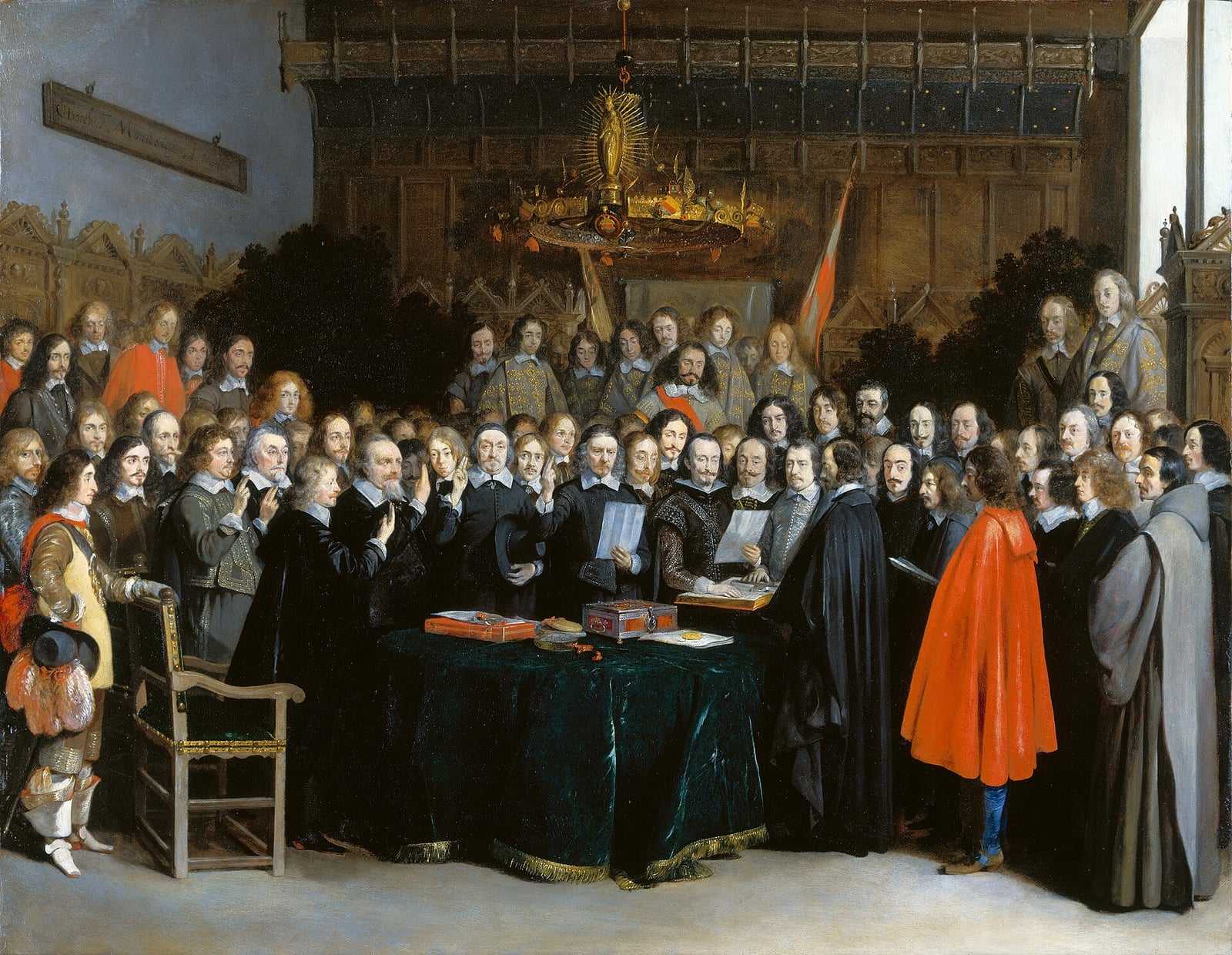
The Peace of Westphalia Ends Decades of War
Long negotiations closed the Thirty Years’ War and reshaped European diplomacy.
In October 1648, two treaties signed in the northwestern German region of Westphalia brought a formal end to the Thirty Years' War across the Holy Roman Empire. The conflict had devastated central Europe since 1618, causing millions of deaths through widespread warfare, disease, and starvation. Reaching a resolution required years of diplomatic maneuvering, producing the Treaty of Münster between the Holy Roman Emperor and France, and the Treaty of Osnabrück between the Emperor and Sweden.
Because the opposing factions refused to convene in a single location under rival authority, talks were split between two demilitarized cities in Westphalia. Catholic-controlled Münster hosted discussions involving France, the Empire, and Spanish representatives, whereas predominantly Protestant Osnabrück accommodated Sweden and imperial diplomats. Delegations from European powers, imperial estates, and a range of other interest groups took part. The congress was formally set to open in July 1643, and the envoys never convened in a unified plenary session, arriving and departing at different intervals over the following years.

Keep reading in Yester
Coming soon to the App Store
Keep following the story

Sources
- Peace Treaties of Westphalia (October 14/24, 1648) (German History in Documents and Images, German Historical Institute)
- Treaty of Westphalia (Avalon Project, Yale Law School)
- Pope Innocent X (Catholic Encyclopedia, New Advent)
- Sovereignty, International Relations, and the Westphalian Myth, by Andreas Osiander (International Organization, Cambridge University Press)
- Peace of Westphalia
Image: Gerard ter Borch