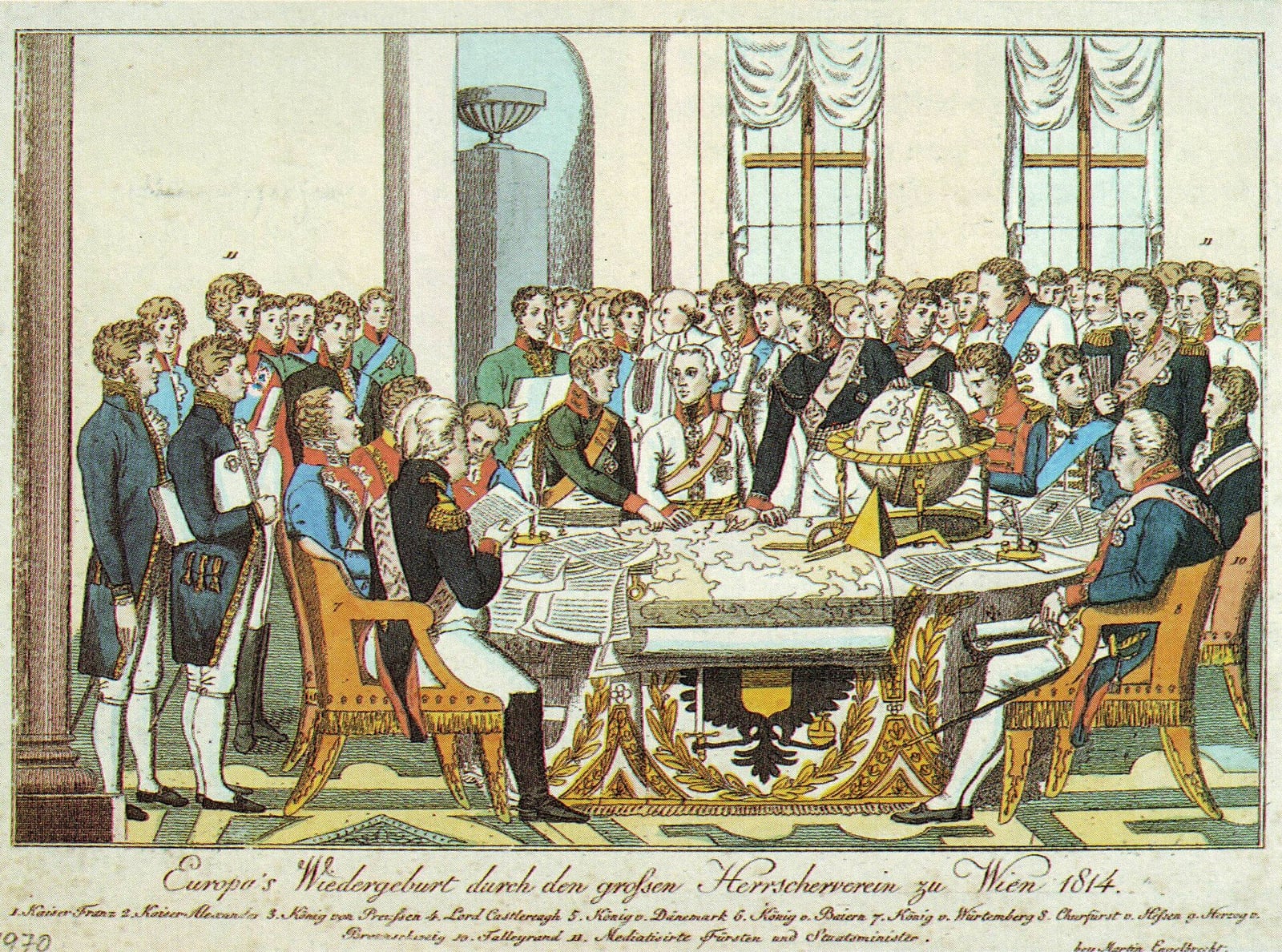
The Congress of Vienna Reorders Europe
Negotiations after Napoleon’s wars sought a durable balance among competing powers.
In September 1814, diplomats and monarchs assembled in Vienna to construct a durable political order following the initial abdication of Napoleon Bonaparte. The protracted fighting of the French Revolutionary Wars and Napoleonic Wars had dismantled established frontiers and destabilized regimes across the continent for more than two decades. Rather than conducting diplomacy through the traditional exchange of couriers between distant capitals, Austrian Foreign Minister Klemens von Metternich organized a centralized framework that brought delegates together in one city. Representatives of some two hundred European states, princely houses, and cities attended, though the decisive agreements were directed by the dominant coalition powers: Austria, the United Kingdom, Russia, and Prussia.
The primary objective of the victorious allies was to establish an enduring continental equilibrium rather than merely restoring prewar boundaries. Conservative leaders aimed to restrain revolutionary, republican, and liberal doctrines while adjusting the territorial weight of major powers to prevent any single realm from achieving hegemony. France, represented by Charles-Maurice de Talleyrand-Périgord, attended under the restored Bourbon monarch Louis XVIII. Despite initially facing exclusion from inner councils, Talleyrand capitalized on divisions among the victors to secure France a seat alongside the four allied courts, ensuring that French borders were largely preserved as they stood prior to Napoleon's conquests.

Keep reading in Yester
Coming soon to the App Store
Keep following the story
Sources
- Final Act of the Congress of Vienna, 9 June 1815, full text ("The World and Japan" Database, GRIPS / University of Tokyo)
- The Congress of Vienna (King's College London Archives exhibition)
- Swiss neutrality (King's College London Archives exhibition)
- The Treaty of Paris (King's College London Archives exhibition)
- The Congress of Vienna (Austrian Federal Chancellery)
- Final Document of the Congress of Vienna 1815 (Austrian Commission for UNESCO, Memory of the World)
- Congress of Vienna
Image: Unknown author Unknown author