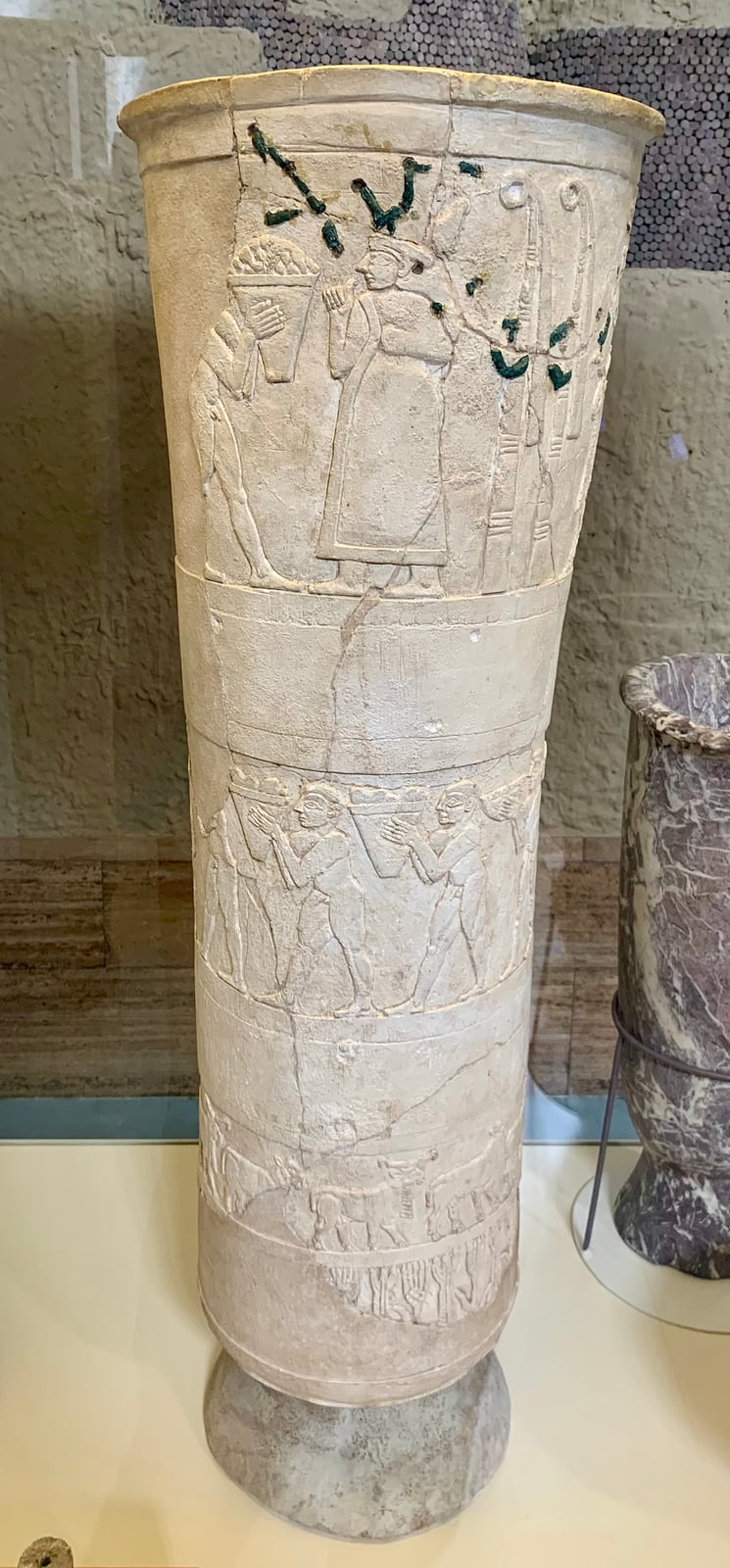
The Warka Vase Shows an Offering in Ancient Uruk
A carved alabaster vessel is one of the oldest surviving narrative reliefs.
During the 1933 and 1934 excavation season at the ancient city of Uruk in southern Iraq, German archaeologists uncovered the fragments of a carved alabaster vessel. Found in the sacred Eanna district in a context dated to around 3000 BCE, the object had not been preserved in its original placement but as part of a temple deposit. Signs of repair in antiquity indicated that the artifact had already experienced a substantial working life before its ancient burial. The reconstructed vessel stands approximately one meter tall, widening toward its upper rim.
Known to historians as the Warka Vase, the vessel presents one of the earliest known examples of complex pictorial narrative in ancient art. Rather than scattering figures loosely across the exterior, its creators organized the imagery into distinct horizontal registers that climb upward around the circumference. This tiered composition established an orderly visual sequence, mapping out a cosmological and social hierarchy rooted in the fertile river delta of the Tigris and Euphrates rivers.

Keep reading in Yester
Coming soon to the App Store
Keep following the story
Sources
- Warka Vase (Object) (Harvard University, HIST 1039 course collection)
- Archaeologists review loss of valuable artifacts one year after looting (University of Chicago Chronicle)
- The Warka Vase at the Iraq Museum (World History Encyclopedia)
- Warka Vase [Bottom Register] (World History Encyclopedia)
- Offering to Inanna, Warka Vase [Top Register] (World History Encyclopedia)
- Editorial: Baghdad Museum Gets Vase Back (Voice of America)
- Warka Vase
Image: Neoclassicism Enthusiast