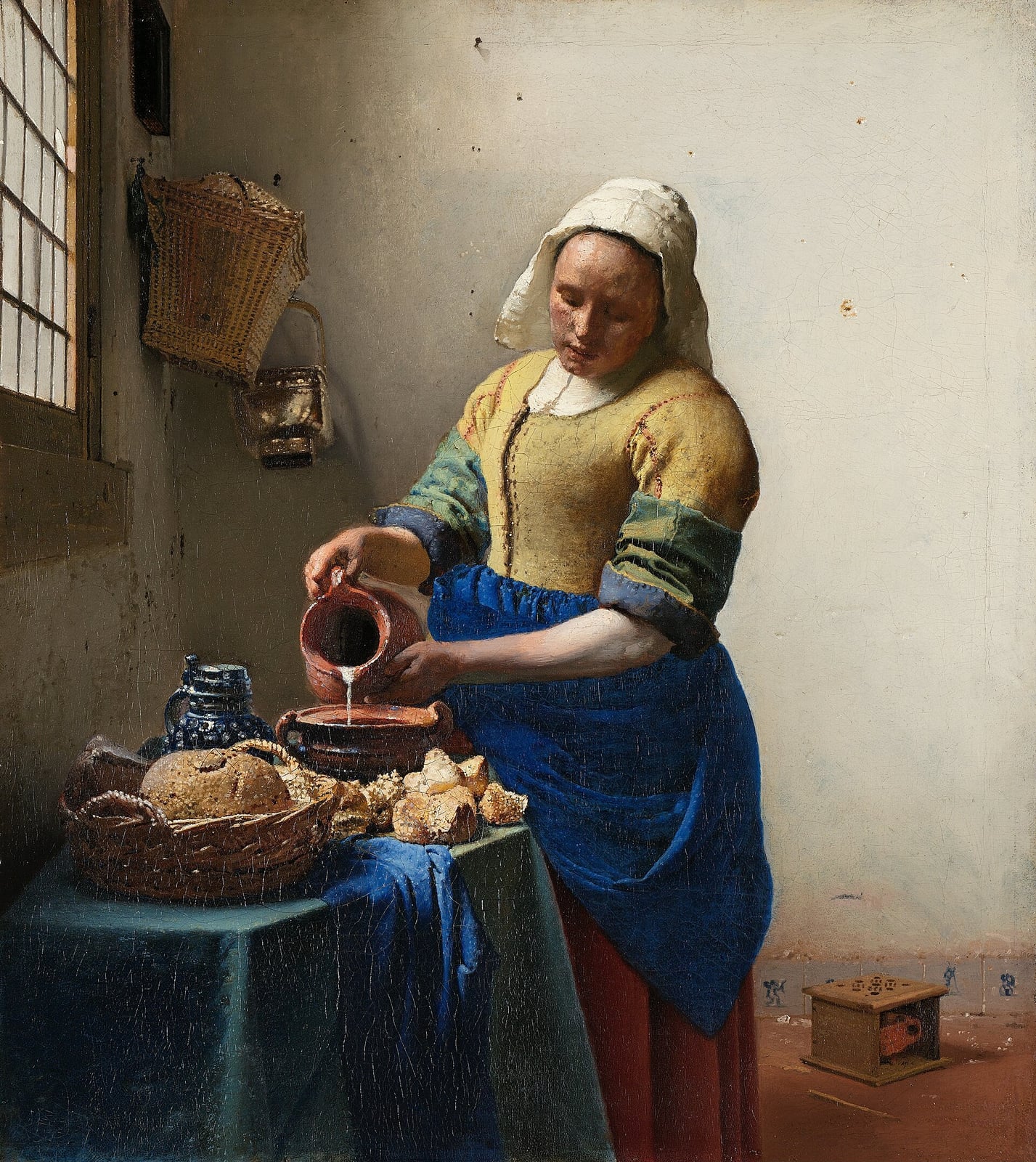
Vermeer Makes Domestic Interiors a World of Looking
Light, material and carefully arranged rooms reveal an artist whose later fame far exceeded his small surviving output.
In October 1632, Johannes Vermeer was baptized into the Reformed Church in the manufacturing city of Delft. His father, Reijnier Janszoon, worked as a caffa weaver producing silk blends before taking up picture dealing and running an inn named The Flying Fox on the Voldersgracht. Following his father's death in 1652, Vermeer inherited the family art business. The following spring he married Catharina Bolnes, a Catholic woman from a considerably wealthier family. Her mother, Maria Thins, resisted the match until fellow painter Leonaert Bramer intervened, and Vermeer is generally thought to have converted to Catholicism around the time of the marriage. The couple eventually settled in Thins's commodious residence on the Oude Langendijk, where Vermeer set up his easel in a second-floor room overlooking the canal.
Accepted into Delft's Guild of Saint Luke in December 1653, Vermeer lacked the funds to settle his entrance dues immediately, an early sign of the financial insecurity that shadowed his career. Little is documented concerning his instruction. Proposals that he trained under Carel Fabritius or Abraham Bloemaert lack definitive archival proof, leaving open the possibility that he was largely self-directed through his father's professional contacts. Scholars have noted that his early work displays compositional similarities with the Utrecht followers of Caravaggio, several of whose paintings appeared within the domestic settings Vermeer depicted. Despite his slow working pace of roughly three paintings per year, Vermeer earned respect among his peers, who elected him headman of the painter's guild in 1662, 1663, 1670, and 1671.

Keep reading in Yester
Coming soon to the App Store
Keep following the story

Sources
Image: Johannes Vermeer