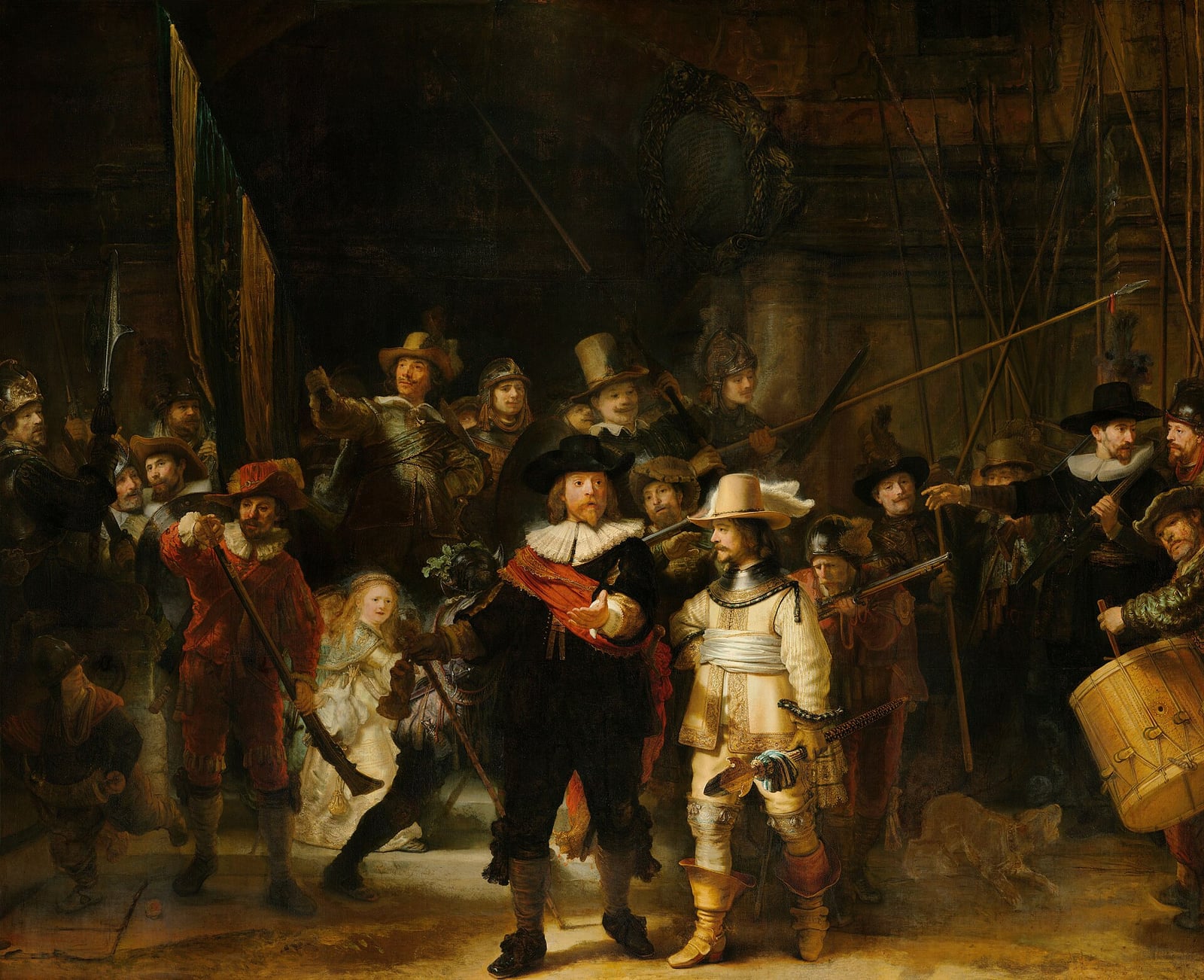
Rembrandt Sets a Civic Guard in Motion
A commissioned militia portrait became a drama of movement, light and shadow.
In 1642, Rembrandt van Rijn finished an enormous group portrait for an Amsterdam civic guard unit. Commissioned no later than December 1640 by Captain Frans Banninck Cocq and seventeen members of his militia company, the painting was intended for the banquet hall of the newly constructed Kloveniersdoelen, the musketeers' meeting hall. The sitters paid according to their prominence, and Rembrandt's fee has been estimated at between 2,000 and 4,000 guilders. The assignment formed part of a broader decorative scheme involving large militia pieces by different artists, an undertaking that has been linked to the grand civic reception held for Marie de' Medici when she arrived in Amsterdam in 1638.
Instead of arranging his patrons in a conventional, orderly line, Rembrandt conceived the gathering as an unfolding event. The composition captures thirty-four figures in mid-stride, commanded by Banninck Cocq, who steps forward in black with a bright red sash alongside his lieutenant, Willem van Ruytenburch, attired in yellow with a white sash. Behind them, the ensign Jan Visscher Cornelissen elevates the company banner, while an illuminated young girl carries an emblem of the arquebusiers: a dead chicken hanging from her belt, whose claws allude to the arquebusiers’ emblem. The canvas, recorded by the Rijksmuseum at 379.5 by 453.5 centimetres, is Rembrandt's largest painting.

Keep reading in Yester
Coming soon to the App Store
Keep following the story
Sources
- The Night Watch, SK-C-5 (Rijksmuseum)
- 10 things about Rembrandt's Night Watch (Rijksmuseum)
- The Night Watch (Encyclopaedia Britannica)
- Unusual lead compound found in Rembrandt's Night Watch (University of Amsterdam)
- Revealing the Secret History of Rembrandt's The Night Watch (Artnet News)
- Not lost forever? How AI is restoring famous paintings (Christian Science Monitor, AP)
- The Night Watch
Image: Rembrandt