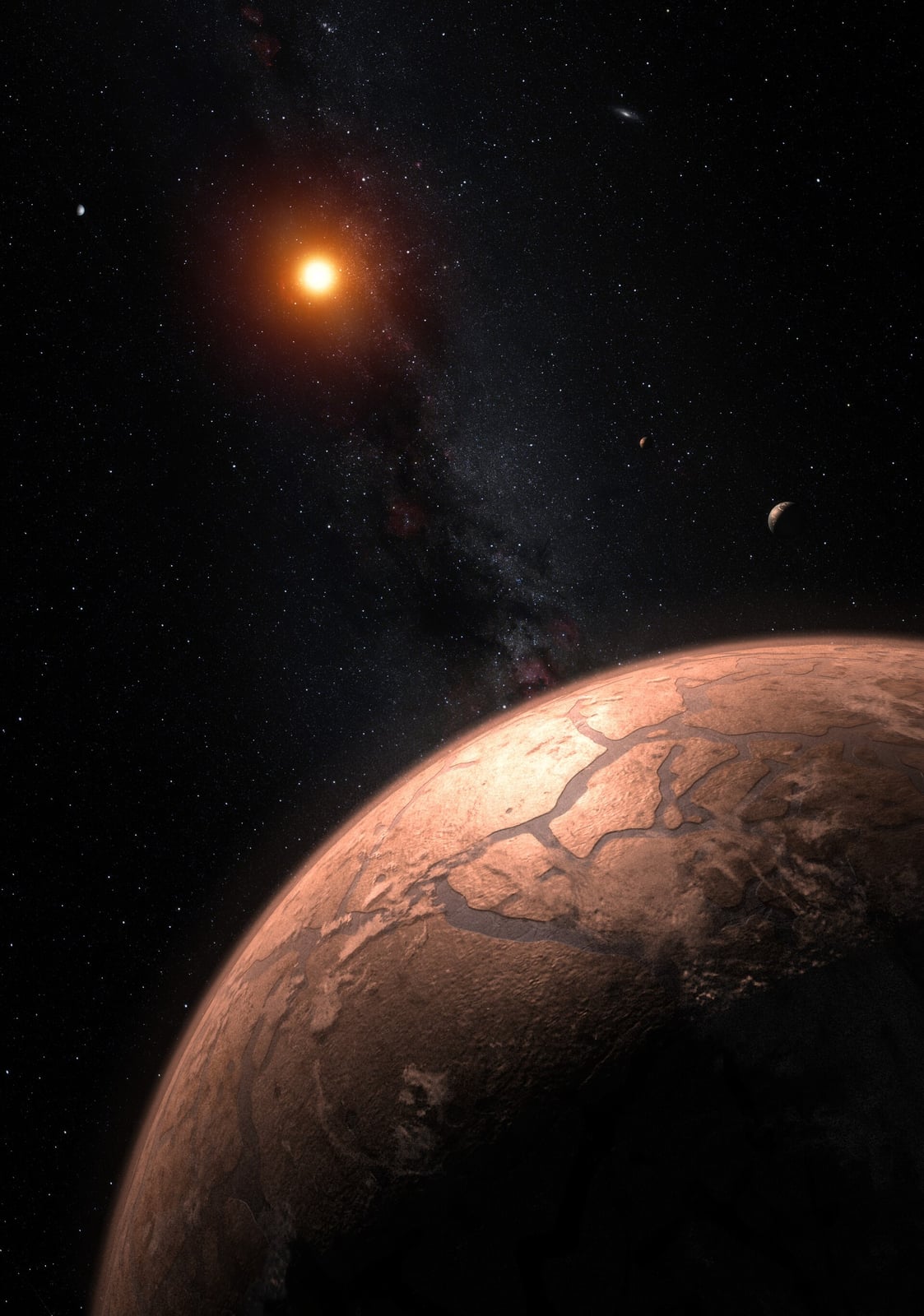
Seven Earth-Sized Planets Are Found Around TRAPPIST-1
A dim red dwarf 40 light-years away turned out to host a record family of rocky worlds.
In 1999, astronomer John Gizis and his collaborators identified an ultra-cool red dwarf roughly forty light-years from Earth in the constellation Aquarius. Formally catalogued and published in 2000, the dim celestial body possessed just nine percent of the mass of the Sun and a radius barely surpassing that of Jupiter. Because its surface temperature hovered around 2,566 Kelvin, it radiated primarily in the infrared spectrum. More than fifteen years later, this faint object became the focal point of a major astronomical breakthrough through the work of the Transiting Planets and Planetesimals Small Telescope project, known as TRAPPIST.
Operating the TRAPPIST-South facility at the La Silla Observatory in Chile, a team led by Belgian astronomer Michaël Gillon detected periodic dips in the star's apparent brightness during 2015 observations. These light curve anomalies indicated that orbiting bodies were passing directly between the star and Earth. By 2016, researchers announced the initial detection of exoplanets in the system. Further monitoring, combining ground-based observatories across several continents with space telescopes, revealed that a signal initially interpreted as a single third planet actually represented multiple distinct worlds. By early 2017, the count of confirmed terrestrial planets circling the star reached seven.

Keep reading in Yester
Coming soon to the App Store
Keep following the story
Sources
- Ultracool Dwarf and the Seven Planets (ESO press release eso1706)
- Three Potentially Habitable Worlds Found Around Nearby Ultracool Dwarf Star (ESO press release eso1615)
- The 7 rocky planets orbiting TRAPPIST-1 may be made of similar stuff (University of Washington)
- NASA's Webb Measures the Temperature of a Rocky Exoplanet (NASA Science)
- TRAPPIST-1
Image: ESO/M. Kornmesser