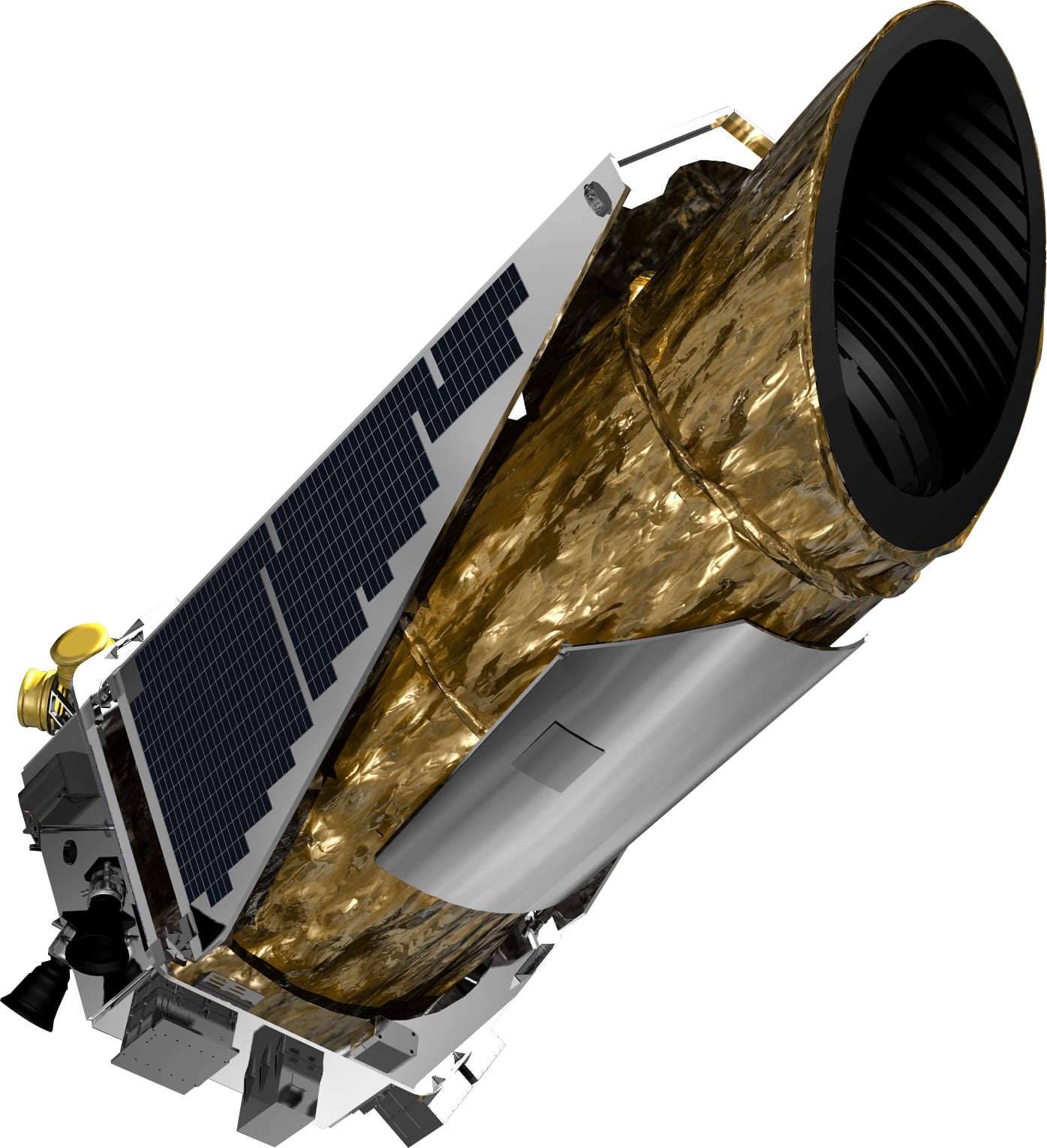
The Kepler Telescope Begins Its Search for Earth-like Planets
A space telescope watched more than 150,000 stars for the dimming of passing planets.
On March 6, 2009, a Delta II rocket launched from Cape Canaveral carrying the Kepler space telescope into an Earth-trailing orbit around the Sun. Managed under NASA's Discovery Program of focused, cost-capped planetary science missions, the observatory was designed to determine the frequency of Earth-sized planets orbiting other stars. Ground-based surveys had already shown that other stars host planets, but earlier techniques favored massive gas giants orbiting very close to their parent stars. Kepler was engineered specifically to look for far smaller worlds, including rocky bodies situated within the habitable zones of Sun-like stars where liquid water might endure.
The spacecraft's design centered on a single sensitive scientific instrument: an expansive Schmidt camera photometer. Equipped with a 1.4-meter primary mirror and a focal plane of forty-two charge-coupled devices totaling 94.6 megapixels, the instrument continuously monitored a fixed field of view covering roughly 115 square degrees across the constellations Cygnus, Lyra, and Draco. Rather than producing sharp visual photographs, the optical system was deliberately calibrated with a soft focus. This allowed it to measure minute, periodic dips in stellar brightness caused when an orbiting planet transited across the face of its host star from Kepler's perspective.

Keep reading in Yester
Coming soon to the App Store
Keep following the story

Sources
- Kepler's Launch (NASA)
- NASA Retires Kepler Space Telescope, Passes Planet-Hunting Torch (NASA)
- Kepler / K2 (NASA Science)
- The Kepler Space Telescope (NASA Kepler & K2 Science Center)
- NASA ends attempts to fully recover Kepler spacecraft (Astronomy)
- Kepler observatory: It still has plenty of planet-hunting left, NASA decrees (Christian Science Monitor)
- Kepler space telescope
Image: NASA