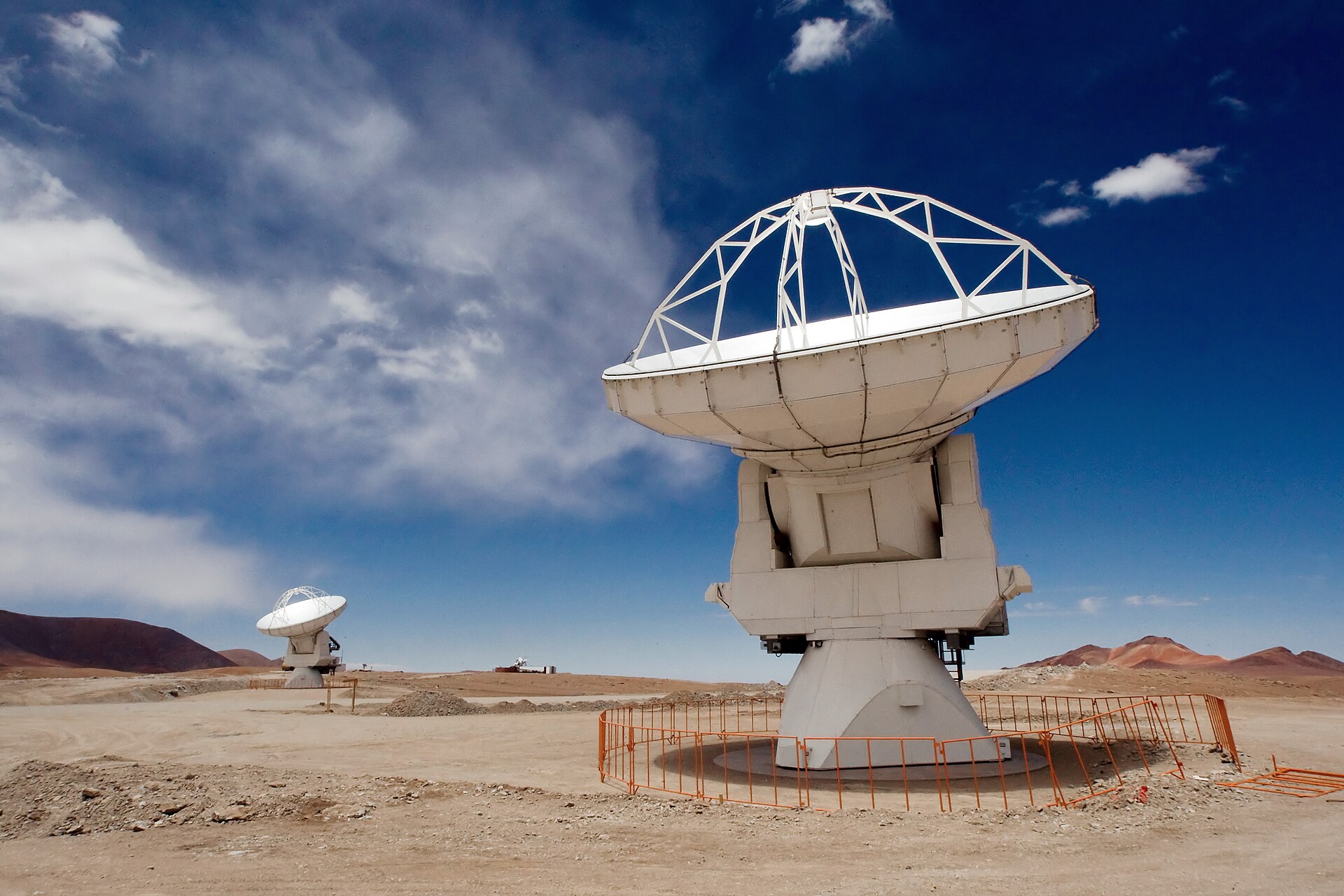
ALMA Opens on a High Plateau in the Atacama
Sixty-six antennas 5,000 metres up began working together as one telescope for the cold universe.
In March 2013, the Atacama Large Millimeter/submillimeter Array was formally inaugurated on the Chajnantor plateau in northern Chile. Situated 5,000 metres above sea level in the dry Atacama Desert, the site was selected specifically because its elevation and low moisture levels minimize atmospheric signal distortion. The observatory, costing approximately 1.4 billion US dollars to build, brought together 66 high-precision radio antennas functioning as a single astronomical interferometer designed to observe millimeter and submillimeter radiation emitted by the cold universe.
The facility originated in the late 1990s as a union between separate regional initiatives: the American Millimeter Array, the European Large Southern Array, and later the Large Millimeter Array proposed by Japan. In 1997, the National Radio Astronomy Observatory and the European Southern Observatory agreed to pursue a unified project, officially choosing the name ALMA in March 1999. Formal partnership accords followed in 2003, with Japan joining the enhanced venture in 2004 to supply additional receiver bands and specialized antennas. Construction required international industrial cooperation, with main antennas manufactured by contractors across North America, Europe, and East Asia.

Keep reading in Yester
Coming soon to the App Store
Keep following the story

Sources
- ALMA Inauguration Heralds New Era of Discovery (ESO press release eso1312)
- Atacama Large Millimeter/submillimeter Array (ESO)
- The ALMA Transporters: Otto and Lore (ESO)
- Milestones (NAOJ ALMA Project)
- ALMA Opens Its Eyes (ESO press release eso1137)
- Revolutionary ALMA Image Reveals Planetary Genesis (ESO press release eso1436)
- Atacama Large Millimeter Array
Image: Iztok Bončina/ESO