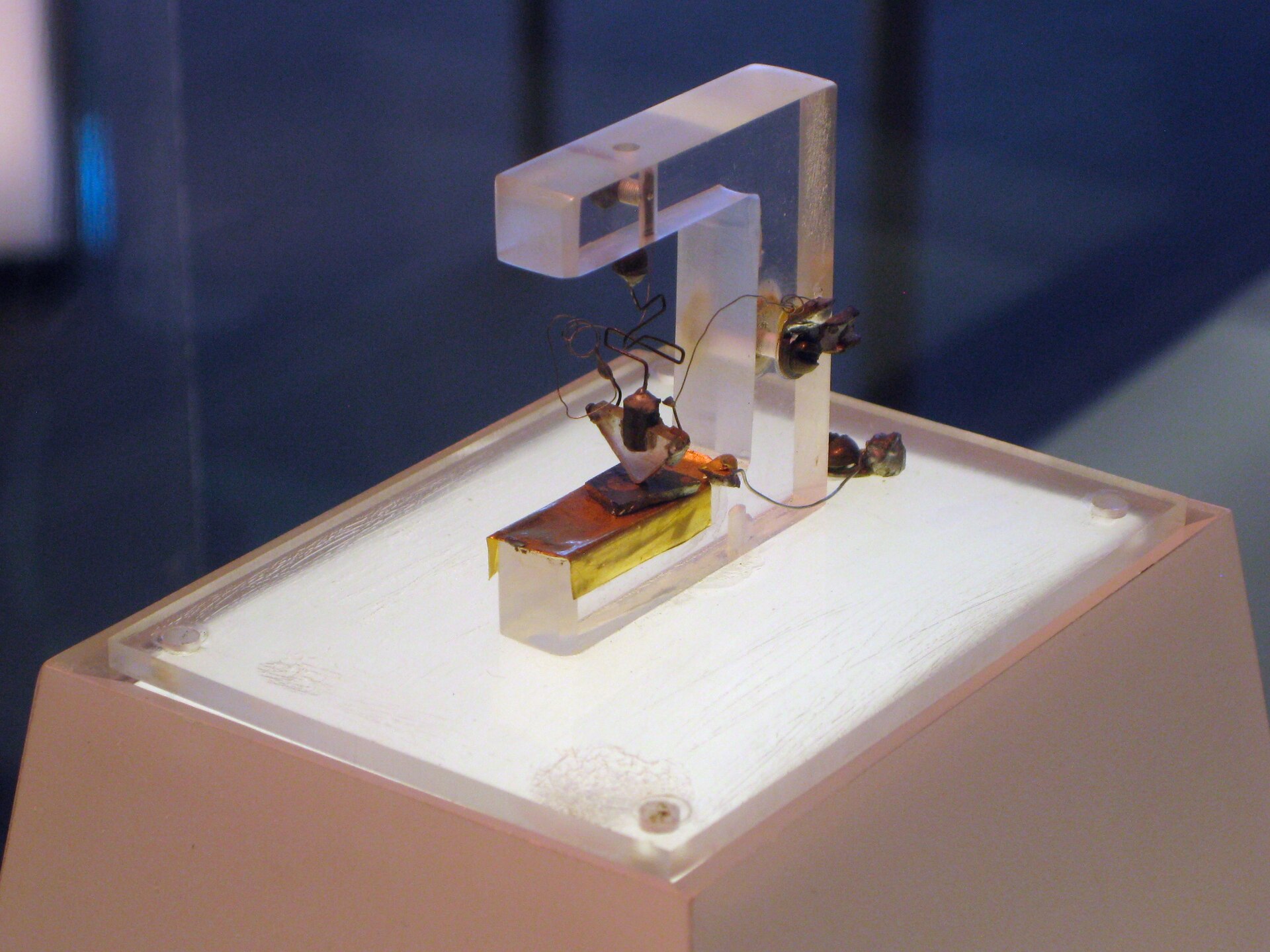
Bell Labs Demonstrates the Transistor
A small semiconductor device began the electronic age.
Between November 17 and December 23, 1947, physicists John Bardeen and Walter Brattain carried out a series of experiments at Bell Labs in Murray Hill, New Jersey. Working with a crystal of germanium, they placed two gold contacts on its surface and discovered that an applied electric signal produced an output power greater than the input. William Shockley, leader of the facility's Solid State Physics Group, recognized the significance of the amplification. The team had initially attempted to create a field-effect device, but fundamental obstacles at the semiconductor surface prompted their shift toward what became the point-contact transistor. The device soon received its name when Bell Labs engineer John R. Pierce coined the term transistor.
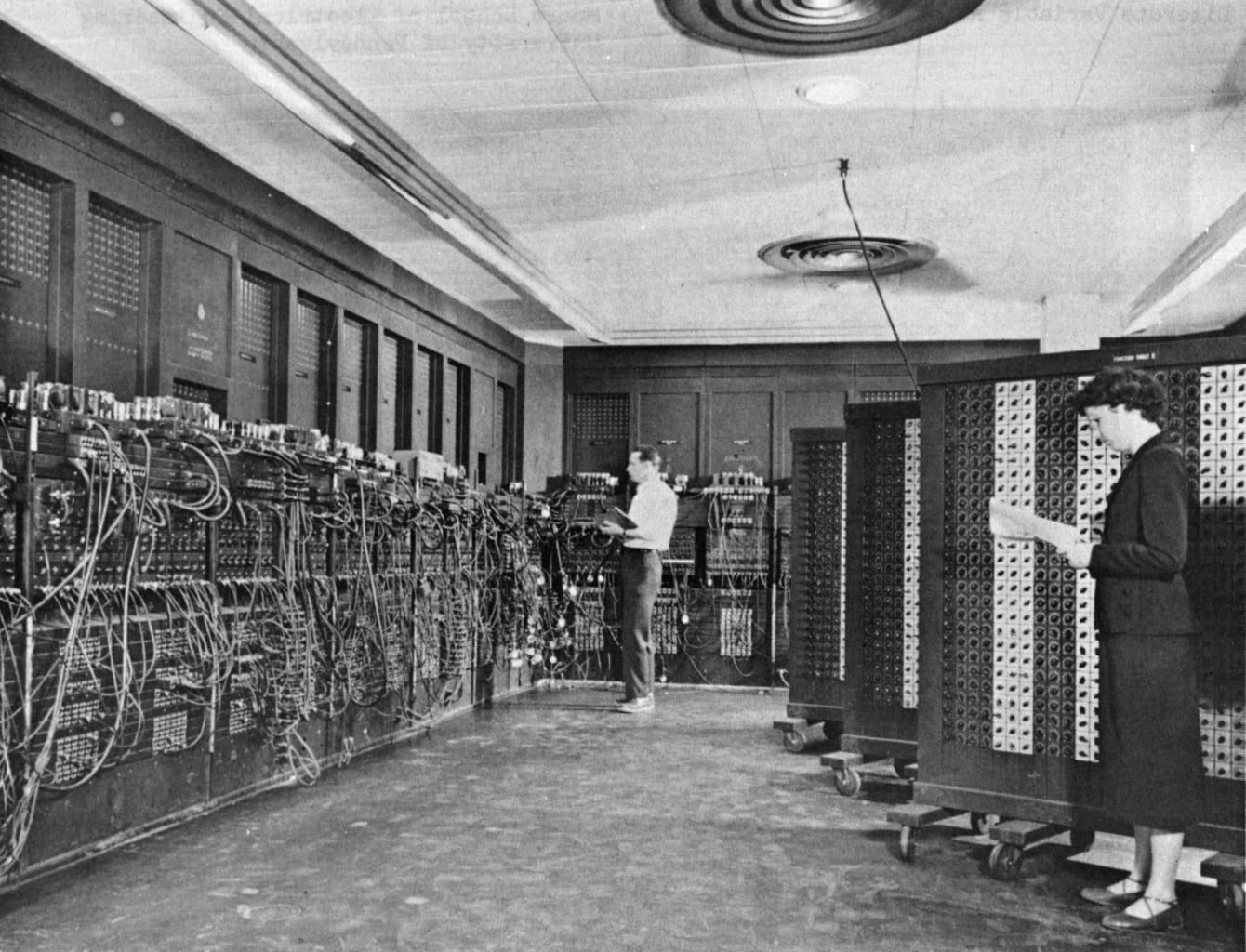
Prior to this breakthrough, electronic amplification relied largely on the thermionic triode, a vacuum tube introduced in 1907. Although vacuum tubes made long-distance telephony and radio broadcasting possible, they were fragile, bulky, and consumed substantial electrical power to heat internal filaments. Physicists had sought solid-state alternatives for decades; Julius Edgar Lilienfeld patented concepts for field-effect devices in Canada and the United States between 1925 and 1928, and Oskar Heil filed a patent on a similar device in 1934. However, neither inventor produced a documented, working prototype, as techniques for refining high-purity semiconductor materials did not exist at the time.

Keep reading in Yester
Coming soon to the App Store
Keep following the story
Sources
- 1947: Invention of the Point-Contact Transistor, The Silicon Engine (Computer History Museum)
- 1926: Field Effect Semiconductor Device Concepts Patented (Computer History Museum)
- 1948: Conception of the Junction Transistor (Computer History Museum)
- 1951: First Grown-Junction Transistors Fabricated (Computer History Museum)
- 1948: The European Transistor Invention (Computer History Museum)
- 1954: Silicon Transistors Offer Superior Operating Characteristics (Computer History Museum)
- 1955: Development of Oxide Masking (Computer History Museum)
- Transistor
Image: Windell Oskay from Sunnyvale, CA, USA