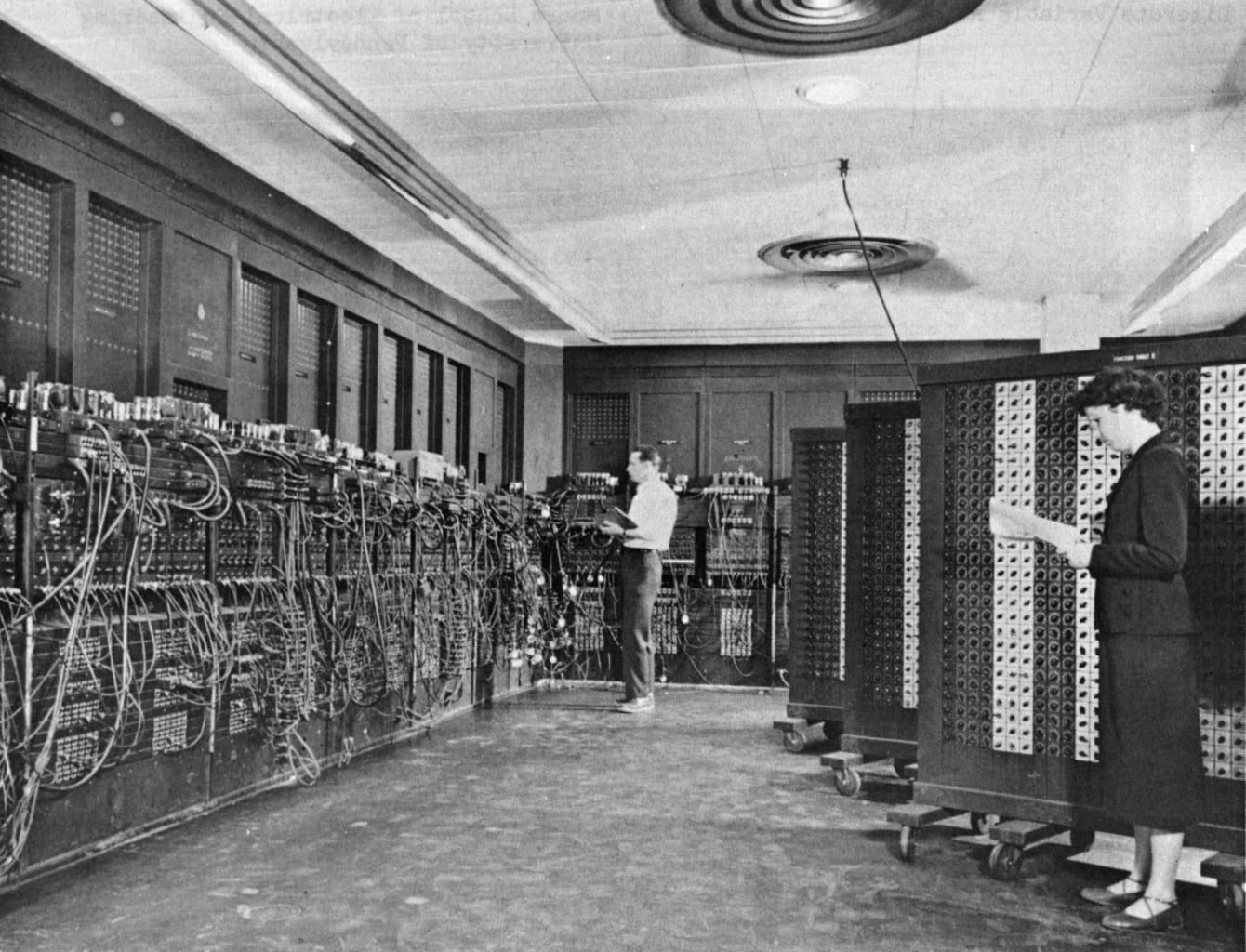
ENIAC Shows What an Electronic Computer Can Do
A wartime machine programmed largely by women became a public demonstration of electronic calculation.
On February 14, 1946, the University of Pennsylvania publicly announced the Electronic Numerical Integrator and Computer, widely known as ENIAC, and the next day the previously secret machine was front-page news in The New York Times. It was shown off in demonstrations of its capabilities, including a ballistic trajectory program. The Times described it as applying electronic speeds to mathematical tasks for the first time, and according to Penn, a ballistics calculation that took twelve hours on a hand calculator could be done on ENIAC in thirty seconds. Behind the dramatic public debut stood years of wartime development aimed at automating military ballistics calculations.
The initiative began in earnest during World War II under the sponsorship of the United States Army Ordnance Corps. At the university's Moore School of Electrical Engineering, women employed as human computers calculated artillery trajectories by hand and with a differential analyzer, and a backlog of ballistics work was building up. In 1942, physicist John Mauchly proposed an all-electronic calculating machine, and with electrical engineer J. Presper Eckert he led its development under a contract from the Army's Ballistic Research Laboratory. The machine was built in secret between 1943 and 1945.

Keep reading in Yester
Coming soon to the App Store
Keep following the story


Sources
Image: Unknown author Unknown author