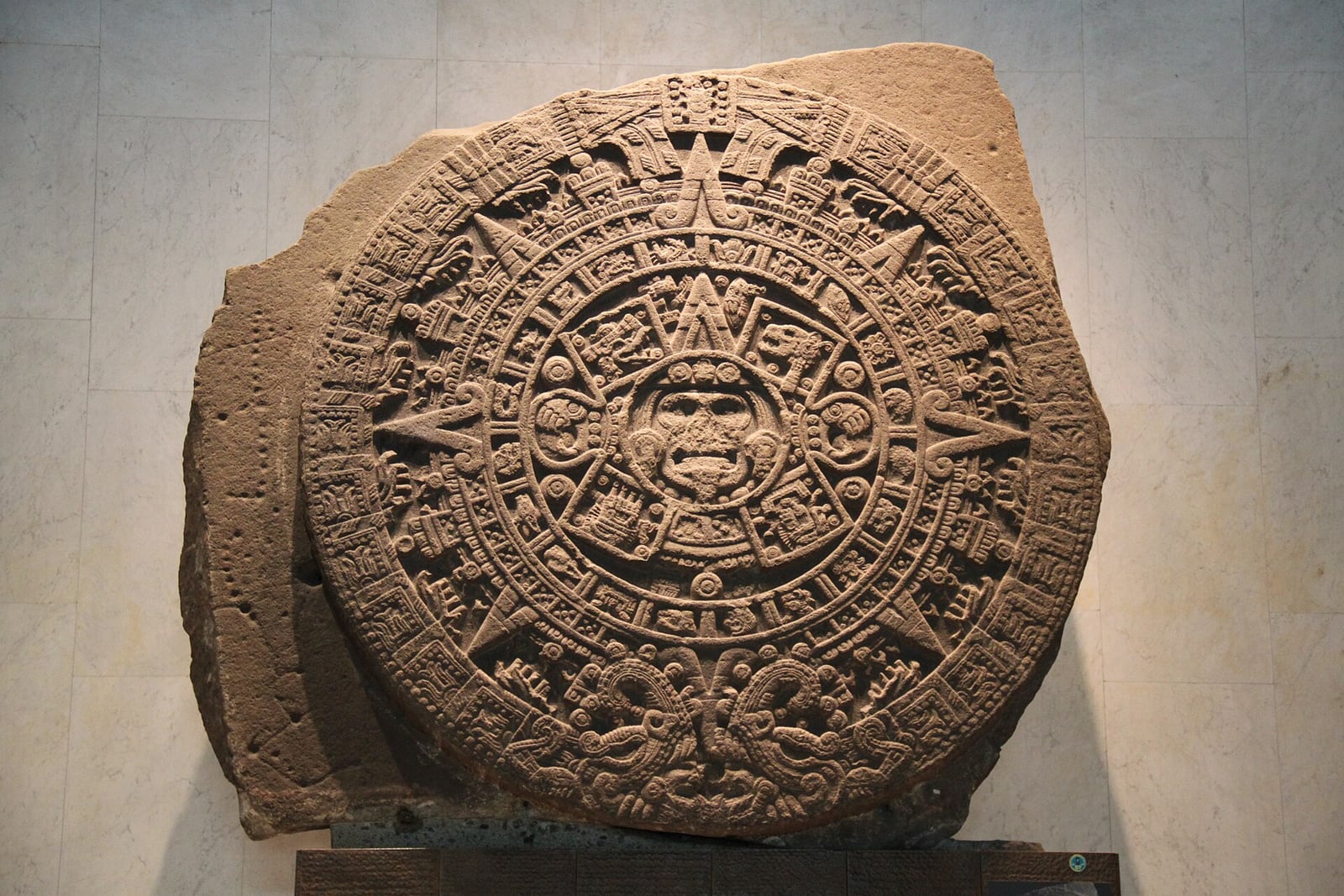
Workers Unearth the Aztec Sun Stone
Paving work in the main square revealed a carved basalt disc weighing about 24 tonnes.
On 17 December 1790, laborers modernizing the main plaza of Mexico City uncovered a massive carved disc buried only half a yard beneath the surface. The discovery occurred during an extensive program of urban leveling, drainage installation, and paving initiated by Viceroy Juan Vicente de Güemes. Overseen by the architect José Damián Ortiz de Castro, workers employed a rigging system of double pulleys to raise the monolith, which lay on the south side of the main square. Weighing about 24 tonnes and spanning 3.6 meters across, the olivine basalt monument had originally been quarried from the Xitle volcano area and transported miles to the Mexica capital.
Following the fall of Mexico-Tenochtitlan in 1521, the carved disc had been placed near the exterior of the sacred precinct before Alonso de Montúfar, Archbishop of Mexico from 1551 to 1572, ordered its burial to suppress recollections of pre-Hispanic sacrificial rites. When the stone reemerged over two centuries later, the Mexican scholar Antonio de León y Gama intervened with ecclesiastical authorities to prevent it from being reburied as a pagan relic. Comparing the monument to classical ruins preserved in Italy, León y Gama argued publicly for its artistic merit against European writers who minimized indigenous American cultural sophistication. Consequently, the monolith was affixed to the west tower of the Metropolitan Cathedral in July 1791.

Keep reading in Yester
Coming soon to the App Store
Keep following the story
Sources
- La Piedra del Sol. Su historia, Felipe Solis (Arqueologia Mexicana)
- El emperador y el cosmos. Nueva mirada a la Piedra del Sol (Arqueologia Mexicana)
- Piedra del Sol, foto del dia (INAH)
- Reinstalan placas conmemorativas a los descubrimientos de la Coatlicue y las piedras del Sol y de Tizoc (INAH)
- Aztec sun stone
Image: Gary Todd