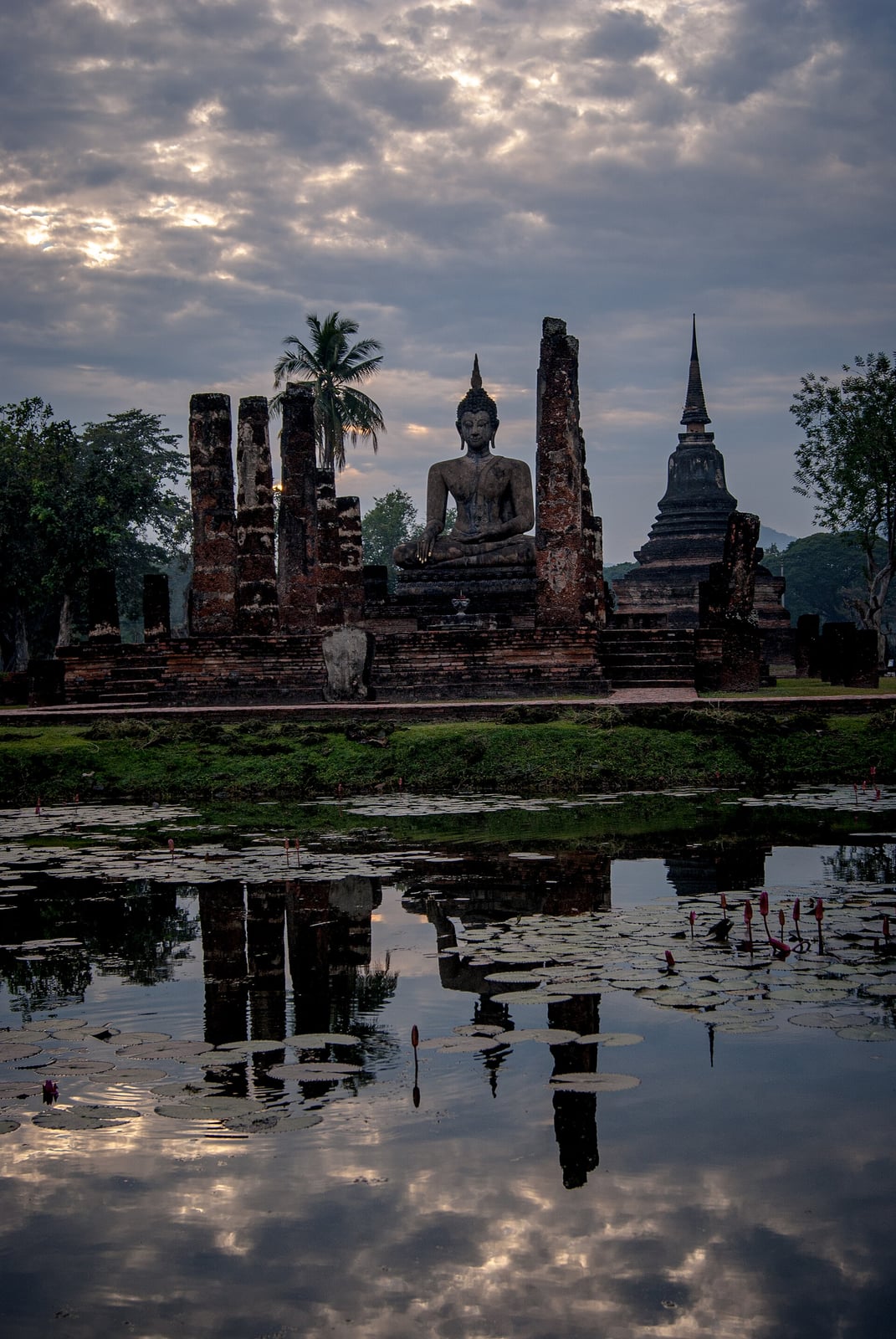
Sukhothai Emerges as a Regional Kingdom
A changing political landscape supported a new center of rule and Buddhist patronage.
Before its emergence as a prominent kingdom, the settlement at Sukhothai developed as a commercial hub positioned at the crossroads of Mon city-states to the west, Tai polities to the north, and the Xiān communities of the lower Chao Phraya basin. Modern historians such as Tanit Sorat trace its urban evolution to at least 1127, while others, including Phiset Jiajanphong, link its mid-twelfth-century development to the Lavo Kingdom's pursuit of inland forest goods. Through this era, local authority fluctuated as neighbouring rulers vied for regional dominance, drawing the town into broader networks that spanned the Yom and Nan river basins.
The political turning point came in 1238, when Bang Klang Hao, a local leader later known as Si Inthrathit, took the city alongside his ally Pha Mueang, the ruler of Mueang Rat. An earlier attempt on the settlement had been led by Pha Mueang's father, Sri Naw Nam Thum, but an uprising under Khom Sabat Khlon Lamphong had restored Mon authority. Combining their forces in a multi-stage campaign, Bang Klang Hao took the nearby centre of Si Satchanalai while Pha Mueang advanced from the east. After their victory, Pha Mueang consecrated Bang Klang Hao at Sukhothai before returning to his own domain.

Keep reading in Yester
Coming soon to the App Store
Keep following the story
Sources
Image: Philip Nalangan