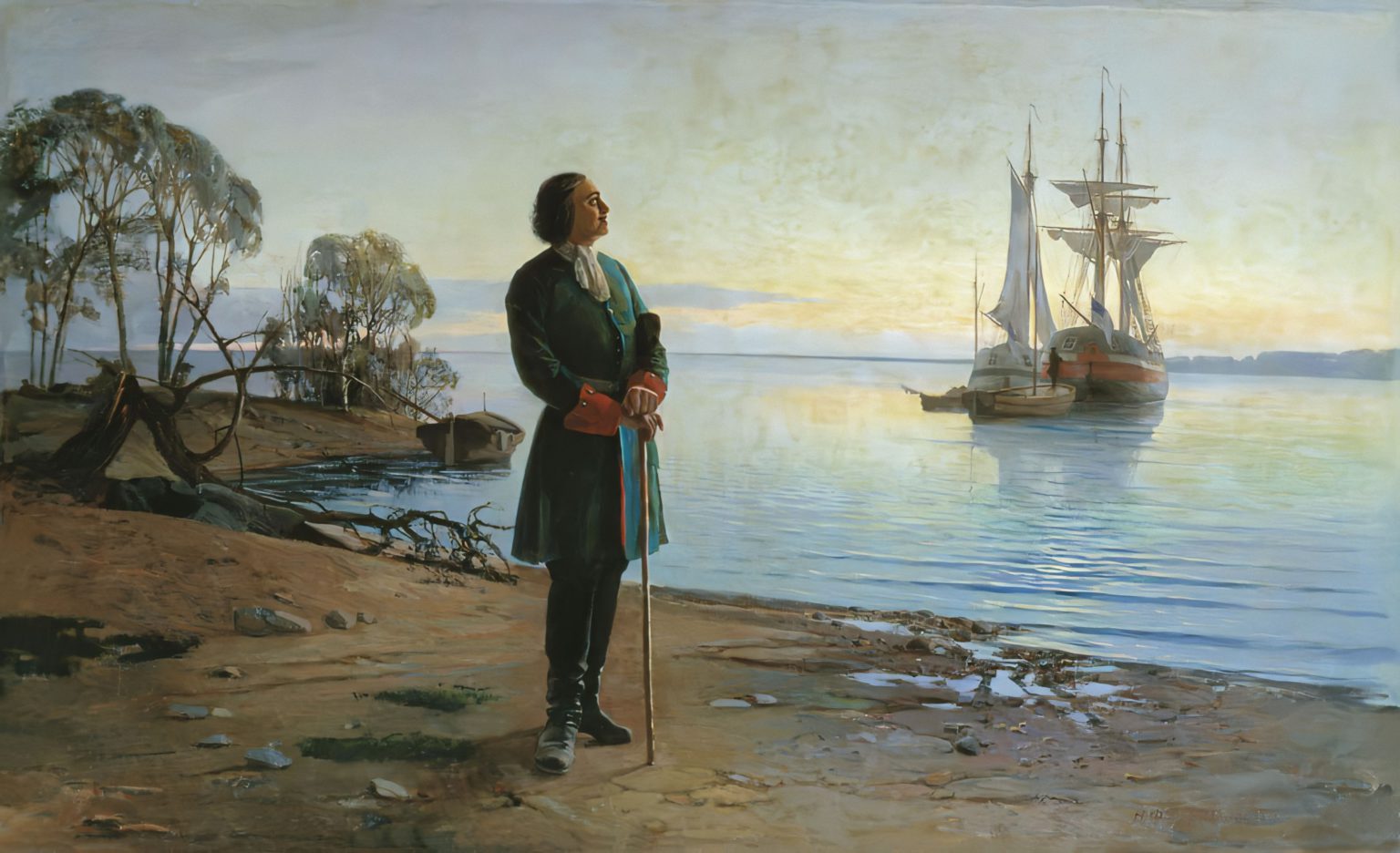
Peter the Great Founds Saint Petersburg
A new capital on the Baltic turned Russia toward Europe.
In May 1703, during the Great Northern War, Tsar Peter the Great captured the Swedish fortress of Nyenskans near the mouth of the Neva River. Seeking an accessible maritime route to expand commerce with Western Europe, Peter sought an alternative to Arkhangelsk on the White Sea, which remained frozen and impassable throughout the winter. On 27 May 1703, roughly five kilometres inland from the Gulf of Finland, he initiated construction of the Peter and Paul Fortress on Zayachy Island. The fortress, first built of earth and timber and rebuilt in stone from 1706, became the nucleus of a new settlement named after Saint Peter, establishing a lasting military foothold on the Baltic shore.
The erection of the settlement demanded substantial physical sacrifices. Thousands of conscripted laborers died while draining wetlands and raising stone buildings under the management of Alexander Menshikov. Several Swedish prisoners of war were also pressed into service. Despite severe logistical difficulties, the nascent settlement expanded rapidly around Trinity Square before adopting formal urban blueprints. By 1716, the Swiss-Italian architect Domenico Trezzini outlined a planned town centre on Vasilyevsky Island structured around a grid of canals, and French architect Jean-Baptiste Alexandre Le Blond was soon appointed as chief architect.

Keep reading in Yester
Coming soon to the App Store
Keep following the story
Sources
- Peter and Paul Fortress: History (State Museum of the History of Saint Petersburg)
- Peter and Paul Fortress and Cathedral (The Museum of Russian Art)
- Historic Centre of Saint Petersburg and Related Groups of Monuments (UNESCO World Heritage Centre)
- Saint Petersburg (Encyclopedia.com)
- History Through the Viewfinder (The National WWII Museum)
- Saint Petersburg
Image: Добровольский, Николай Флорианович