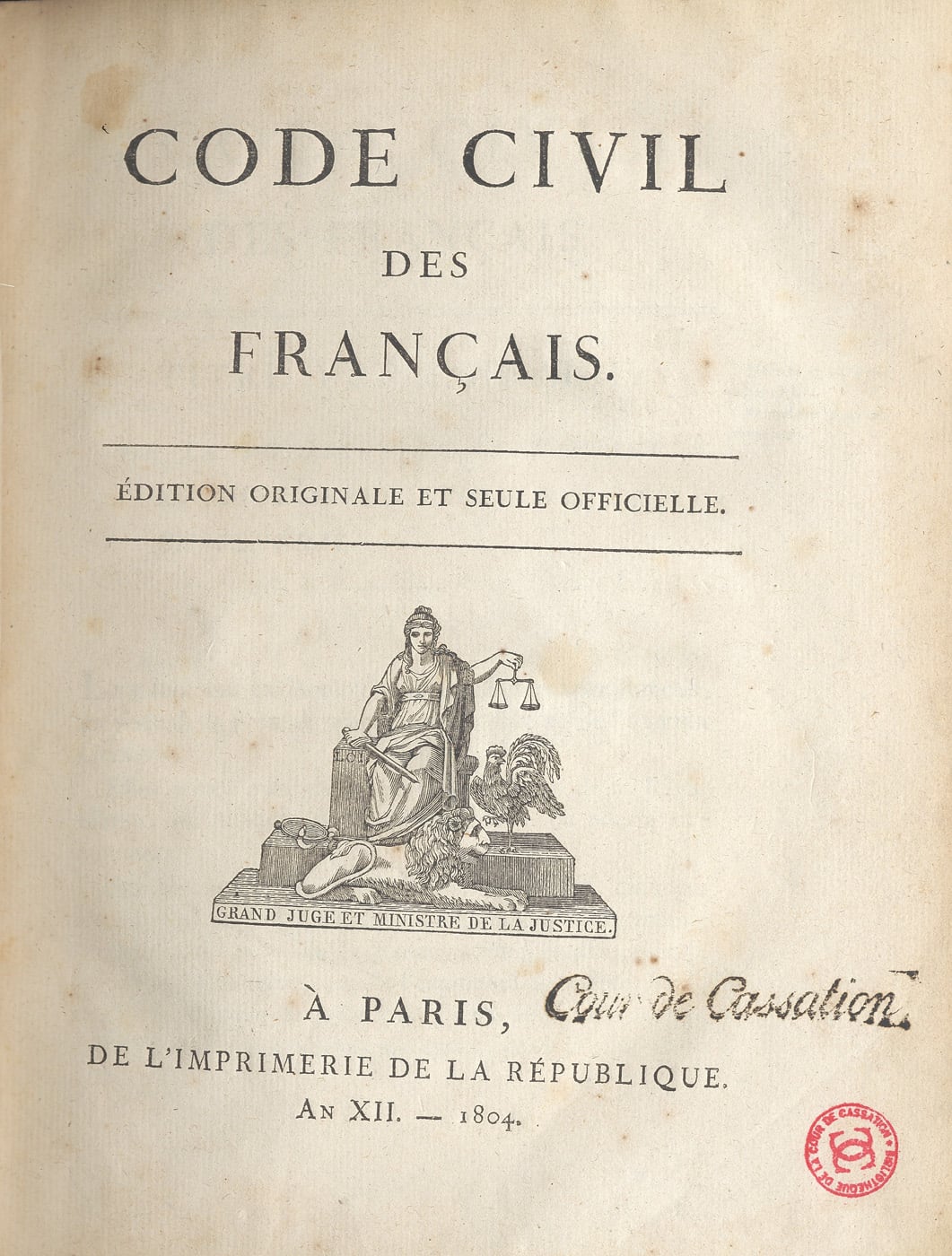
The Napoleonic Code Becomes Law in France
A single civil code replaced France’s patchwork of local laws.
On 21 March 1804, France enacted the Civil Code of the French, an overarching statute that swept away centuries of fragmented legal traditions. Prior to this reform, the country operated under an intricate patchwork of regional customs, royal decrees, local exemptions, and feudal privileges. In northern France, unwritten customary laws predominated, often compiled in regional custumals such as the Custom of Paris, while southern territories relied more heavily on traditions derived from Roman legal sources. The revolutionary assemblies had pledged to establish a unified civil code for the entire realm as early as 1791, but turbulent domestic politics and external warfare stalled multiple drafting commissions throughout the 1790s.
The effort gained renewed momentum following Napoleon Bonaparte's rise to First Consul and the stabilization of his authority after the Battle of Marengo. In August 1800, Napoleon appointed a commission of four jurists: Jacques de Maleville, François Denis Tronchet, Félix-Julien-Jean Bigot de Préameneu, and Jean-Étienne-Marie Portalis. While these four legal experts drafted the text, Napoleon took an active interest in the discussions, presiding over 55 of the 107 Council of State sessions devoted to the code, alongside Second Consul Jean-Jacques-Régis de Cambacérès. When the initial bill faced resistance in the legislature in late 1801, Napoleon used political maneuvers and adjourned sessions to secure an obedient majority, ultimately pushing the comprehensive body of civil law into force.

Keep reading in Yester
Coming soon to the App Store
Keep following the story



Sources
- Le Code civil (21 mars 1804) : naissance, principes et posterite (Fondation Napoleon, napoleon.org)
- Le Code civil des Francais, 21 mars 1804 : quelques points de repere (Fondation Napoleon, napoleon.org)
- Proposition de loi portant reforme du divorce, rapport (Senat, France)
- Quand le divorce etait interdit (1816 - 1884) (Ministere de la Justice, France)
- Napoleonic Code
Image: unknown graphic artist