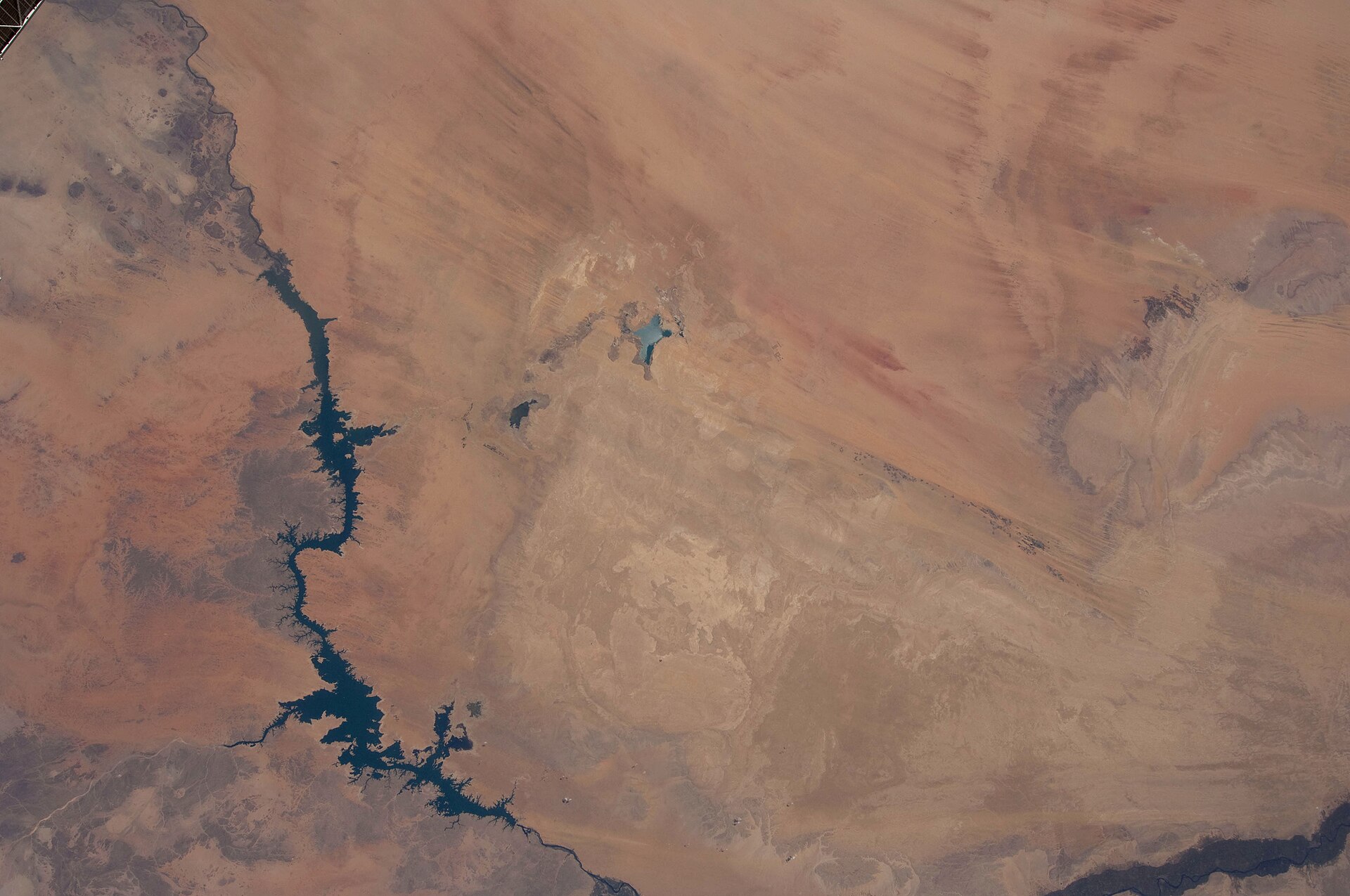
Herders Arrange Stones in the Sahara at Nabta Playa
A circle of standing stones in the Egyptian desert may have marked the summer solstice.
In the arid expanse of the Nubian Desert, roughly one hundred kilometers west of Abu Simbel in southern Egypt, lies Nabta Playa, an ancient basin that once held water during periods of higher rainfall. While the Western Desert is hyper-arid today, the African humid period supported a savanna environment with grazing animals. Seasonal hunter-gatherer camps began appearing around the tenth millennium BCE as rainfall created a temporary lake. Over time, groups returned regularly to exploit seasonal vegetation and graze animals, gradually transforming the basin into an organized center for regional gatherings.
By the seventh millennium BCE, larger settlements emerged at Nabta Playa, sustained by deep wells that tapped subterranean water supplies throughout the year. Inhabitants constructed small huts arranged in linear rows, gathered wild plants including sorghum, legumes, and tubers, and fashioned indigenous pottery decorated with combed patterns. Domesticated goats and sheep from Western Asia appeared toward the end of the seventh millennium BCE. While early researchers suggested local pastoralists kept domesticated cattle even earlier, later analyses indicate those initial remains belonged to hunted wild aurochs, with domestic cattle introduced across northeast Africa toward the end of the seventh millennium BCE.

Keep reading in Yester
Coming soon to the App Store
Keep following the story
Sources
- Astronomy at Nabta Playa, Southern Egypt (Handbook of Archaeoastronomy and Ethnoastronomy, Springer)
- Early North African Cattle Domestication and Its Ecological Setting: A Reassessment (Journal of World Prehistory, Springer)
- Neolithic Skywatchers (Archaeology magazine, Archaeological Institute of America)
- Nabta Playa
Image: NASA/Expedition 31 crew member