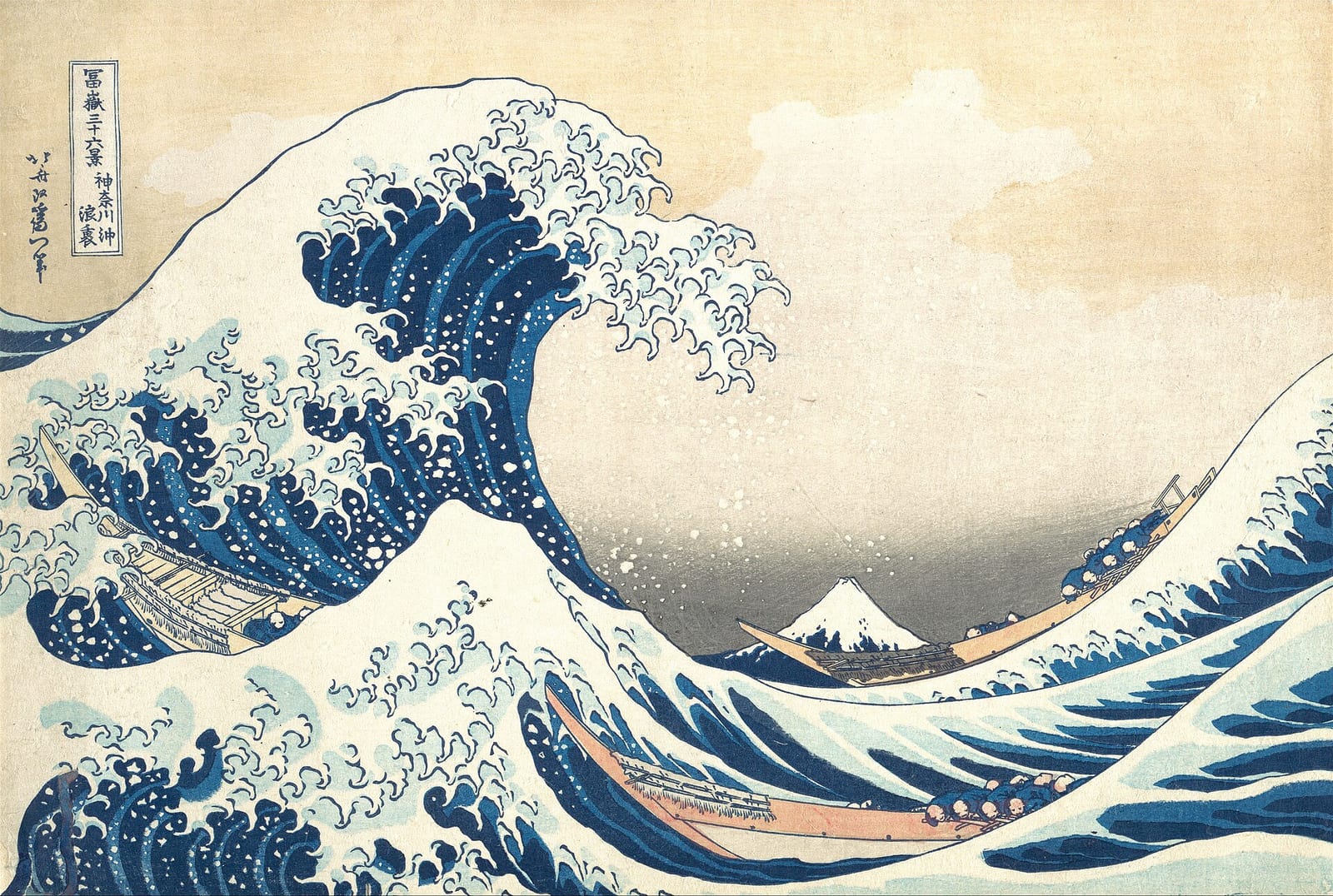
The Great Wave Was Made to Travel
Hokusai placed a mountain behind a wave and sent the image into the world as a print. Its power came from both its composition and a craft built for making copies.
The mountain is easy to miss at first. A great curve of water dominates the foreground, its spray breaking into sharp, fingerlike forms above narrow boats. Beyond that agitation, Mount Fuji appears small and still. Hokusai’s Under the Wave off Kanagawa, made around 1830–1832, belongs to a series devoted to the mountain, yet it makes viewers find its named subject behind something much more immediate. The composition organizes a tension between what overwhelms the eye and what quietly anchors it.
The image is a woodblock print, not a photograph of a particular disaster. Describing it casually as a tsunami can turn an artwork into false documentary evidence. Boats, sea and mountain create a designed encounter with scale and movement. The people in the boats are not simply decorative marks beneath a famous shape. They give the water a human measure, making the distance between the small bodies and the large wave part of what the viewer experiences.

Keep reading in Yester
Coming soon to the App Store
Keep following the story
Sources
Image: Katsushika Hokusai