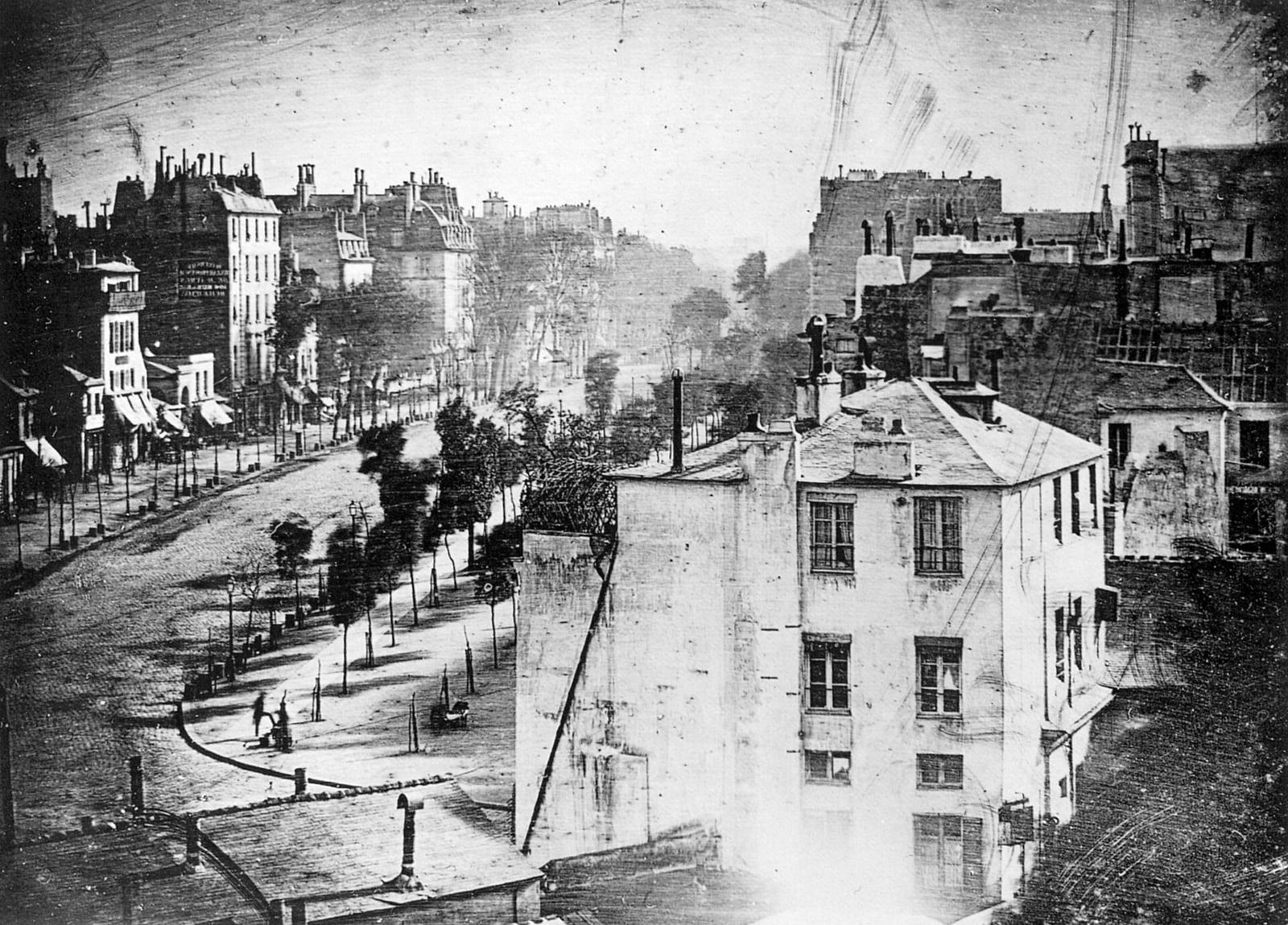
The Street That Photography Almost Emptied
A busy Paris street appears strangely quiet in an early photograph. The missing traffic reveals how a new way of recording reality could also leave things out.
The buildings are clear, the street is broad, and the traffic seems to have vanished. Louis Daguerre’s view of the Boulevard du Temple, generally dated to 1838, preserves a Paris street with an unsettling stillness. Near one corner, a figure apparently having his shoes polished remained long enough to register. Most people and vehicles in motion did not. The photograph is not proof that the boulevard was deserted. It is a record of what an early camera could hold.
A long exposure gathered the scene over time rather than freezing a single instant. Stationary architecture kept directing light toward the same places on the plate. Passing traffic did not remain in one position long enough to leave a comparable image. That limitation is what makes the picture so revealing. From the beginning, a photograph could be precise and incomplete at once. Its appearance depended not only on what stood before the lens but on how the recording process worked.

Keep reading in Yester
Coming soon to the App Store
Keep following the story
Sources
Image: Louis Daguerre