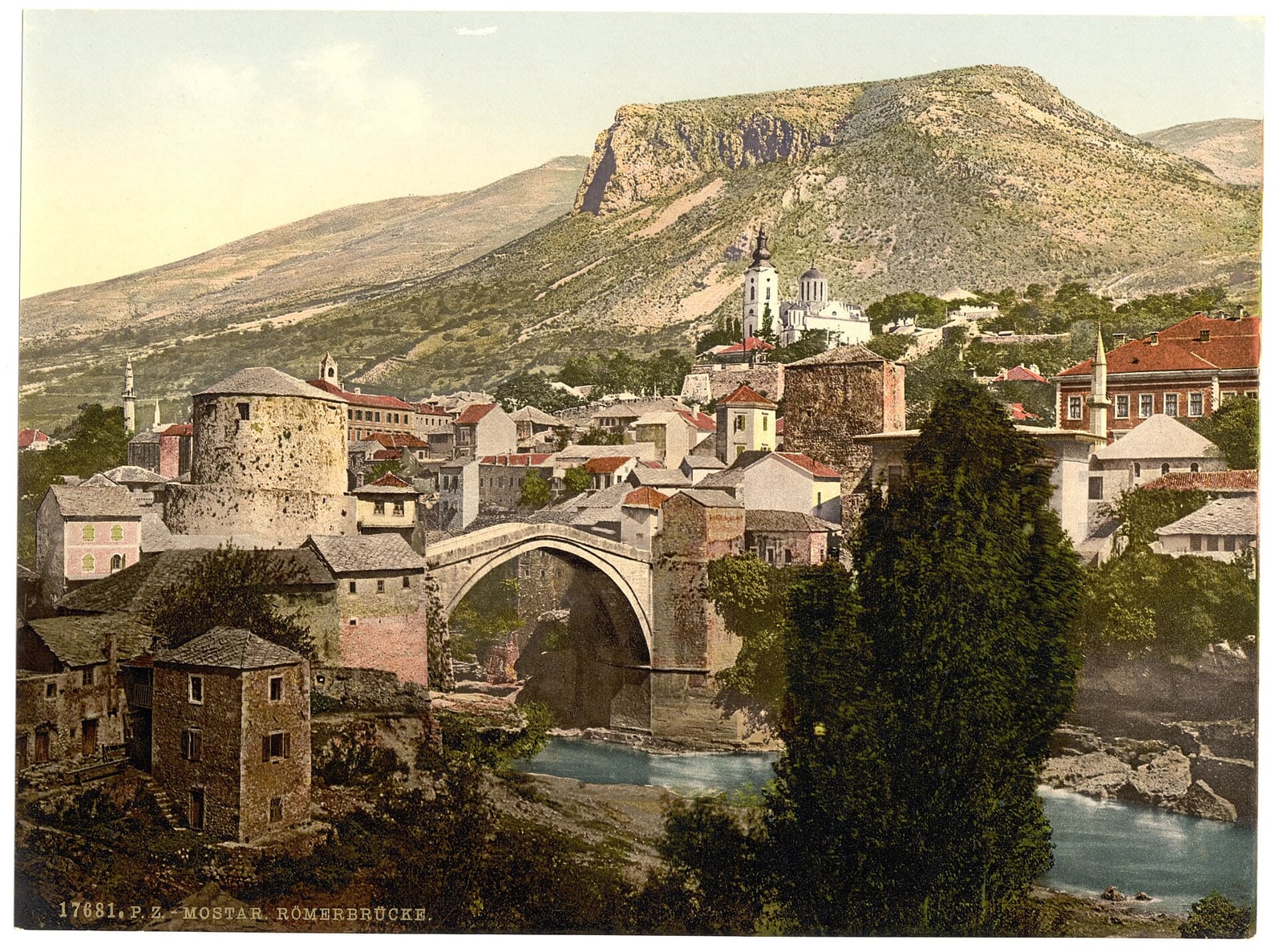
The Ottomans Complete the Old Bridge at Mostar
A single stone arch spanned the Neretva for 427 years before its destruction in 1993.
In 1557, Sultan Suleiman the Magnificent commissioned a grand stone bridge to span the gorge of the Neretva River in Mostar. At the time, the settlement relied on a precarious wooden suspension bridge supported by chains, which the Ottoman geographer Katip Celebi noted swayed so violently that travelers crossed it in fear. With the town's administrative and commercial importance expanding within the Ottoman Empire, imperial authorities required a permanent crossing capable of securing communications and reflecting the authority of the realm.
The ambitious design was entrusted to Mimar Hayruddin, a pupil of the celebrated imperial architect Mimar Sinan. Ottoman records show that the project took nine years to finish, with an inscription documenting its completion in the Islamic calendar year 974 AH, corresponding to 1566 or 1567. The construction was overseen locally by Karagoz Mehmet Bey, the patron of the town's principal mosque complex. Local accounts recorded that Hayruddin faced severe pressure under threat of death to achieve the unprecedented span, though few direct technical records survived the period.

Keep reading in Yester
Coming soon to the App Store
Keep following the story

Sources
- Old Bridge Area of the Old City of Mostar (UNESCO World Heritage Centre)
- Advisory Body Evaluation: Old City of Mostar, 2005 (ICOMOS / UNESCO)
- Stari Most (Encyclopaedia Britannica)
- Bosnia Celebrates Reopening Of Mostar Bridge (RFE/RL, 23 July 2004)
- Was the destruction of Old Mostar Bridge a war crime? (JusticeInfo.net)
- Prlic et al.: The Destruction of the Old Bridge of Mostar and Proportionality (EJIL: Talk!)
- Stari Most
Image: Photochrom Print Collection