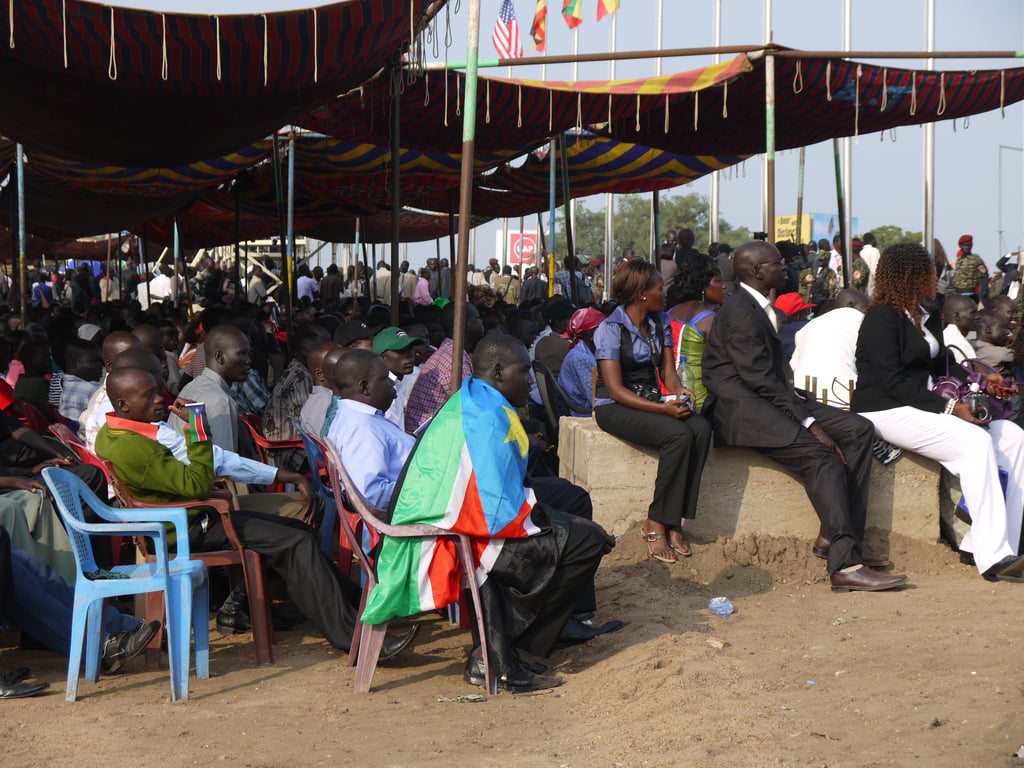
South Sudan Becomes the World’s Newest Country
After decades of civil war, a 2011 referendum led to independence from Sudan.
On 9 July 2011, South Sudan formally declared its independence from Sudan, becoming the fifty-fourth independent country in Africa. The declaration followed an internationally monitored referendum held between 9 and 15 January 2011, in which 98.83 percent of participants cast ballots in favor of separation. The peaceful vote fulfilled a key term of the 2005 Comprehensive Peace Agreement, which had brought an end to more than two decades of fighting in the Second Sudanese Civil War. At ceremonies in Juba, Salva Kiir Mayardit signed a transitional constitution and assumed the presidency of the newly founded Republic of South Sudan.
The partition was the culmination of structural divides rooted in decades of colonial rule and central neglect. From 1899 to 1956, Sudan was governed under an Anglo-Egyptian condominium that left the predominantly non-Arab south isolated and underdeveloped, with schools and clinics run mainly by Christian missions. In 1930, British authorities enforced a Southern Policy that managed the south as a distinct entity, before abandoning that policy in 1946. Neglect and marginalization by the central government in Khartoum fueled the First Sudanese Civil War from 1955 to 1972 and renewed hostilities from 1983 to 2005.

Keep reading in Yester
Coming soon to the App Store
Keep following the story
Sources
- UN welcomes South Sudan as 193rd Member State (UN News)
- As South Sudan celebrates independence, UN vows support (UN News)
- Independence Referendum, 2011 (Peace Accords Matrix, Kroc Institute, University of Notre Dame)
- Background Note: South Sudan, 12/07/11 (U.S. Department of State archive)
- UNMIS Background (United Nations Peacekeeping)
- South Sudan, Africa's 54th nation, faces the mother of all challenges (Daily Maverick)
- S Sudan rejects UN appeal to withdraw troops (Al Jazeera)
- South Sudan
Image: USAID Africa Bureau