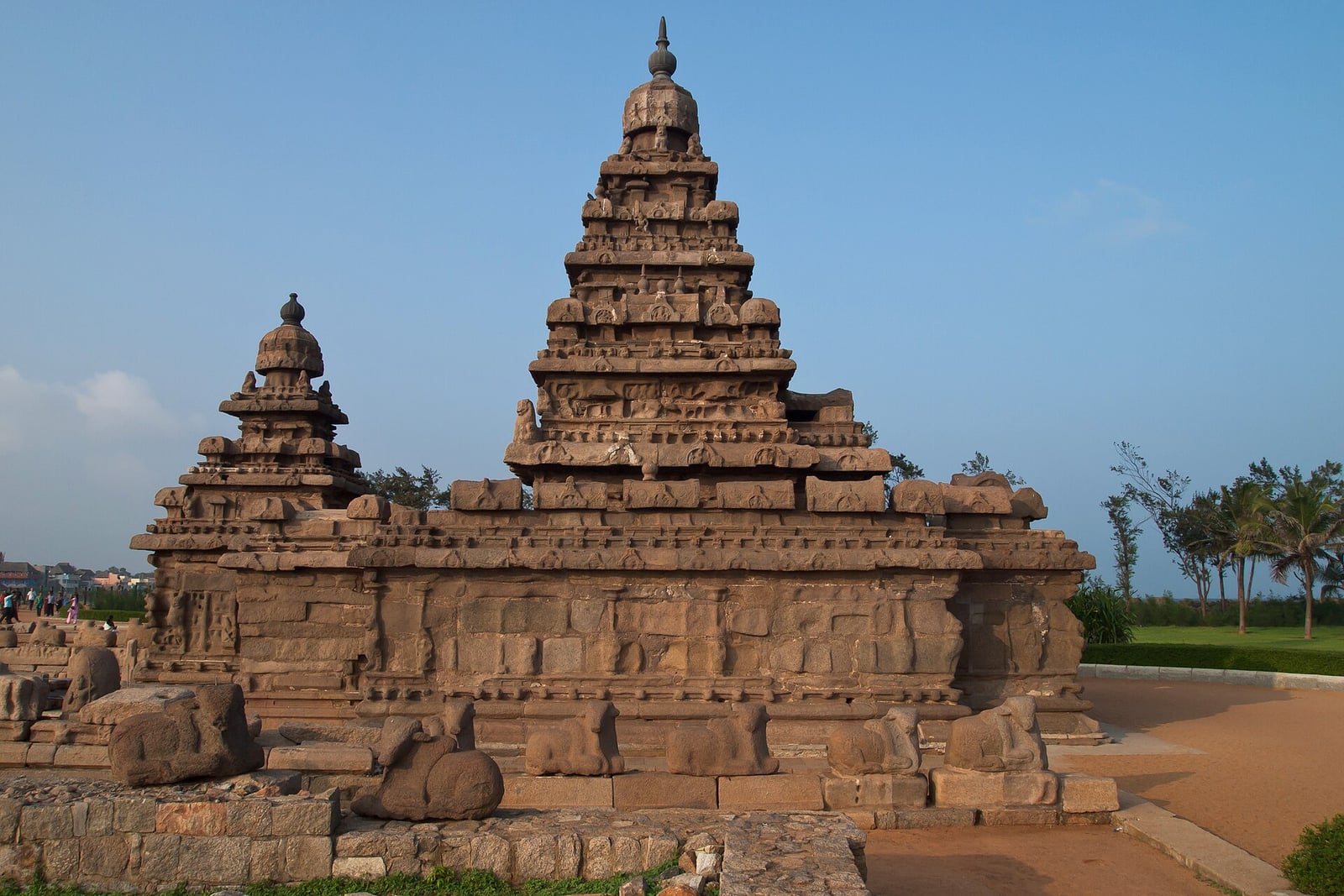
The Pallavas Build a Temple by the Sea
A granite temple on the Bay of Bengal has faced the waves for thirteen centuries.
Positioned along the edge of the Bay of Bengal at Mahabalipuram in Tamil Nadu, the Shore Temple represents a decisive moment in South Indian architecture. Dating to the early eighth century, the complex was commissioned during the reign of the Pallava king Narasimhavarman II, also known as Rajasimha, who governed from around 700 to 728. At that time, the coastal settlement served as a bustling commercial port. While earlier Pallava rulers had shaped monuments primarily through rock-cut excavation, carving caves and monolithic structures from existing outcrops, the builders of the Shore Temple relied on quarried blocks of local granite to assemble a free-standing structural sanctuary.
The compound stands upon a common platform and brings together three distinct shrines, reflecting both Shaivite and Vaishnavite devotion. Two shrines honor Shiva, while a smaller third chamber between them is dedicated to Vishnu in his reclining form, known as Anantashayi. Epigraphical records written in the Pallava Grantha script describe the Vishnu shrine as the earliest excavated structure at the site, labeled with titles belonging to Rajasimha. Inscriptions on the smaller Shiva temple name the components of the complex as Kshatriyasimha Pallavesvara-gruham, Rajasimha Pallavesvara-gruham, and Pallikondaruliya-devar, designating the wider site as Jalashayana, meaning lying in water.

Keep reading in Yester
Coming soon to the App Store
Keep following the story
Sources
Image: Vyacheslav Argenberg