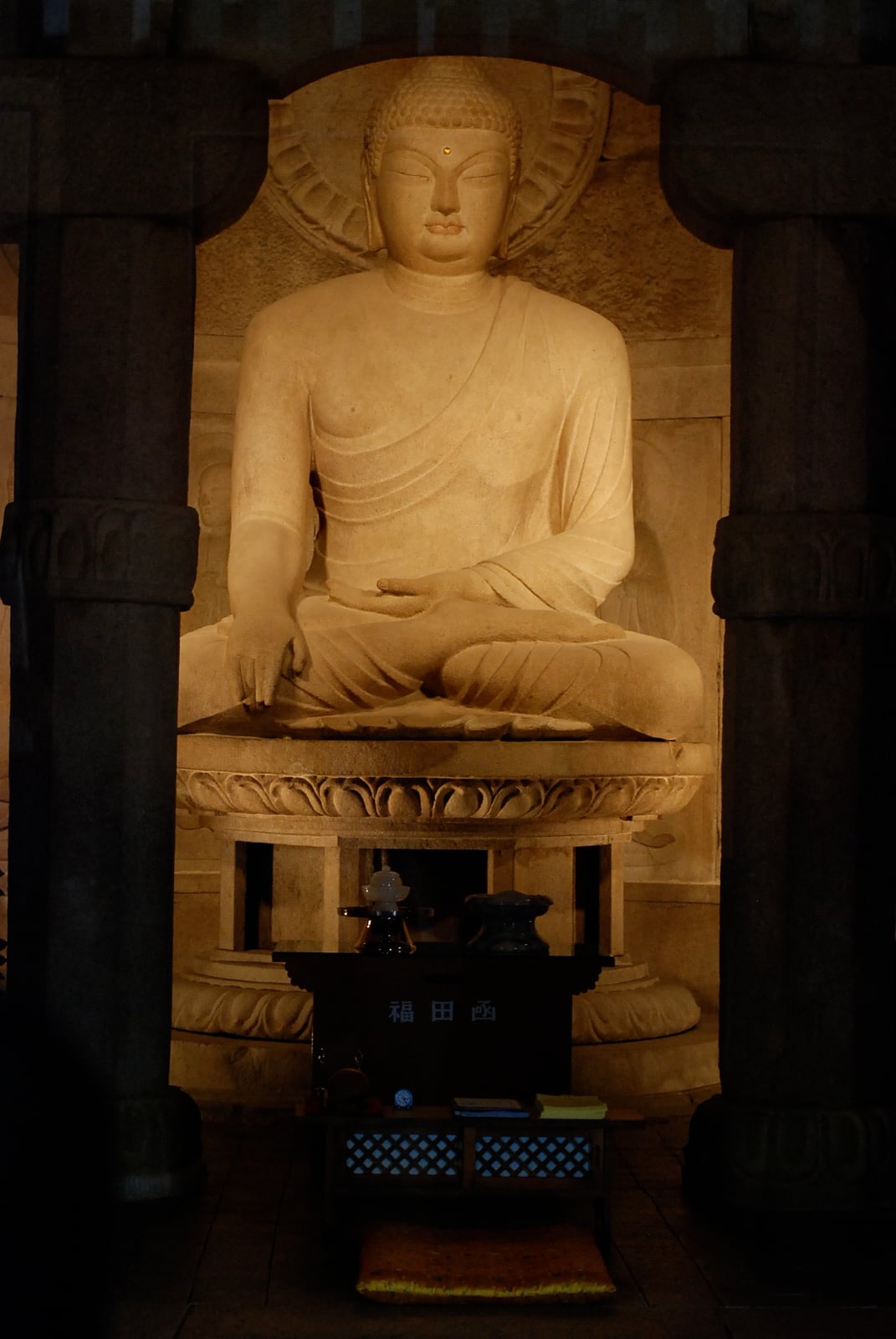
Silla Builds the Stone Grotto of Seokguram
A granite cave temple with a seated Buddha crowned Silla’s Buddhist art.
High on the slopes of Mount Toham in southeastern Korea, the court of Unified Silla completed an artificial stone sanctuary in 774. Originally known as Seokbulsa, or Stone Buddha Temple, the site was conceived around 751 under the direction of the minister Kim Daeseong. Following his death, the Silla state assumed control to finish the ambitious project. Set high on the mountain near the capital of Gyeongju, the hermitage looked east toward the sea, serving as a monument to the kingdom's religious devotion and technical mastery during its cultural zenith.
Buddhist traditions across India and China had long favored excavating shrines and colossal statues directly into soft cliff faces and natural caves. The Korean Peninsula, however, presented builders with dense, unyielding granite, which made traditional rock-cut excavation impractical. Silla masons responded by constructing an artificial cave from hundreds of dressed granite blocks. Instead of binding the stones with mortar, the builders shaped and fitted the granite blocks closely together. They engineered an arched entrance, a rectangular antechamber, and a narrow connecting corridor that opened into a domed rotunda, using natural ventilation and balanced geometry to maintain structural stability.

Keep reading in Yester
Coming soon to the App Store
Keep following the story
Sources
Image: myllissa from Seoul, S. Korea