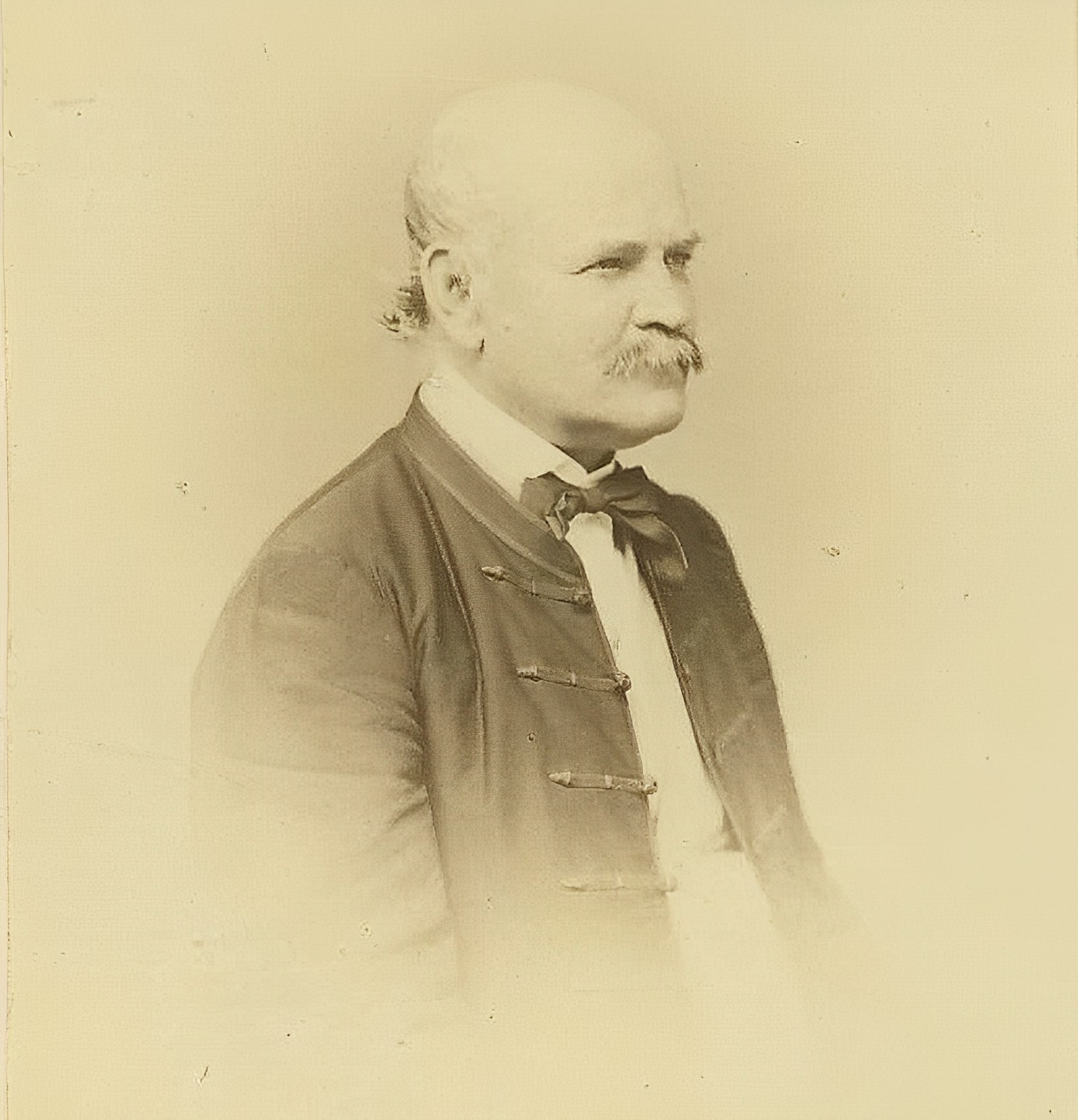
Semmelweis Connects Hand Cleaning with Safer Childbirth
Hospital evidence pointed toward a lifesaving practice before a broadly accepted explanation of infection existed.
In July 1846, Hungarian physician Ignaz Semmelweis assumed the role of assistant in the First Obstetrical Clinic at the Vienna General Hospital. The maternity institution operated two distinct divisions that admitted patients on alternating schedules. The First Clinic, staffed by medical faculty and students, suffered from an average maternal mortality rate of about ten percent due to puerperal fever, while the Second Clinic, staffed entirely by student midwives, averaged under four percent. Aware of this stark contrast, women frequently begged not to enter the first division, and some deliberately gave birth in the surrounding streets. Semmelweis observed that women who delivered outside the hospital rarely succumbed to childbed fever, leading him to systematically investigate environmental and procedural discrepancies between the wards.
A decisive breakthrough occurred in early 1847 following the death of Jakob Kolletschka, a professor of forensic medicine and close friend of Semmelweis. Kolletschka had suffered an accidental puncture from a student scalpel during an autopsy, and his post-mortem examination revealed internal lesions identical to those observed in women dying from childbed fever. Semmelweis deduced that physicians and students routinely carried unseen cadaverous particles from the dissection room directly into the delivery ward on their hands. Student midwives in the second division did not routinely participate in autopsies, helping explain the lower, though not zero, mortality there.

Keep reading in Yester
Coming soon to the App Store
Keep following the story
Sources
- Ignaz Semmelweis: The Saviour of Mothers (Museum of Health Care at Kingston)
- Semmelweis (Dictionary of Scientific Biography, Encyclopedia.com)
- Hektoen International
- Ignaz Semmelweis, savior of mothers (Zientzia.eus)
- James Lind Library
- Sinclair, Semmelweis: His Life and his Doctrine (Manchester, 1909), p. 63 (Hungaricana / Semmelweis University Central Library)
- Ignaz Semmelweis
Image: József Borsos / Albert Doctor