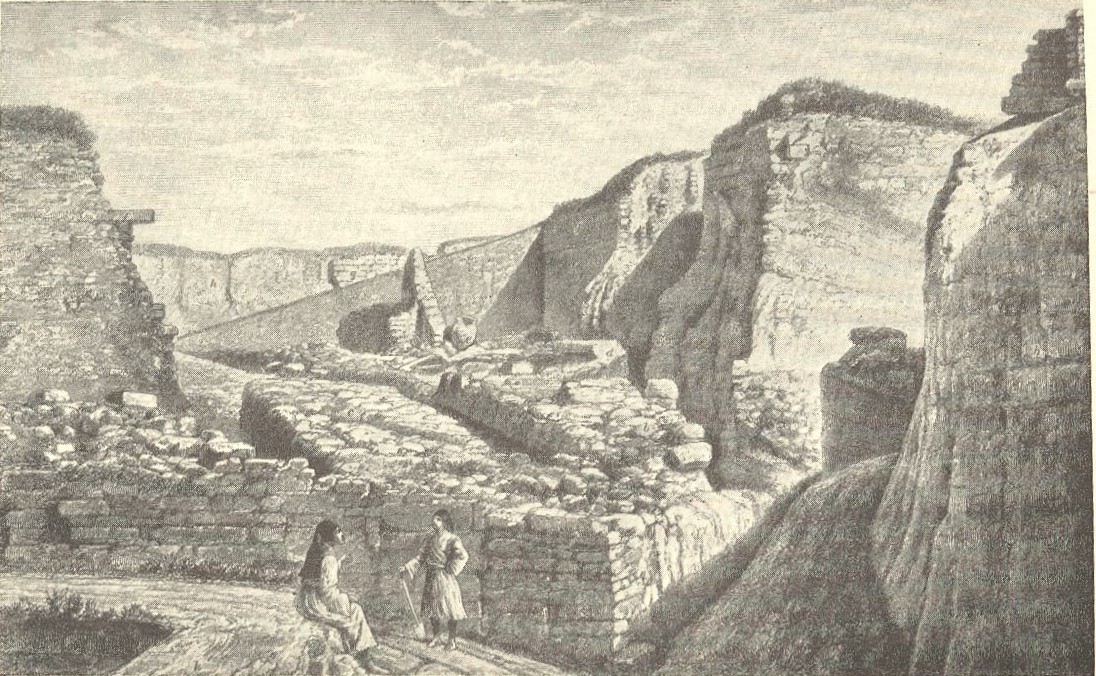
Schliemann Digs for Troy at Hisarlik
Excavations found an ancient city but damaged much of the evidence they sought.
In 1870, Heinrich Schliemann began cutting deep trenches into the mound of Hisarlik in northwestern Turkey, determined to demonstrate that Homer's Iliad described real places. Before his arrival, the most common scholarly candidate for ancient Troy was a hilltop at Pinarbasi. Schliemann conducted trial soundings there but found nothing of interest. It was Frank Calvert, an English amateur archaeologist and local landowner, who identified Hisarlik as Troy and persuaded the wealthy German to dig on land belonging to Calvert's family.
Schliemann brought enormous wealth and singular drive to the effort, having retired from international commerce and speculative banking. At Hisarlik, he uncovered evidence of nine superimposed cities spanning millennia of human habitation. Relying on sheer speed and massive trenches rather than careful stratigraphic documentation, his laborers dug through thick accumulations of soil. Deep within the mound, the excavators found copper implements, metal molds, tools, shields, and vases.

Keep reading in Yester
Coming soon to the App Store
Keep following the story
Sources
- Calvert and Schliemann: the discoverers of Troy (Schliemann-Museum Ankershagen)
- The Treasure of Priamos (Schliemann-Museum Ankershagen)
- 150 Years Since Heinrich Schliemann Uncovered the Treasure of Priamos in Troy (Staatliche Museen zu Berlin)
- Schliemann's discovery of 'Priam's Treasure': two enigmas (Antiquity, Cambridge University Press)
- Archaeological Site of Troy (UNESCO World Heritage Centre)
- Schliemann, Heinrich (Encyclopedia.com, Gale and Oxford reference entries)
- Heinrich Schliemann
Image: Unknown author Unknown author