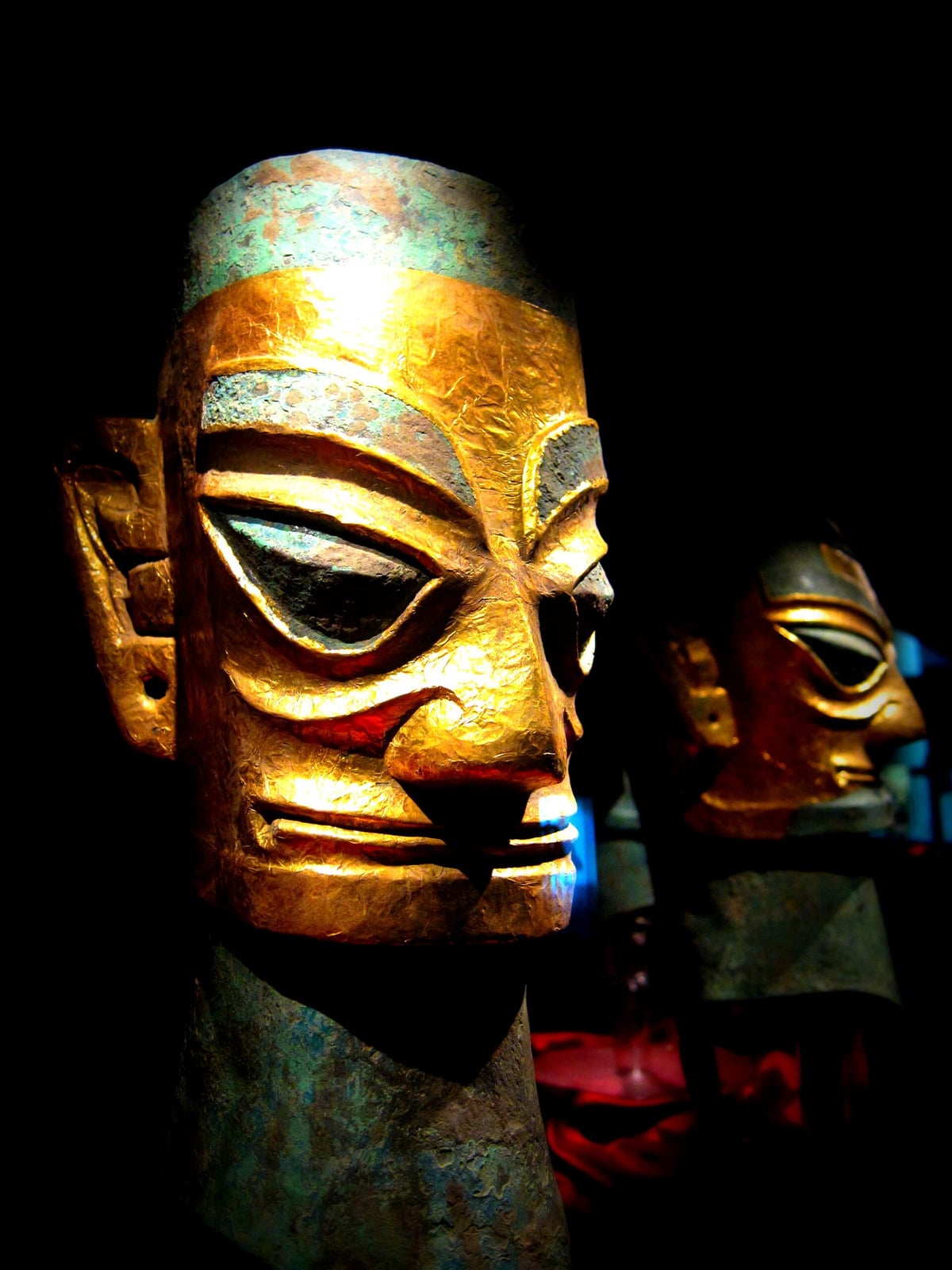
Sanxingdui’s Bronze Masks Reveal an Unknown Culture
Pits of bronze faces showed that Bronze Age China had more than one center.
In the summer of 1986, brickyard laborers near the town of Guanghan in Sichuan stumbled upon subterranean deposits that altered understanding of China's Bronze Age. Digging into the earth, workers revealed pits packed with layers of burnt, fractured objects, including ivory tusks, jade blades, and striking cast bronzes. A second pit uncovered just weeks later yielded hundreds more artifacts, confirming that an extraordinary ceremonial deposit lay buried in the Chengdu Plain.
Decades before this sudden emergence, isolated traces had surfaced around Guanghan. A farmer uncovered a cache of jade pieces while clearing an irrigation canal in 1929, drawing the curiosity of local scholars and Christian missionaries who arranged preliminary documentation and an excavation in 1934. Yet the scale of the broader urban center remained hidden until systematic field archaeology documented a large walled city. Bordered by the Yazi River and an extensive canal network, the settlement extended across several square kilometers, featuring packed earth fortifications, distinct industrial and residential zones, and large timber-and-adobe halls.

Keep reading in Yester
Coming soon to the App Store
Keep following the story
Sources
- Sanxingdui excavation unveils new findings (China Daily Hong Kong / Xinhua, June 2022)
- The Mysterious Ancient City That's Rewriting Chinese History (Sixth Tone)
- New Sanxingdui Relics Offer More Clues of Ancient Civilization (Sixth Tone, 2022)
- Contemporaries of the Shang: The Sanxingdui site in Sichuan (University of Oregon, History 387 course page)
- A gripping mystery (China Daily, 2024)
- Excavation of six new pits at Sanxingdui (China Daily, March 2021)
- Sanxingdui
Image: momo