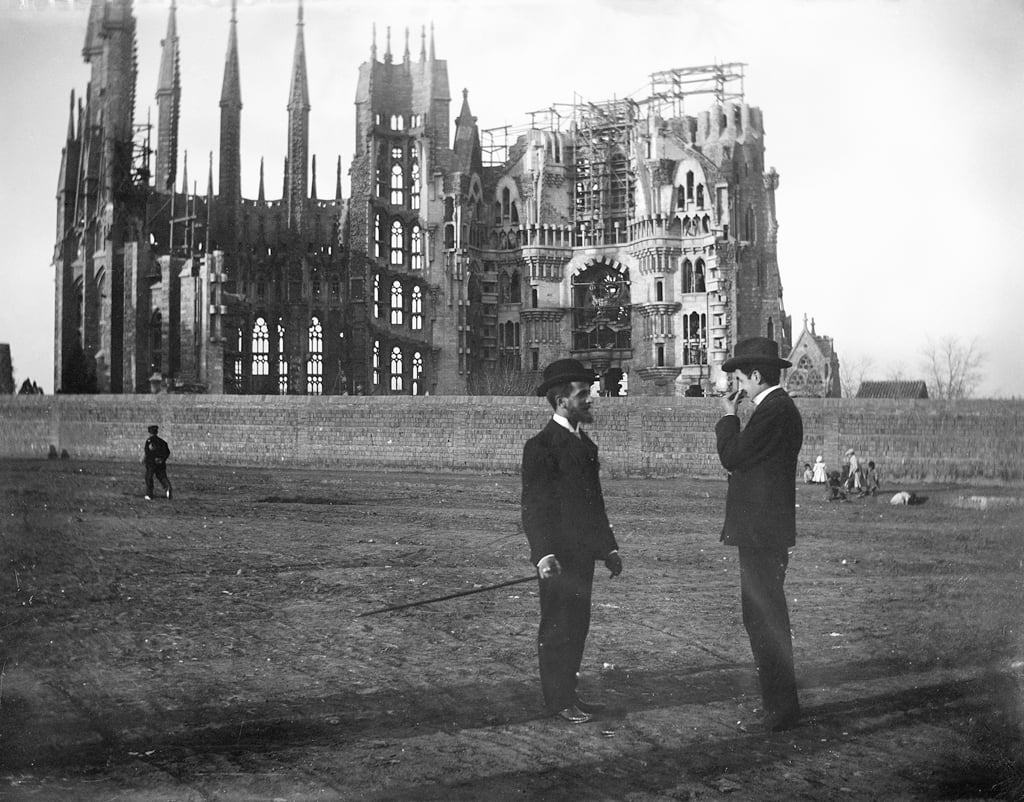
Work Begins on the Sagrada Família
A church begun in 1882 became Gaudí’s lifelong and still unfinished project.
On 19 March 1882, Bishop Urquinaona laid the cornerstone of a new church on land in Sant Martí de Provençals, then a town just outside Barcelona. The initiative originated with José María Bocabella, a bookseller and founder of the Spiritual Association of Devotees of St. Joseph, who with his friend Father Josep Manyanet envisioned an expiatory temple funded entirely by donations and hoped to strengthen Christianity in an increasingly secular city. Bocabella originally engaged Francisco de Paula del Villar to design a standard Gothic revival church. Villar began the crypt beneath the future apse, but disagreements with his patrons, which the basilica's own history links to the cost of materials, led to his departure, opening the path for a complete overhaul of the project.
Antoni Gaudí took over the project in 1883, first completing the crypt largely to Villar's neo-Gothic design with minor adjustments; in 1885 its Chapel of Saint Joseph hosted the first masses. Beyond the crypt, Gaudí transformed the church almost beyond recognition, combining Gothic inspiration with modern engineering and geometric experimentation. Although his plan kept the traditional Latin cross of nave, transept and apse, he replaced Gothic buttresses with inclined, branching columns, refined through hanging-chain models, that carry the building's weight down to the foundations.

Keep reading in Yester
Coming soon to the App Store
Keep following the story
Sources
Image: Baldomer Gili i Roig