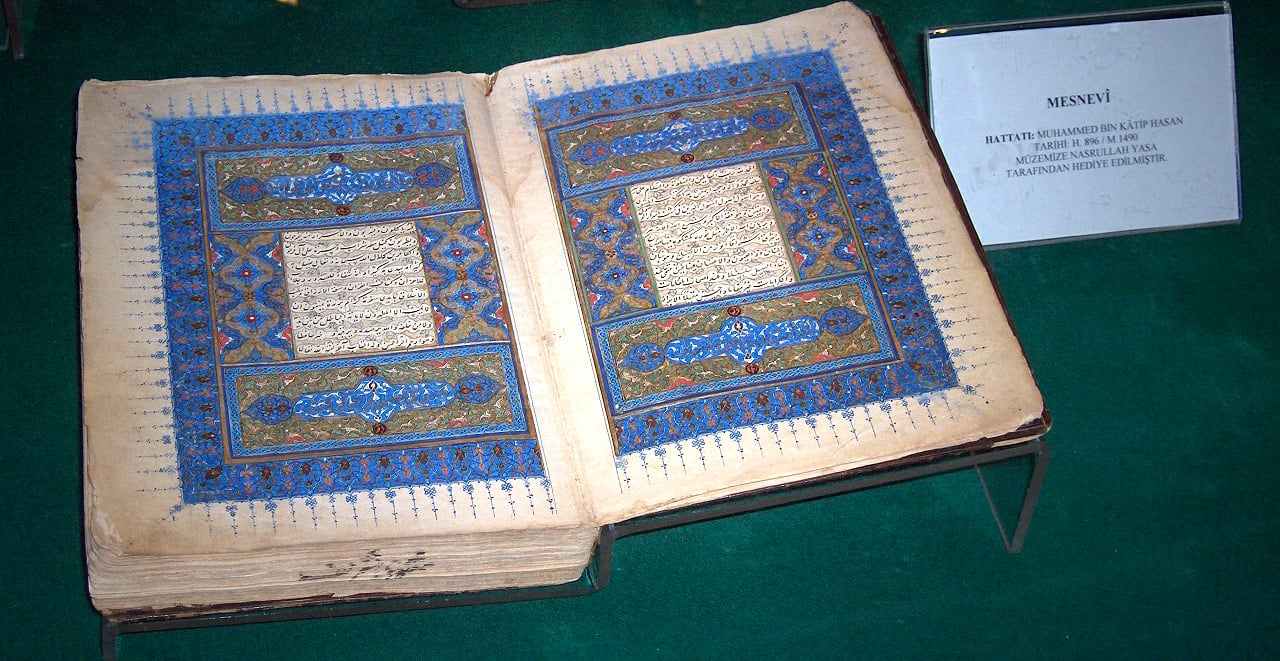
Rumi Begins the Masnavi
Stories and teaching are woven into a major work of Persian Sufi poetry.
Around the year 1258, the Persian poet and mystic Jalal al-Din Muhammad Rumi began dictating the verses of the Masnavi, a monumental spiritual composition that occupied the final fifteen years of his life. Approaching the age of fifty-four, Rumi undertook the project at the urging of his favorite disciple, Husam al-Din Chalabi. Chalabi had observed that their circle of followers regularly studied the didactic poetry of earlier masters such as Sana'i and Farid al-Din 'Attar. To offer his community an original guide tailored to their spiritual pursuits, Rumi agreed to compose an extensive work in the rhyming couplet form known as masnavi.
The composition unfolded through an intimate collaborative routine. Rumi delivered the verses orally during regular gatherings, while Chalabi recorded the spoken lines and recited them back to the poet for review. This steady labor continued across six distinct books, totaling roughly 25,000 verses or 50,000 lines. The creative process ended only with Rumi's death in 1273. Because the concluding narrative of the sixth book stops abruptly, scholars have long debated whether the poet left the text unfinished or intended an unrecorded seventh volume, though the six surviving volumes remain the canonical core of the work.

Keep reading in Yester
Coming soon to the App Store
Keep following the story
Sources
Image: Georges Jansoone ( JoJan )