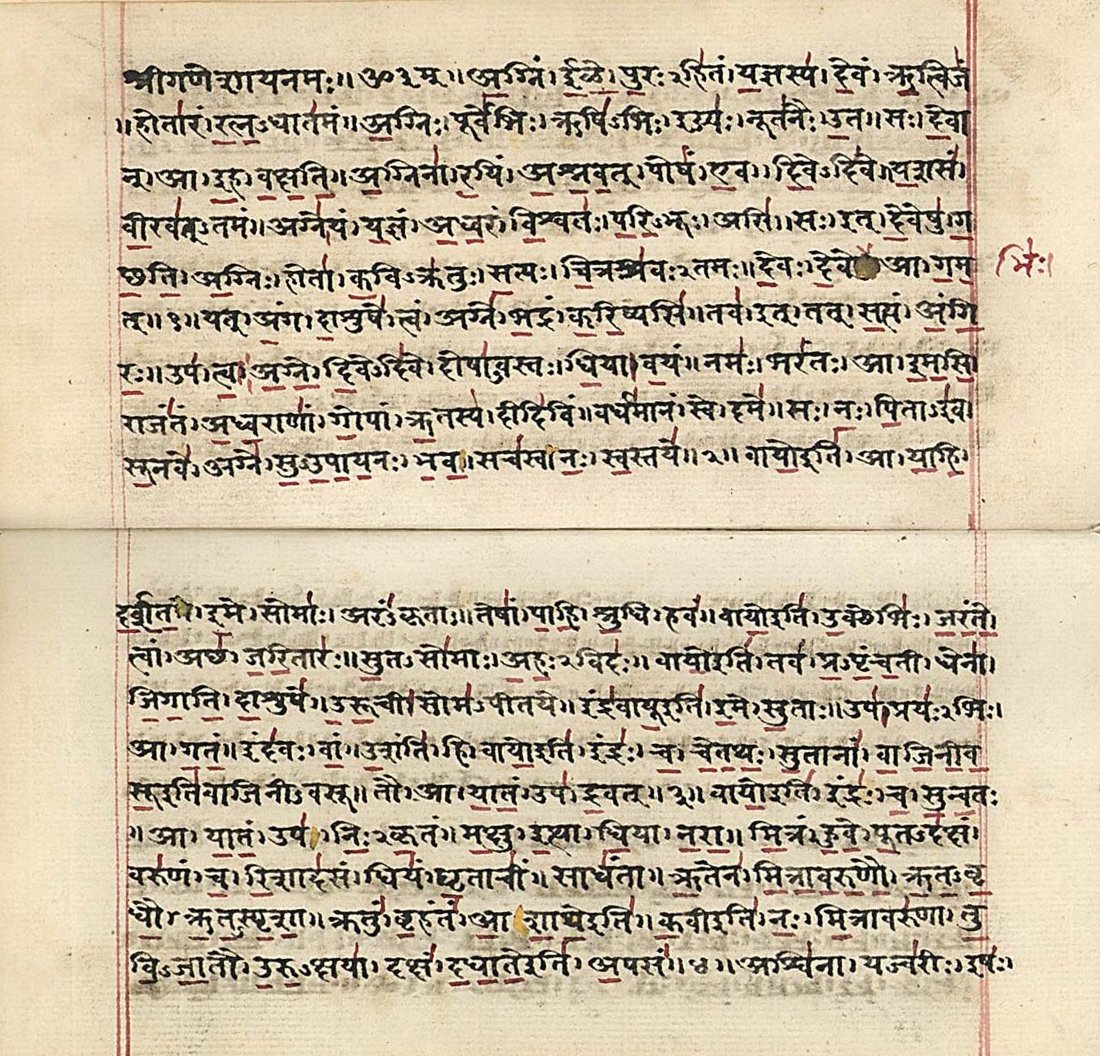
Poets Compose the Hymns of the Rigveda
Sanskrit hymns were passed down orally for centuries with remarkable precision.
The Rigveda, an ancient collection of Vedic Sanskrit poetry, represents the oldest known literary layer of the Indo-Aryan languages. Philological and linguistic research places the composition of its core verses primarily in the northwestern region of the Indian subcontinent, commonly dated between 1500 and 1000 BCE, though broader estimates span from 1900 to 1200 BCE. The anthology forms the foundational core of the four sacred Vedas, preserved not through contemporary written inscriptions, but through an exacting oral culture that spanned many generations.
The primary collection, known as the Rigveda Samhita, is organized into ten books or mandalas. Books 2 through 7, often termed the family books, represent the oldest and most uniform section, with each attributed to specific clans of poet-priests or rishis, such as the families of Vishvamitra and Vasishtha. These earlier compositions consist largely of liturgical eulogies praising deities including Agni, Indra, and Soma, intended to accompany sacrificial ceremonies. In contrast, the later additions, particularly Books 1 and 10, incorporate speculative inquiries regarding cosmic origins, social charity, and the nature of the divine.

Keep reading in Yester
Coming soon to the App Store
Keep following the story
Sources
Image: Unknown author Unknown author