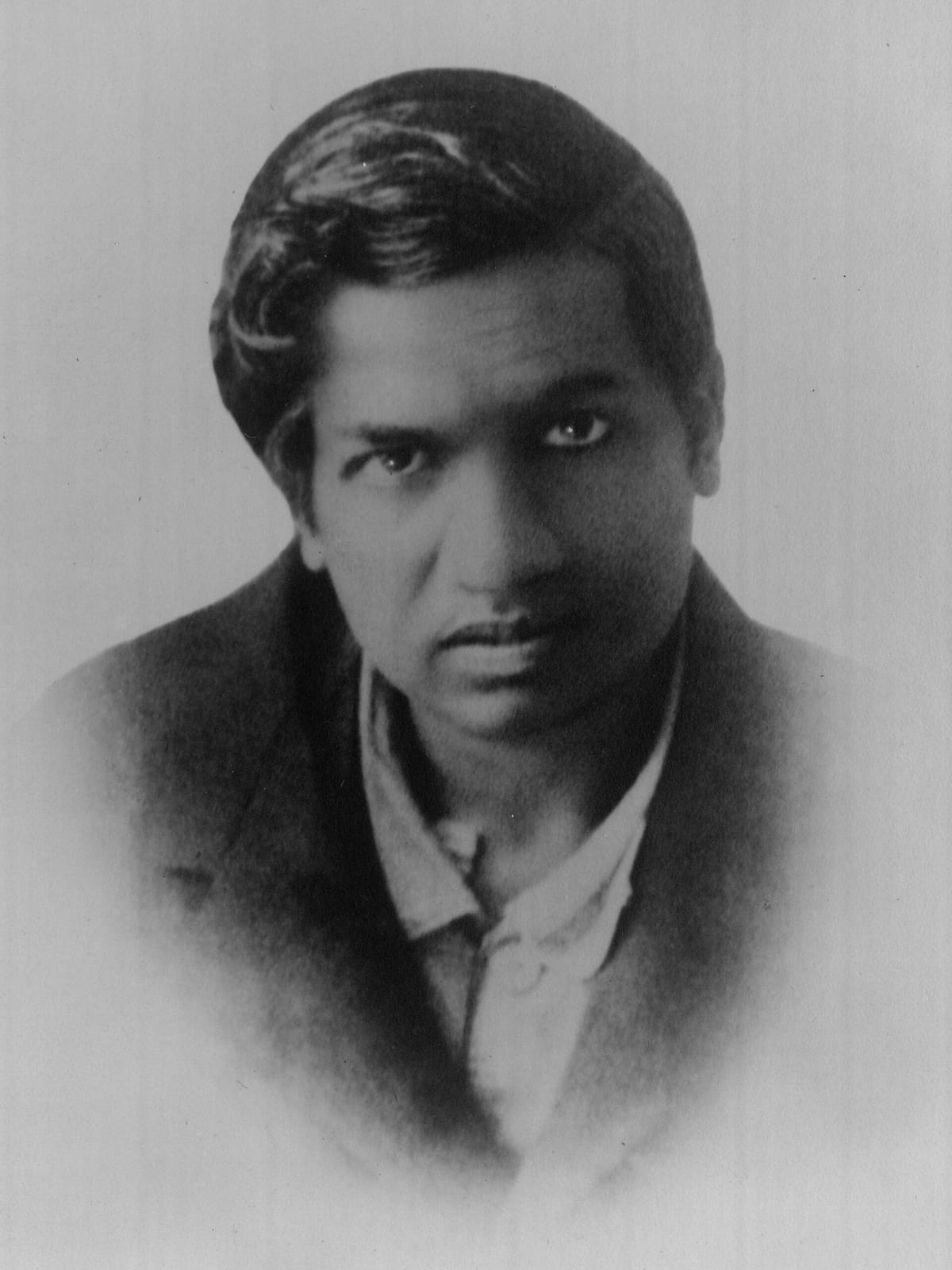
A Letter Carries Ramanujan’s Mathematics to Cambridge
An unconventional mathematical education led to a remarkable collaboration, without making its human costs disappear.
On 16 January 1913, Srinivasa Ramanujan posted a letter from Madras to the English mathematician G. H. Hardy at the University of Cambridge. Enclosed were nine pages filled with mathematical theorems and equations, spanning infinite series, improper integrals, and hypergeometric functions. Hardy had initially suspected that the unknown clerk's manuscript might be a fraud. Several prominent British academics had already ignored or returned Ramanujan's materials, but as Hardy and his colleague J. E. Littlewood examined the formulas, they realized that many of the results were startlingly original and far beyond the work of ordinary practitioners.
Ramanujan's path to that correspondence had developed outside the standard institutional tracks of higher education. Raised in Kumbakonam, he had demonstrated exceptional talent in arithmetic and trigonometry as a schoolboy, but his intense, solitary concentration on mathematical formulas led him to neglect other subjects. After obtaining a copy of G. S. Carr's synopsis of theorems at age sixteen, he pursued independent research while failing his college examinations in subjects such as English, physiology, and Sanskrit. Lacking a degree, he lived in severe poverty before finding support from local mentors and securing an accounting clerkship at the Madras Port Trust in 1912.

Keep reading in Yester
Coming soon to the App Store
Keep following the story
Sources
Image: Unknown author Unknown author