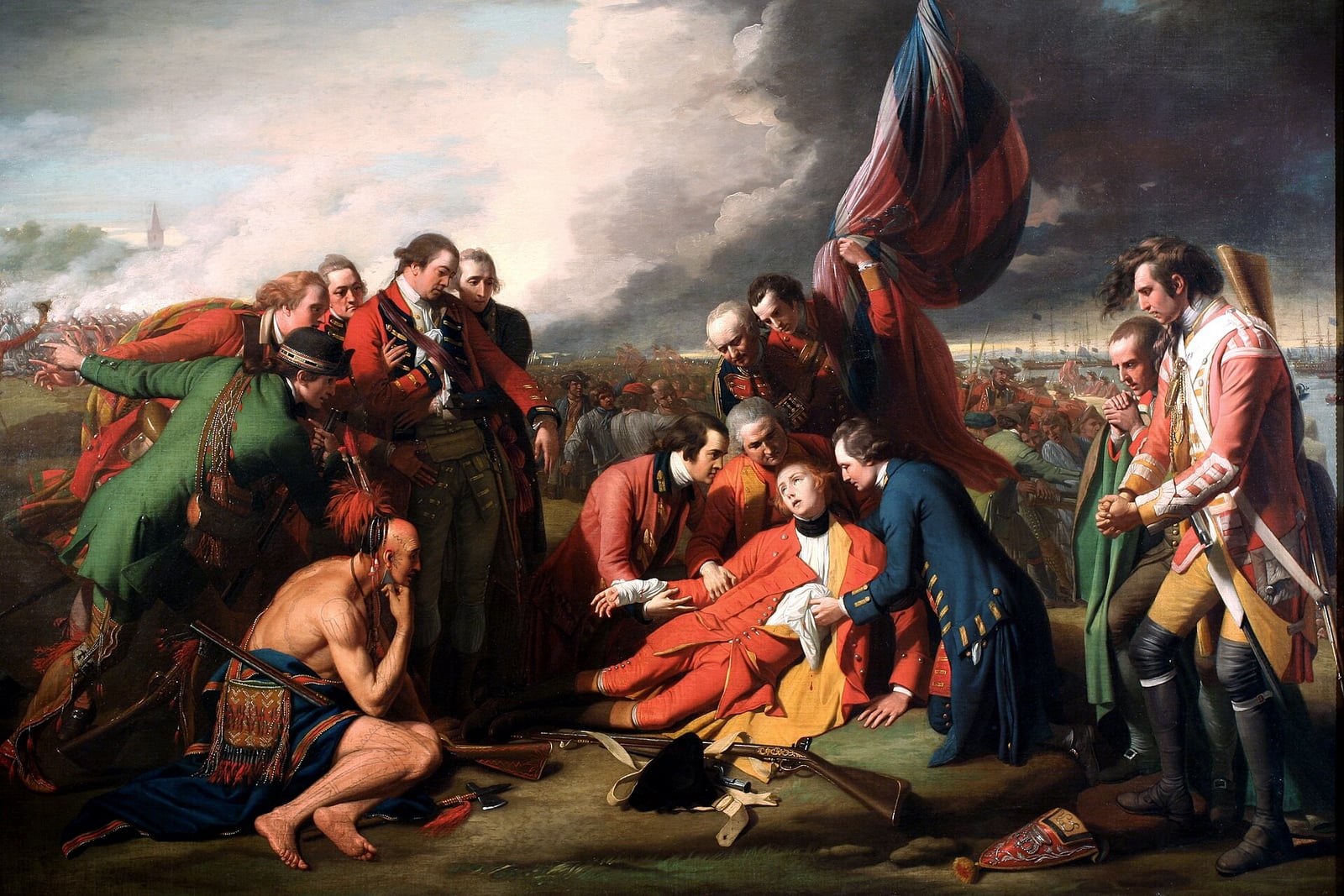
British Troops Win at the Plains of Abraham
A short battle outside Quebec decided the fate of New France.
On the morning of 13 September 1759, British regular infantry scaled the cliffs above the Saint Lawrence River and formed battle lines on a plateau outside Quebec City. Known as the Plains of Abraham probably after Abraham Martin, a 17th-century pilot and fisherman who owned land there, the site became the decisive battleground in the struggle between Great Britain and France over northern North America during the Seven Years' War. The operation followed an exhausting three-month amphibious siege directed by Major General James Wolfe against the regional French forces commanded by the Marquis de Montcalm.
Throughout the summer, French defenders had effectively rebuffed British efforts from strongly entrenched positions along the Beauport shore, east of Quebec. Montcalm concentrated the majority of his regular forces and Canadian militia there, anticipating further landings along the shallows. Wolfe's major assault near the Montmorency River on 31 July had collapsed under heavy fire, costing the British hundreds of casualties. Facing declining health and the arrival of autumn, Wolfe abandoned downstream assaults in late August, opting instead for a risky landing upriver at L'Anse-au-Foulon, a steep cove situated west of Quebec City.

Keep reading in Yester
Coming soon to the App Store
Keep following the story
Sources
- Battle of the Plains of Abraham (The Canadian Encyclopedia)
- Wolfe, James (Dictionary of Canadian Biography)
- Martin, Abraham (Dictionary of Canadian Biography)
- A Chronology of Canadian Military History, 1759 (Canadian War Museum)
- Wars on Our Soil: The Seven Years' War (Canadian War Museum)
- Battle of the Plains of Abraham
Image: Benjamin West