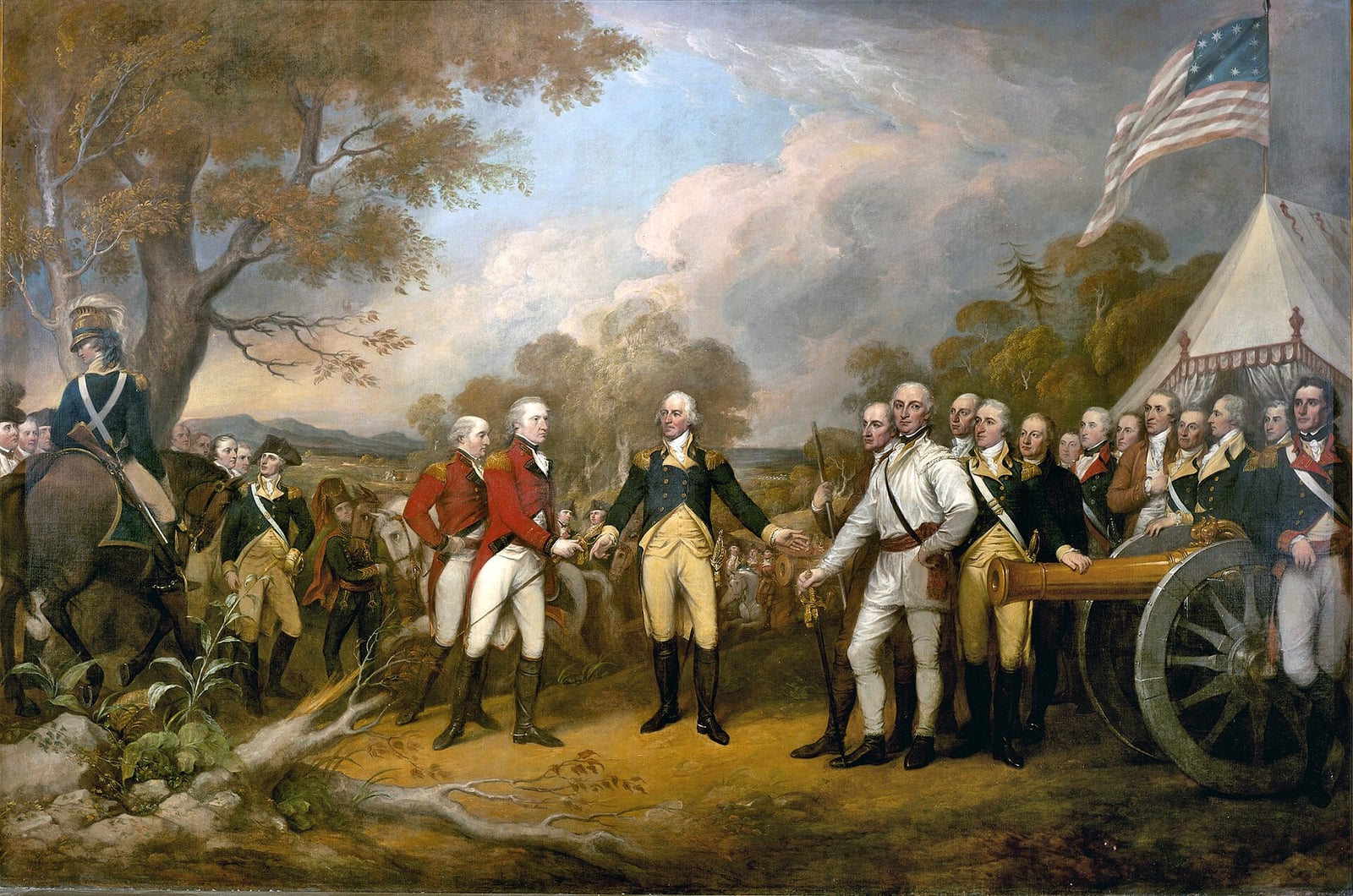
The British Surrender at Saratoga
An American victory brought France into the Revolutionary War.
In the summer of 1777, British strategists launched an offensive from Canada down the Hudson River corridor to isolate New England from the rest of the rebellious American colonies. The plan called for three forces to converge at Albany, New York, but it collapsed when complementary columns failed to arrive. General William Howe sailed his army south toward Philadelphia instead of advancing up the Hudson, and Brigadier General Barry St. Leger withdrew into Ontario after failing to take Fort Stanwix. British Lieutenant General John Burgoyne continued southward alone toward Albany, crossing the Hudson River in mid-September despite mounting logistical difficulties, depleted Indian support, and an American army swelling with militia recruits.
Ten miles south of Saratoga, Major General Horatio Gates established the Continental Army on Bemis Heights, commanding the road to Albany from defensive earthworks designed by Polish engineer Tadeusz Kosciuszko. Burgoyne probed these positions on September 19 at Freeman's Farm. Moving in three columns, the British ran into marksmen led by Colonel Daniel Morgan and infantry dispatched from Major General Benedict Arnold's wing. The battle swayed through repeated charges and sharpshooting in the woods, with British officers and artillerymen sustaining heavy casualties. Although a late flank assault by German troops under Baron Riedesel allowed Burgoyne to hold the field, the tactical victory cost him nearly 600 casualties, while American losses were roughly 300.

Keep reading in Yester
Coming soon to the App Store
Keep following the story
Sources
- Battle of Freeman's Farm (National Park Service, Saratoga National Historical Park)
- Battle of Bemus Heights (National Park Service, Saratoga National Historical Park)
- After Saratoga: The Convention Army (National Park Service, Saratoga National Historical Park)
- Saratoga (American Battlefield Trust)
- Battles of Saratoga
Image: John Trumbull