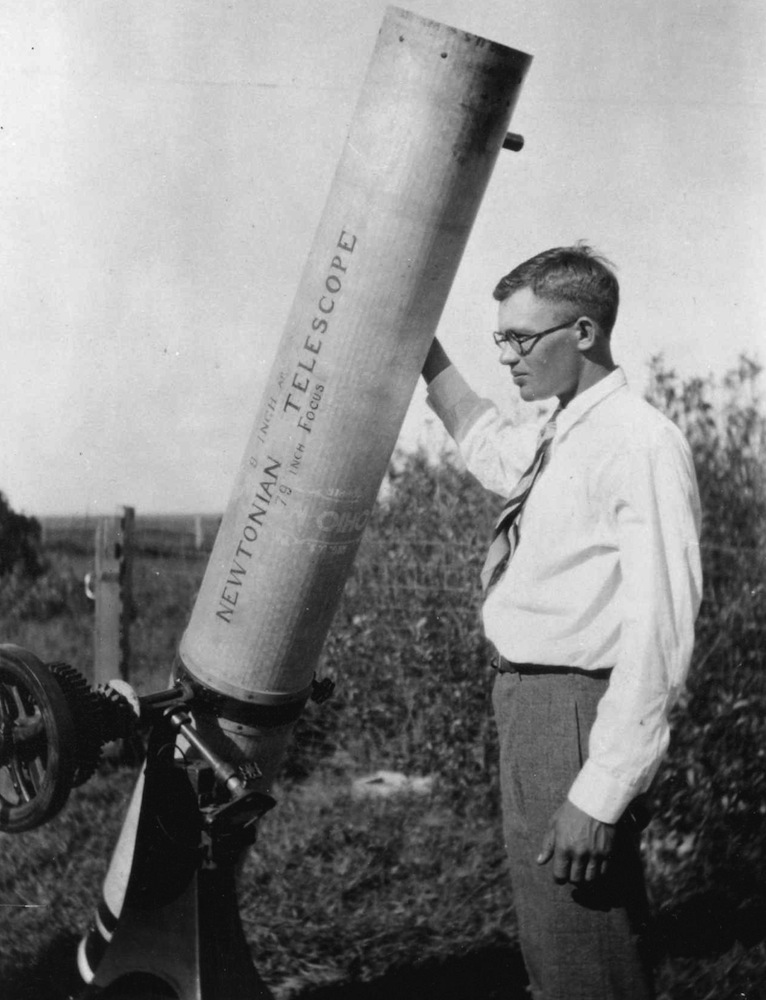
Clyde Tombaugh Finds Pluto
A young observer comparing photographic plates found a distant world.
In April 1929, Clyde Tombaugh began a demanding observational survey at the Lowell Observatory in Flagstaff, Arizona. The observatory sought an unconfirmed trans-Neptunian body, long referred to as Planet X, which founder Percival Lowell had predicted from irregularities in the orbit of Uranus. Tombaugh, a young self-taught astronomer raised on farms in Illinois and Kansas, had built his own telescopes, grinding their mirrors by hand. His detailed drawings of Jupiter and Mars had convinced the observatory staff to recruit him for the systematic photographic campaign.
The search required operating the facility's thirteen-inch astrograph to capture paired photographic glass plates of identical sky sectors several nights apart. Tombaugh inspected these plates using a blink comparator, an optical device that rapidly shifted the viewer's field between two images. While distant background stars remained stationary in the comparator, an orbiting body would appear to shift slightly against the celestial grid. The work demanded intense scrutiny to distinguish potential planets from photographic flaws or previously documented asteroids.

Keep reading in Yester
Coming soon to the App Store
Keep following the story


Sources
- Mathematical discovery of planets (MacTutor, University of St Andrews)
- Tombaugh, Clyde W. (1906-1997) (World of Earth Science, Encyclopedia.com)
- How Pluto got its name, Kevin Schindler, Lowell Observatory (Astronomy)
- Feb 18, 1930: Discovery of Pluto (Astronomy)
- The Final IAU Resolution on the definition of planet ready for voting, iau0602 (International Astronomical Union)
- Eris (NASA Science)
- Pluto (NASA Science)
- Clyde Tombaugh
Image: Unknown author Unknown author