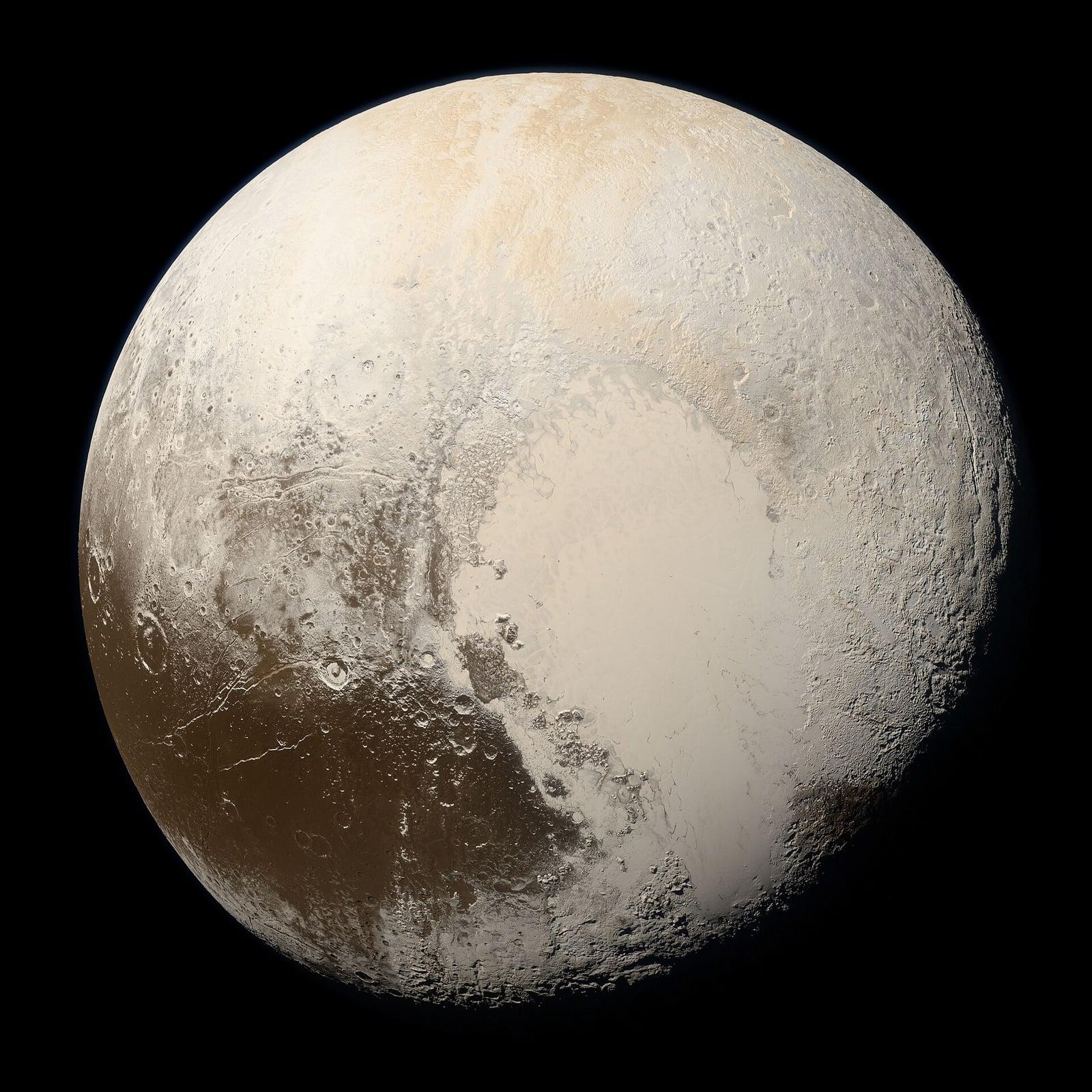
New Horizons Flies Past Pluto
A small spacecraft made the first close flyby of Pluto and photographed the dwarf planet and its moons.
On January 19, 2006, an Atlas V rocket lifted off from Cape Canaveral Space Force Station carrying the New Horizons space probe directly onto an escape trajectory from Earth and the Sun. Departing at about 58,500 kilometers per hour (roughly 16.26 kilometers per second) relative to Earth, the robotic craft became the fastest human-made object ever sent from Earth on departure. Engineered through a partnership between the Johns Hopkins University Applied Physics Laboratory and the Southwest Research Institute under team leader Alan Stern, the mission was designed to explore the uncharted outer limits of the solar system as the inaugural venture of NASA's New Frontiers program.
A major boost occurred on February 28, 2007, when New Horizons made its closest approach to Jupiter. The giant planet provided a critical gravity assist that increased the probe's speed by about 14,000 kilometers per hour and shortened its trip to Pluto by three years, while offering engineers an opportunity to test scientific instruments on Jupiter's atmosphere, magnetosphere, and moons. To preserve its systems across the long transit into deep space, the spacecraft spent the majority of its subsequent journey in electronic hibernation, interrupted only by scheduled yearly checkouts. Technicians revived the vessel on December 6, 2014, initiating the preparations required for its primary target.

Keep reading in Yester
Coming soon to the App Store
Keep following the story

Sources
Image: NASA/Johns Hopkins University Applied Physics Laboratory/Southwest Research Institute/Alex Parker