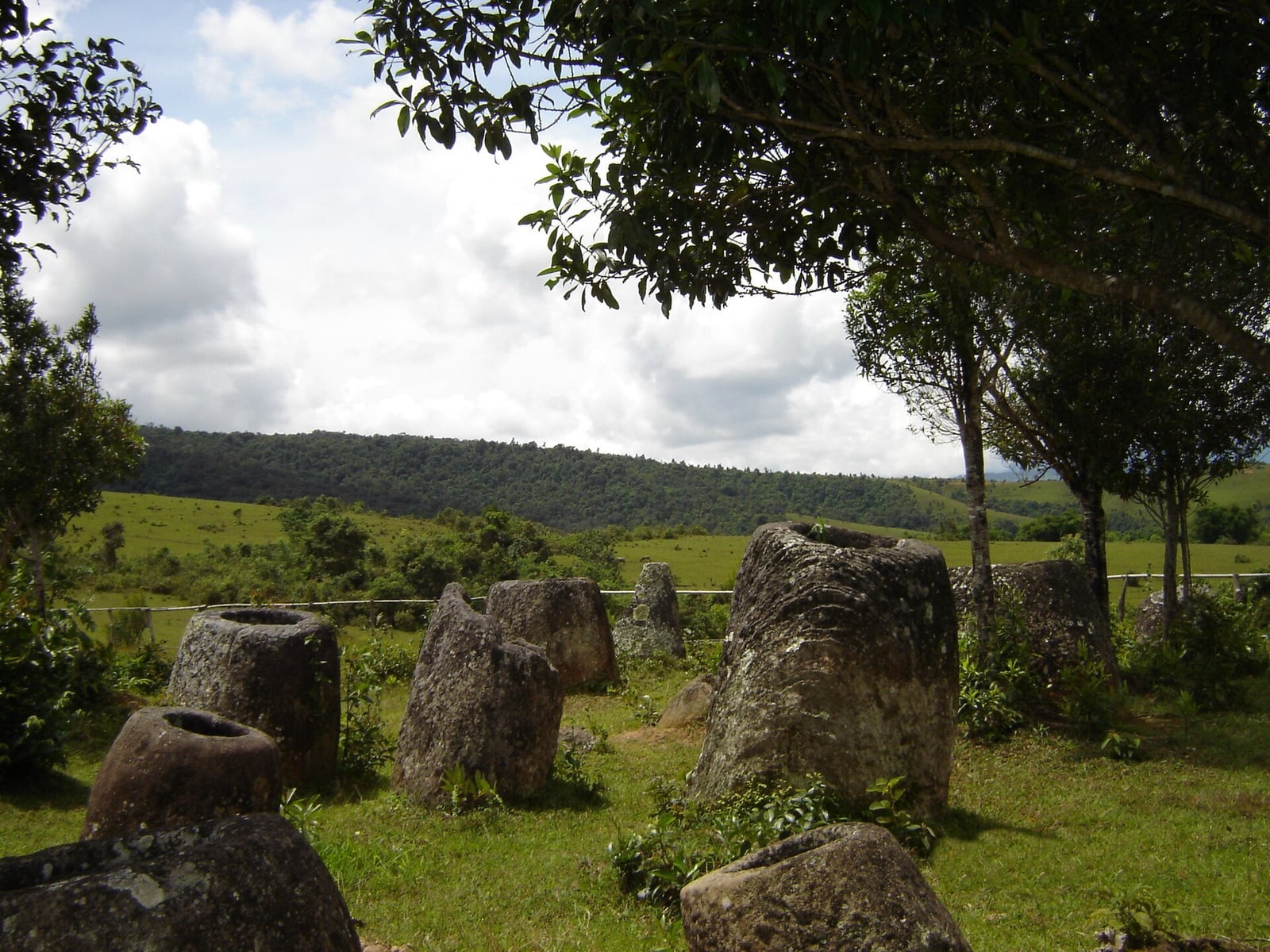
Thousands of Stone Jars Cover a Plateau in Laos
Giant jars carved from rock were most likely used in ancient funeral rites.
Across the upland valleys and lower ridges of the Xiangkhouang Plateau in northern Laos, thousands of carved stone vessels sit grouped across an ancient landscape known as the Plain of Jars. Recent surveys have confirmed 129 jar sites in and around the province, with documented inventories recording more than 2,100 stone vessels. While clusters range from solitary monuments to gatherings of several hundred, each vessel was sculpted directly from bedrock. They stand between one and three meters in height and diameter, displaying a uniform cylindrical silhouette that remains noticeably broader at the base than at the mouth.
Recent scientific analysis suggests that the placement of these megaliths may have begun as early as the late second millennium BCE. Optically stimulated luminescence dating of sediment beneath jars at one site indicates they were probably set in place between roughly 1240 and 660 BCE, earlier than the range of about 500 BCE to 500 CE given in the UNESCO World Heritage listing. Most of the monuments were fashioned from sandstone, though granite, limestone, conglomerate, and breccia were also utilized depending on local geological formations. Partially sculpted vessels left embedded in bedrock at nearby quarries reveal on-site extraction, while detrital zircon analysis at Site 1 indicates that stone was hauled over distances of at least eight kilometers across rugged mountain terrain.

Keep reading in Yester
Coming soon to the App Store
Keep following the story
Sources
Image: PTD Phonsavan