Bronze Drums of the Đông Sơn Culture
Large decorated drums spread across Southeast Asia.
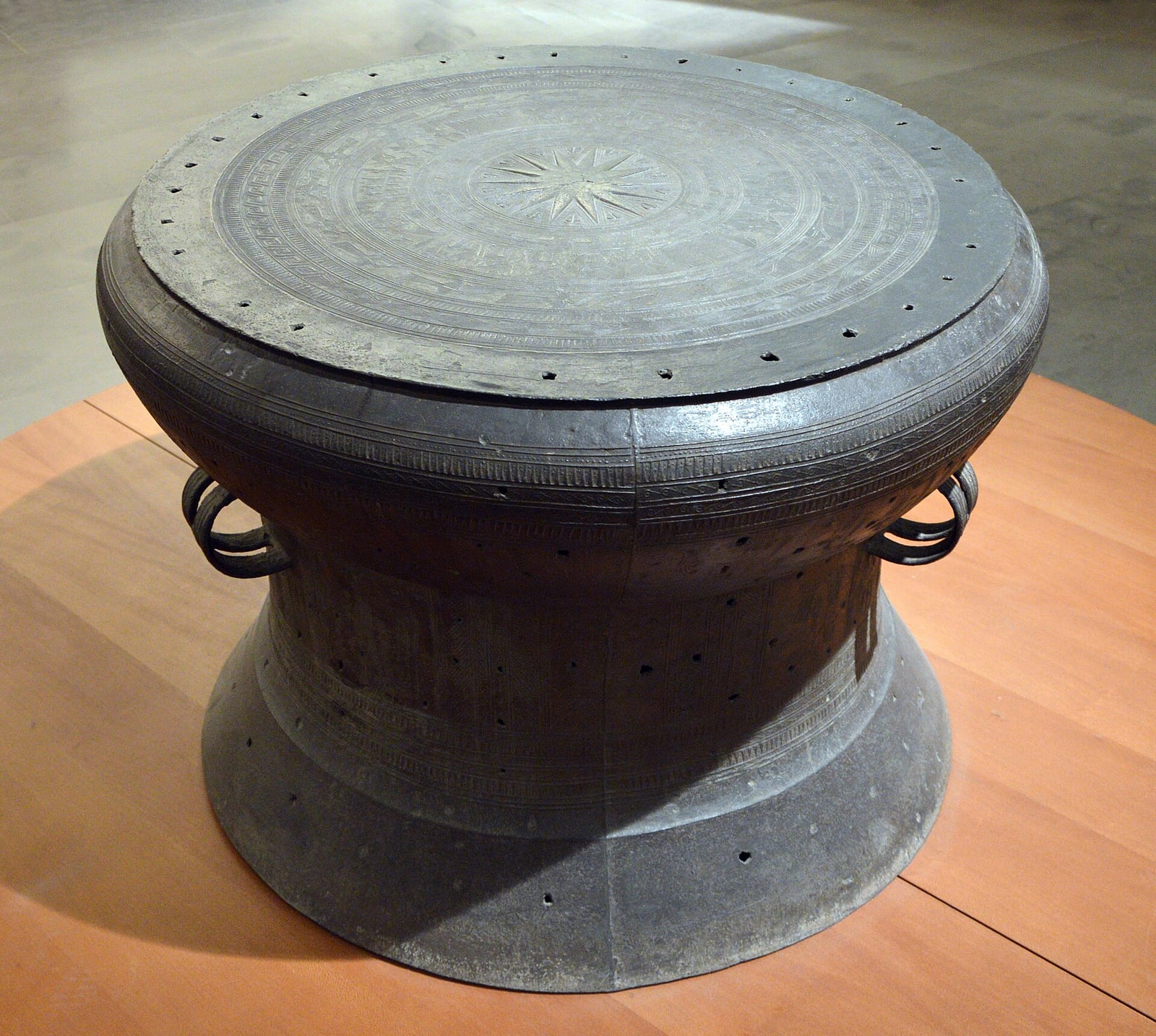
Archaeological excavations across northern Vietnam have revealed an intricate tradition of metalworking centered along the valleys of the Red River Delta. Produced from roughly the middle of the first millennium BCE into the early centuries CE, the bronze drums of the Đông Sơn culture rank among the most elaborate cast-metal artifacts of ancient Southeast Asia. These large bronze vessels, produced using the lost-wax casting technique, reached dimensions of up to a meter in height and could weigh as much as one hundred kilograms. Their surviving surfaces carry fine ornamental bands, stylized figures, and dynamic scenes of ritual life that offer tangible evidence of early metallurgical mastery.
A typical Đông Sơn drum displays a symmetrical tripartite structure consisting of a top drumhead or tympanum, an upper curved body or barrel, and a splayed base known as the leg. The flat surface of the drumhead frequently features concentric circular registers radiating from a central star design. These registers incorporate intricate geometric patterns alongside detailed depictions of everyday activities, such as people processing and pounding rice, rowers piloting longboats, and figures dancing in feathered attire. Repeated natural motifs, including deer, egrets, and the traditional Lạc waterbird, weave through the panels, reflecting the environment and agrarian rituals of the communities that crafted them.

Keep reading in Yester
Coming soon to the App Store