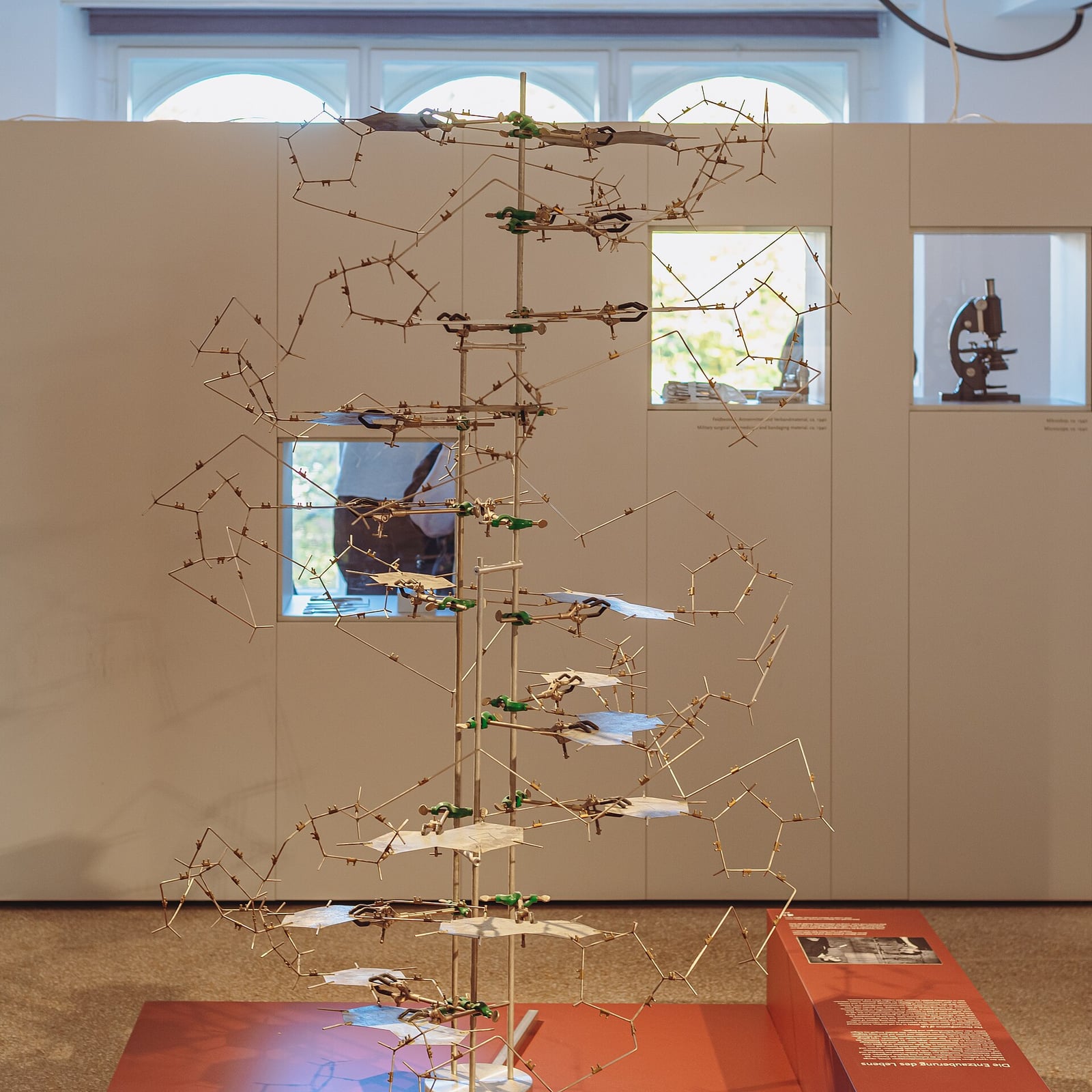
Rosalind Franklin’s Team Records Photo 51
An X-ray image of DNA revealed the shape of a double helix.
On 2 May 1952, doctoral candidate Raymond Gosling conducted an X-ray fiber diffraction experiment at King's College London under the direction of Rosalind Franklin. Working within a research group overseen by Sir John Randall, Gosling produced a diffraction image from a paracrystalline gel composed of deoxyribonucleic acid fibers. Tagged as Photo 51 because it was the fifty-first diffraction record Gosling had obtained, the exposure captured the physical configuration of the B form of DNA with exceptional clarity.
Despite the quality of the image, Franklin chose to set Photo 51 aside. According to a later account provided by Gosling, her immediate research priority focused on solving the diffraction pattern of the alternative A form of DNA. As professional transitions approached and arrangements were made for Franklin to leave King's College London, Randall instructed Gosling to transfer his collected data to Maurice Wilkins, another senior researcher in the unit who was scheduled to assume supervision over Gosling's remaining doctoral work.

Keep reading in Yester
Coming soon to the App Store
Keep following the story
Sources
- The story behind Photograph 51 (King's College London)
- The DNA Riddle: King's College, London, 1951-1953 (Rosalind Franklin Papers, Profiles in Science, US National Library of Medicine)
- Rosalind Franklin: Biographical Overview (Profiles in Science, US National Library of Medicine)
- The Nobel Prize in Physiology or Medicine 1962 (NobelPrize.org)
- Frequently asked questions (NobelPrize.org)
- Molecular Configuration in Sodium Thymonucleate, Franklin and Gosling (Nature, 1953)
- Photo 51
Image: Flocci Nivis