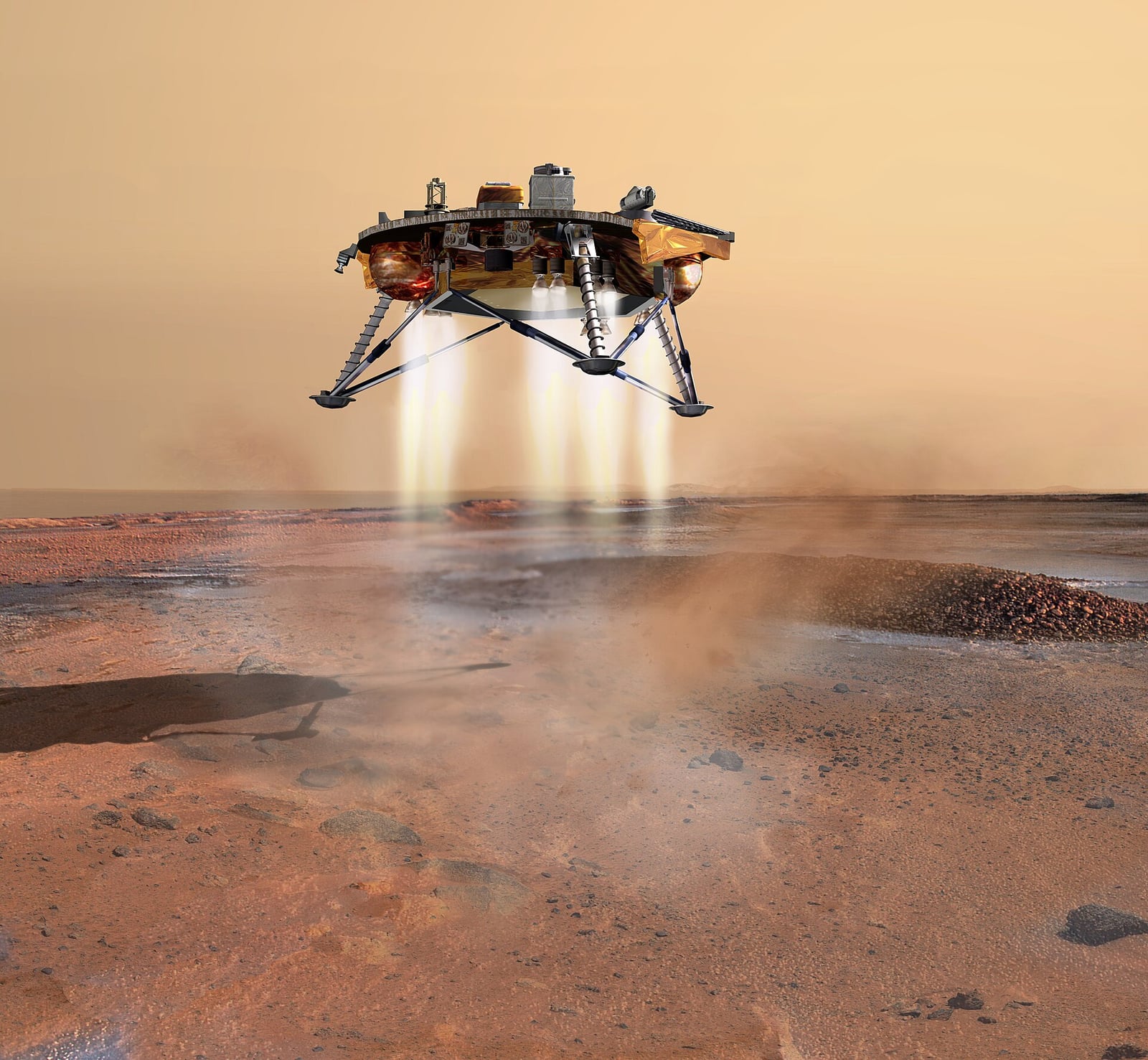
Phoenix Touches Water Ice on Mars
A lander near the Martian north pole dug up and confirmed water ice.
On May 25, 2008, the Phoenix spacecraft touched down on the northern plains of Mars, marking the sixth successful landing by NASA out of seven attempts and the first inside a Martian polar region. Rather than building an entirely new probe from scratch, the Mars Scout Program refurbished hardware from earlier efforts, relying on the modified Mars Surveyor 2001 Lander and instruments originally assembled for the Mars Polar Lander. The multi-agency endeavor, managed by the Jet Propulsion Laboratory and led scientifically by the Lunar and Planetary Laboratory at the University of Arizona, aimed to investigate whether water ice lay within reach beneath the arctic topsoil.
Orbiting observations by the Mars Odyssey probe in 2002 had recorded surface hydrogen signatures that pointed to subterranean water ice. Phoenix targeted this arctic zone directly, coming to rest on a flat expanse shaped into distinct polygons bounded by troughs. Unlike landscapes explored by earlier landers such as Viking, the surrounding terrain lacked dunes or prominent boulders. Shortly after arrival, the robotic arm camera spotted smooth, bright patches under the vehicle where the descent thrusters had blown away loose dirt, suggesting shallow deposits right below the surface.

Keep reading in Yester
Coming soon to the App Store
Keep following the story
Sources
- Mars Phoenix (NASA Science)
- Detection of perchlorate and the soluble chemistry of martian soil at the Phoenix lander site (Science, via PubMed)
- Phoenix Mars Mission (Canadian Space Agency)
- Sixty-One Martian Days of Weather Monitoring (NASA Photojournal)
- NASA's Phoenix Mars Lander stops communicating (Science News)
- Phoenix Mars Lander is silent, new image shows damage (ScienceDaily, NASA/JPL release)
- Phoenix (spacecraft)
Image: NASA/JPL/Corby Waste