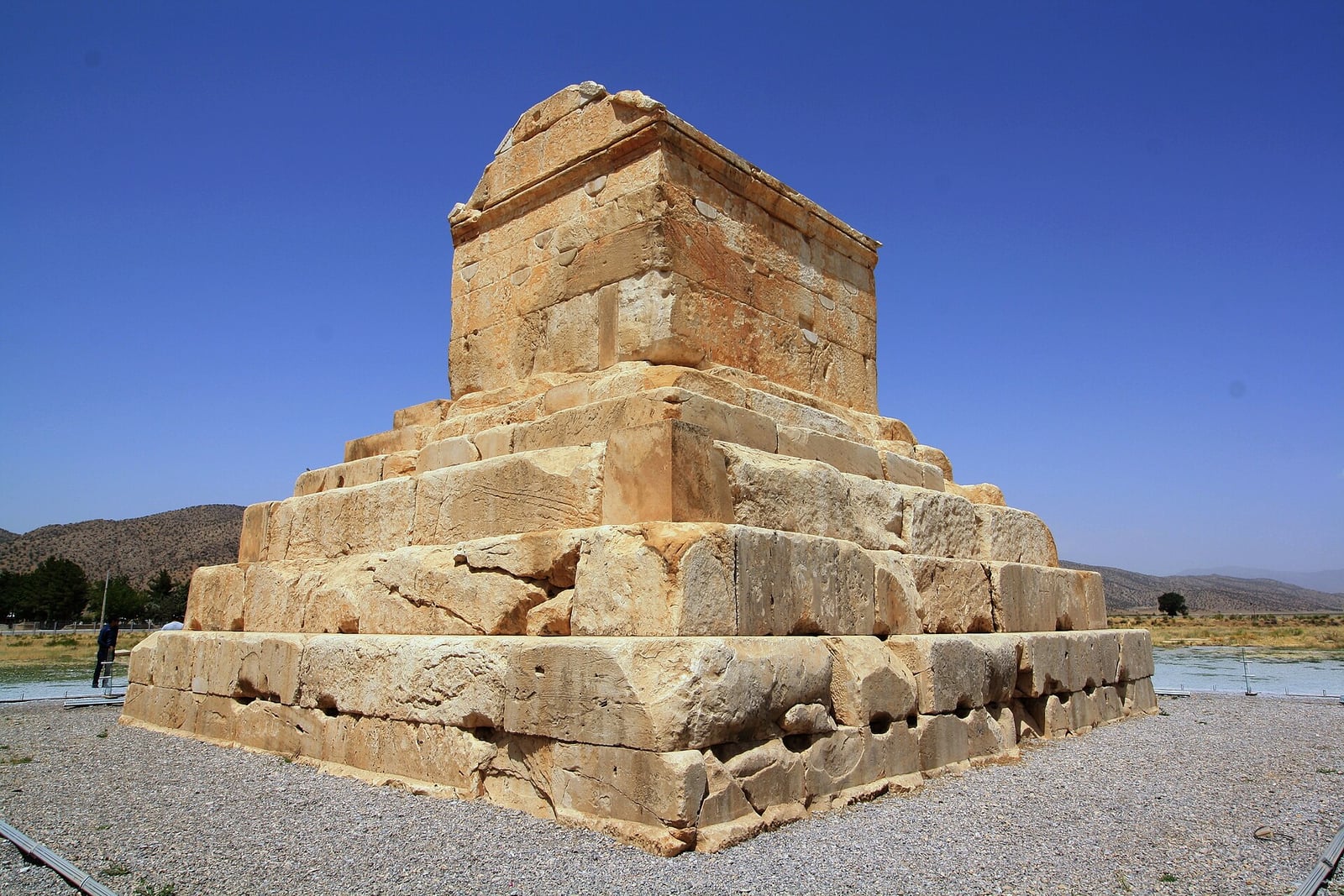
Cyrus the Great Is Laid to Rest at Pasargadae
A plain stone tomb on a stepped plinth still stands in the first Persian royal capital.
In the sixth century BCE, the founder of the Achaemenid Empire established his first capital in the highlands of southwestern Iran. Pasargadae was constructed in modern Fars province near the location where Cyrus the Great defeated the Median king Astyages around 550 BCE. Named after the monarch's own royal clan, the city served as the primary administrative and ceremonial seat of the Persian realm until Darius later transferred imperial operations to Persepolis. Today, the archaeological park spans roughly 1.6 square kilometres, preserving palace foundations, fortifications, and early royal monuments.
The focal point of the site is an austere stone chamber set upon a stepped foundation, traditionally identified as the final resting place of Cyrus. Six broad limestone tiers rise toward a gabled funerary chamber, entered by a low and narrow opening. The interior room measures 3.17 metres long, 2.11 metres wide, and 2.11 metres high. The primary exterior ornament is a rosette carved above the doorway within the gable. In earlier eras, local traditions associated the structure with the mother of Solomon, and while direct physical proof connecting the monument to Cyrus is lacking, classical accounts affirm that ancient rulers viewed it as his sepulchre.

Keep reading in Yester
Coming soon to the App Store
Keep following the story
Sources
Image: Blondinrikard Fröberg from Göteborg, Sweden