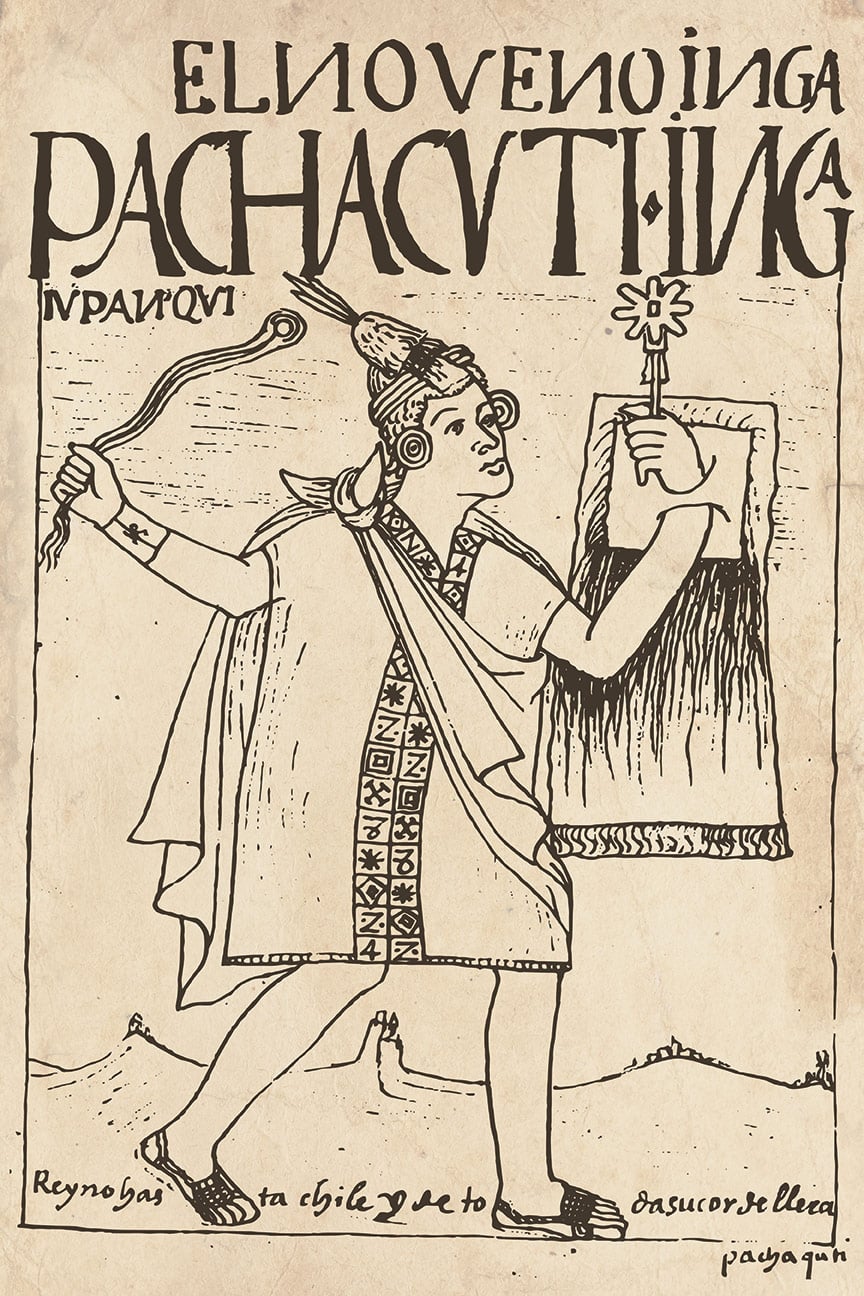
Pachacuti’s Reign Expands Inca Power
Later accounts associate a major transformation of the Inca state with this ruler.
In the early fifteenth century, the Inca presence in the Andes was centered on the valley of Cusco, operating as a localized chiefdom alongside rival regional powers. According to widespread traditional accounts recorded in Spanish colonial documents, the polity faced a severe existential threat from an invasion by the neighboring Chanka confederation. The reigning ruler, Viracocha Inca, and his designated successor fled the settlement. In their absence, a younger son named Cusi Yupanqui rallied local forces, organized the defense of Cusco, and routed the attackers at the battle of Yahuar Pampa. After securing victory, he claimed the throne, adopted the name Pachacuti, and initiated an era of rapid institutional and territorial transformation.
The name Pachacuti, derived from Quechua roots signifying a cataclysmic turning or return of the world, reflected the profound upheaval associated with his ascension. Historical scholarship remains divided over the nature of his early exploits. While earlier historians like John Howland Rowe and María Rostworowski interpreted his defense of Cusco as the genuine turning point toward empire, later researchers, such as Pierre Duviols, suggest that the narrative of the Chanka war served largely as a mythic and ideological archetype designed to legitimize imperial expansion. Structuralist anthropologists have even proposed that pre-imperial Andean rule functioned as a diarchy or collective factional system rather than a succession of individual autocrats, though others maintain that Pachacuti was a distinct historical monarch.

Keep reading in Yester
Coming soon to the App Store
Keep following the story
Sources
Image: Felipe Huaman Puma de Ayala