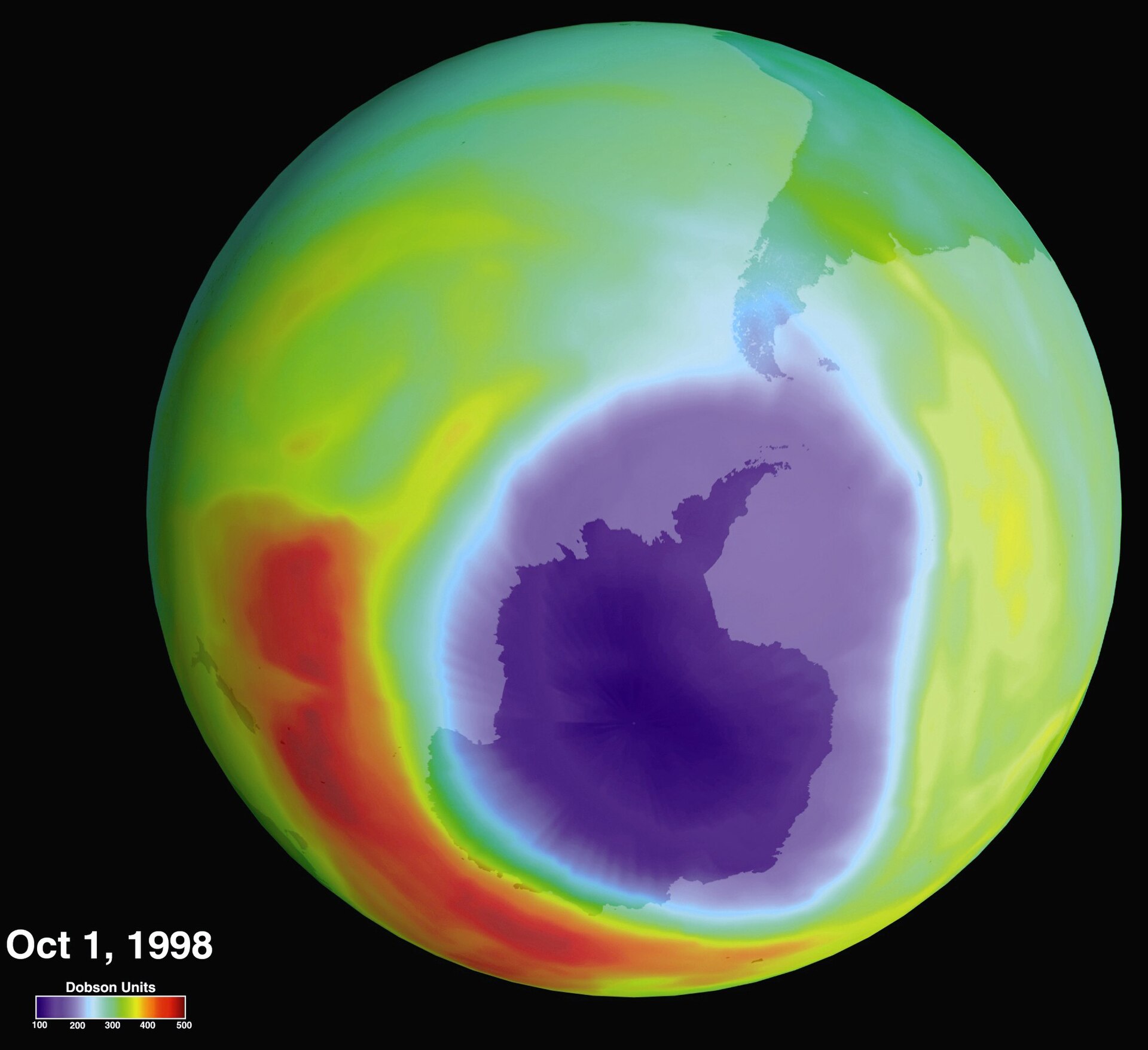
Scientists Report a Hole in the Ozone Layer
Measurements over Antarctica revealed a seasonal loss of ozone high in the atmosphere.
In May 1985, researchers published atmospheric measurements showing that concentrations of stratospheric ozone over Antarctica were dropping sharply each southern spring. Measurements at the British Antarctic Survey's Halley station showed that by 1984 the springtime ozone layer overhead was only about two-thirds as thick as it had been in earlier decades. Instruments measuring atmospheric thickness revealed that this seasonal decline, soon known as the ozone hole, reduced ozone levels over the continent to a fraction of their historical baselines. An independent team quickly confirmed the findings, and satellite data showed that the depletion extended over a vast region of the Antarctic sky.
Stratospheric ozone shields the surface of the Earth by absorbing biological wavelengths of ultraviolet radiation, specifically UVB light. Ozone molecules, composed of three oxygen atoms, form continuously when ultraviolet photons split molecular oxygen, prompting the liberated atoms to combine with existing pairs. Because ozone absorbs most incoming UVB radiation, any broad decrease in its abundance permits greater amounts of high-energy light to reach the ground. The resulting exposure was projected to elevate rates of sunburn, cortical cataracts, and non-melanoma skin cancers, while disrupting microalgae and terrestrial plant life.

Keep reading in Yester
Coming soon to the App Store
Keep following the story

Sources
- The story behind the discovery of the ozone hole (UK Research and Innovation)
- Scientific Assessment of Ozone Depletion 2022: Twenty Questions and Answers About the Ozone Layer (NOAA Chemical Sciences Laboratory)
- Basic Ozone Layer Science (US Environmental Protection Agency)
- Ozone Facts: What is the Ozone Hole? (NASA Ozone Watch)
- Chlorofluorocarbons (CFCs) (NOAA Global Monitoring Laboratory)
- Ozone depletion
Image: NASA