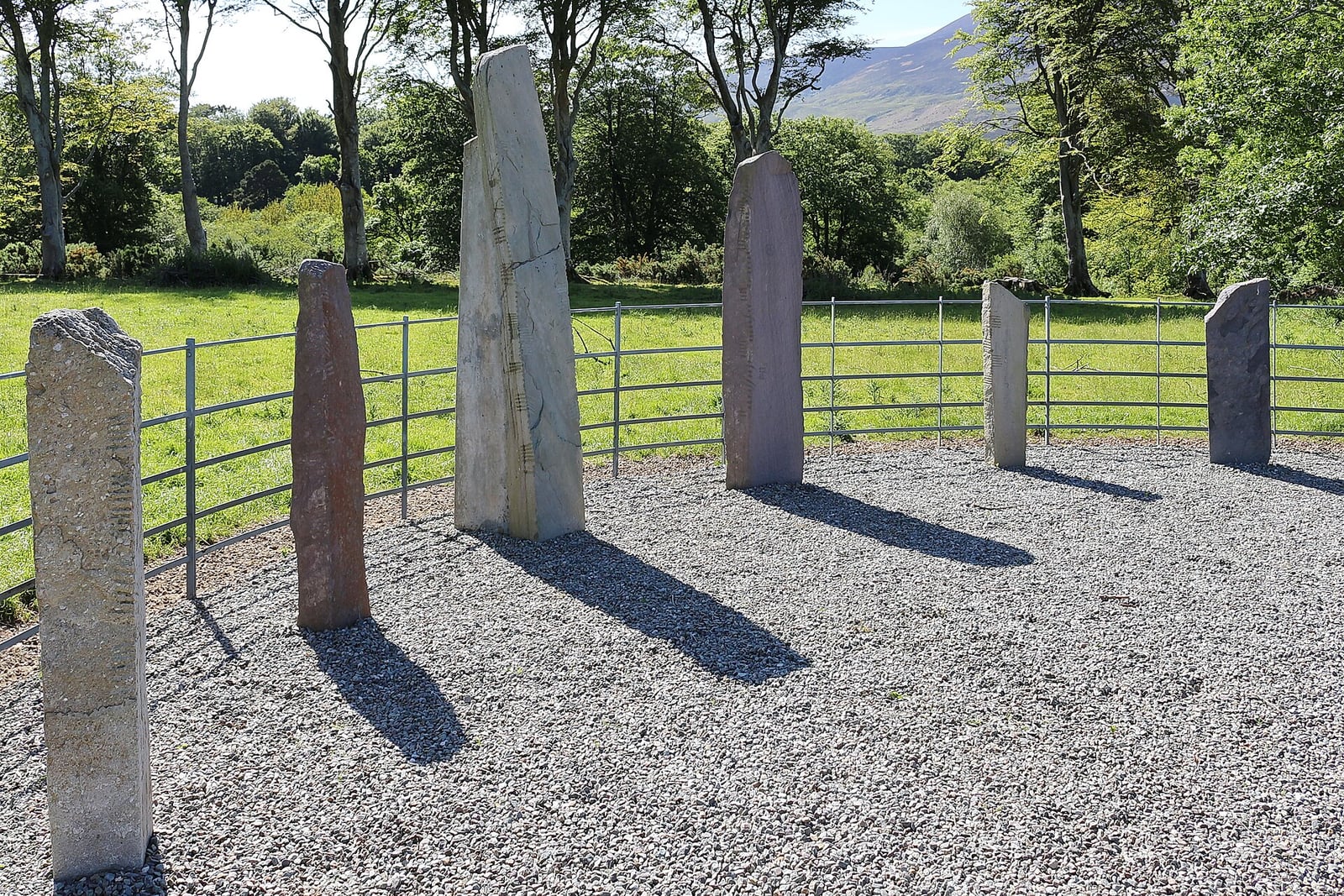
Irish Carvers Mark Standing Stones in Ogham
Notches cut along the edges of stones spell out personal names in early Irish.
During the fourth century, carvers in Ireland and across the Irish Sea began chiseling a unique linear script into the corners of tall standing stones. Known as ogham, this writing system used groups of one to five strokes cut across or beside a central stemline. When carving stone, the natural angle or arris of the pillar served as the stem. Readers traced the characters upward from the base along the left side, following the text over the top and, when necessary, down the opposing edge. Around four hundred classical monuments survive today, concentrated overwhelmingly in the southern province of Munster, with County Cork and County Kerry accounting for roughly sixty percent of all Irish examples.
The texts preserved on these pillars rarely record complex narratives, functioning instead as memorials or territorial boundary markers. Most consist strictly of personal names framed by formulaic genealogical phrases. The underlying idiom is Primitive Irish, an archaic forerunner of Old Irish that provides linguists with a window into the phonetic shifts of early Insular Celtic speech. Aside from the heavy concentration in Munster, examples appear across western Britain, particularly in Pembrokeshire, Wales, alongside sparse outliers in Devon, Cornwall and the Isle of Man. Several Welsh monuments pair the ogham characters with parallel Latin text, reflecting close contact between Irish settlers and Romanised British communities.

Keep reading in Yester
Coming soon to the App Store
Keep following the story
Sources
Image: Robert Linsdell from St. Andrews, Canada