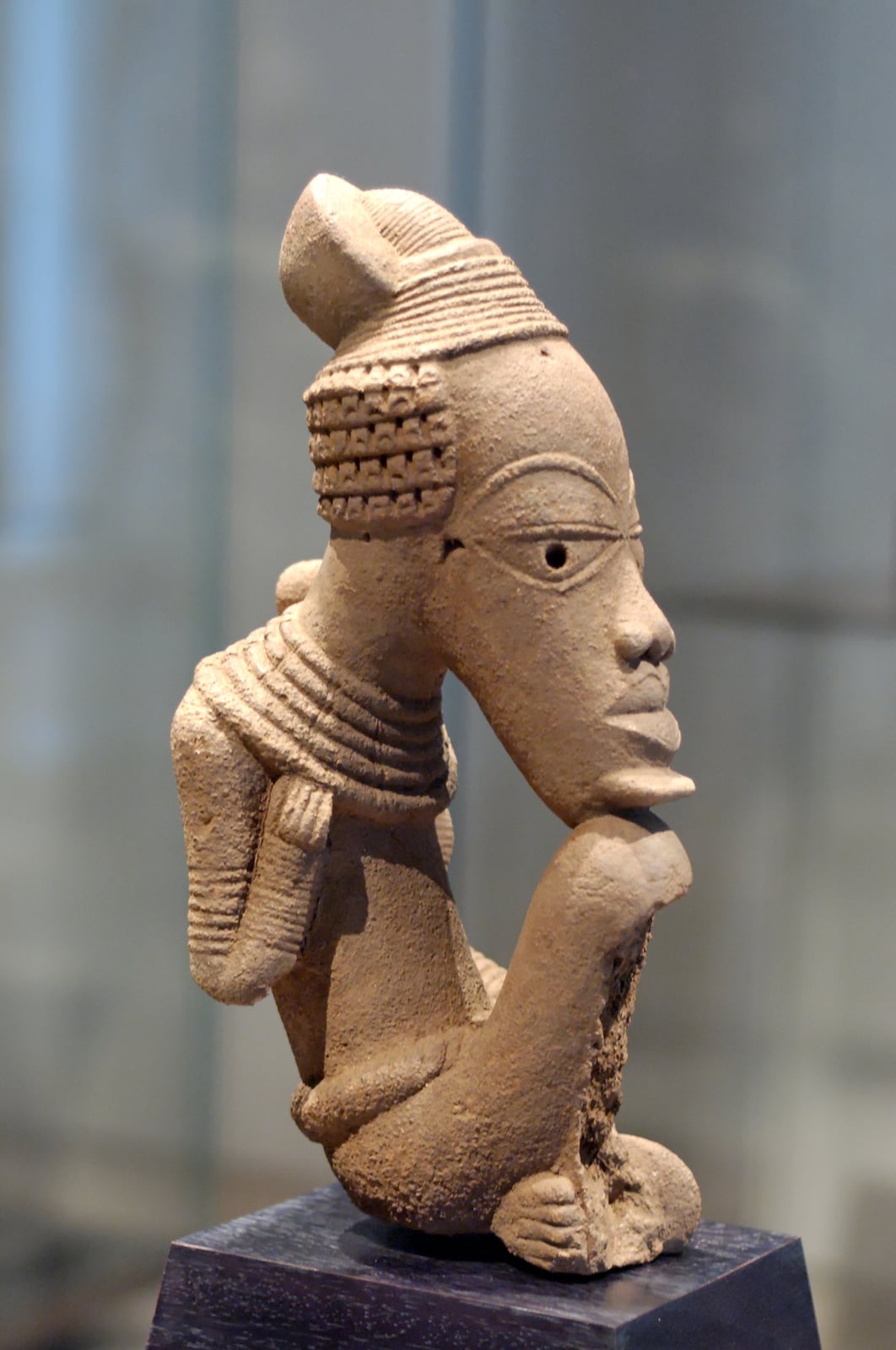
The Nok Culture Makes Terracotta Sculpture in West Africa
Fired clay heads are among the oldest figurative sculpture south of the Sahara.
In 1928, tin miners near the village of Nok in central Nigeria uncovered an unusual fired clay sculpture from deep alluvial gravels. The artifact was placed in a mining museum in Jos, but its broader significance remained obscure until 1943, when another distinctive terracotta head surfaced nearby and had been put to use as the head of a scarecrow. Bernard Fagg, an administrative officer trained in archaeology, recognized the shared style of the objects and traced their distribution. These discoveries brought to light an ancient West African tradition now named after the village of Nok, celebrated for producing the earliest known large-scale figurative sculptures in Sub-Saharan Africa.
Scientific excavations conducted over several decades have dated the broader Nok culture from approximately 1500 BCE to around the turn of the common era, with terracotta sculpture production possibly starting around 900 BCE. Radiocarbon and thermoluminescence testing at undisturbed sites such as Taruga and Samun Dukiya established that the tradition flourished during the first millennium BCE. Archaeologists working on the chronology have divided Nok ceramic sequences into early, middle, and late phases. The middle period, spanning roughly 900 to 400 BCE, represents the height of artistic activity, showing a dramatic expansion in both terracotta artifacts and early iron implements.

Keep reading in Yester
Coming soon to the App Store
Keep following the story
Sources
- Nok Terracottas (Trafficking Culture, University of Glasgow)
- Nok Sculptures (High Museum of Art, Mellon Fellows essay)
- Nok research project enters final phase (Goethe University Frankfurt)
- Nok-Forschungsprojekt geht in die letzte Phase (idw, Goethe University Frankfurt press release)
- Professor Peter Breunig: The Significance of Nok Culture Sculptures in Nigerian Prehistory (Scientia)
- Nok culture
Image: Marie-Lan Nguyen