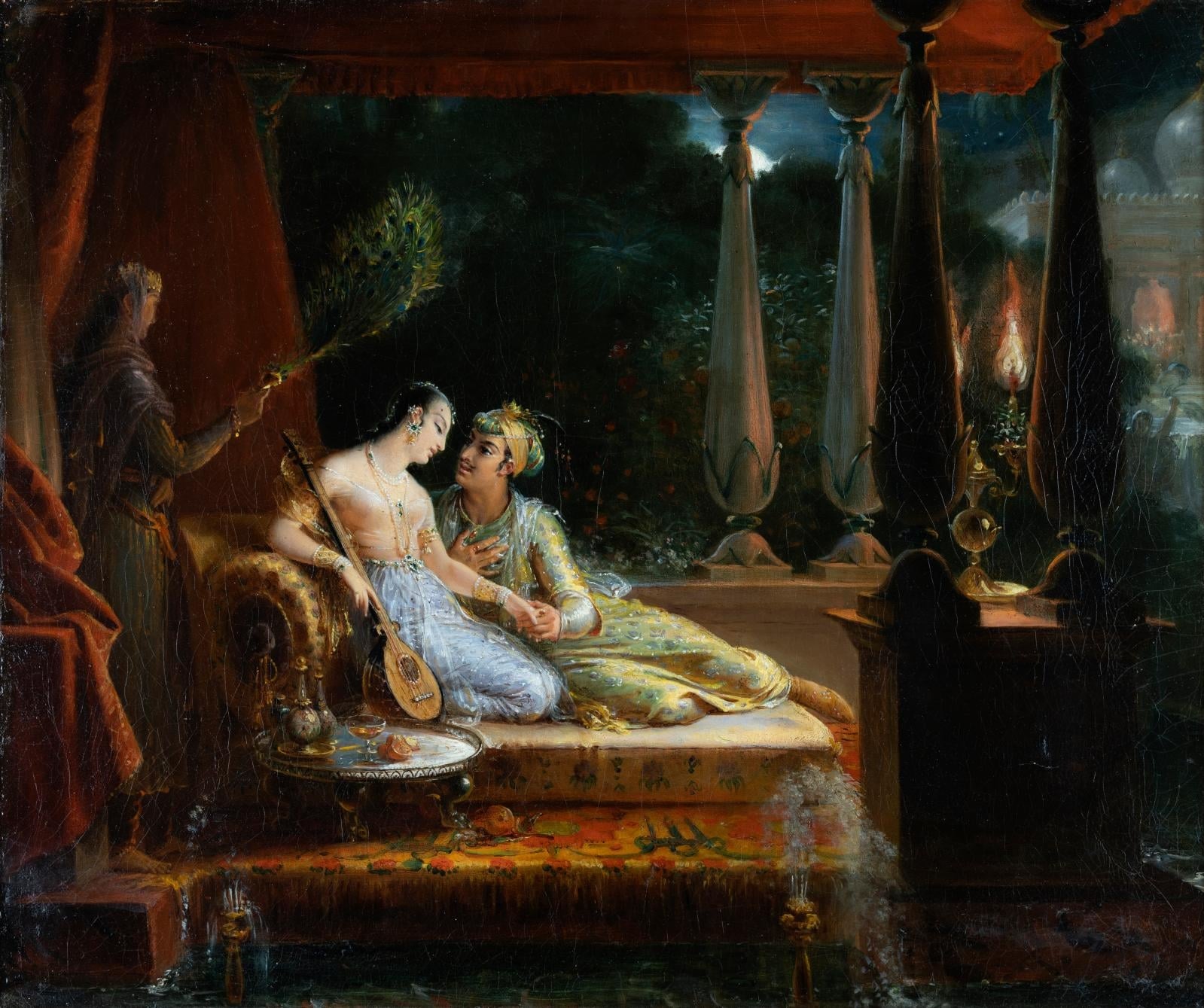
Galland’s Translation Brings the Thousand and One Nights to Europe
A French edition added famous tales and changed how the collection was known.
In 1704, the French scholar Antoine Galland began publishing Les Mille et une nuits, a multi-volume translation that introduced the Arabic storytelling tradition of One Thousand and One Nights to European readers. The underlying compilation possessed no single author or definitive text. Instead, it was an evolving composite of folklore assembled over centuries across West Asia, Central Asia, South Asia, and North Africa. Early written roots reach back to an Arabic translation of a lost Persian work, the Hezar Afsan, while the earliest surviving physical fragment is an Arabic manuscript remnant from the ninth century titled The Book of the Tale of a Thousand Nights.
Central to these diverse traditions was a common frame story, in which King Shahryar executes each new bride the morning after their wedding until Scheherazade volunteers to wed him. She preserves her life by telling engrossing tales each evening and leaving the endings unresolved until the following night. By 947 the historian al-Masudi was already describing the Persian Hazar Afsana, or A Thousand Tales, which people called A Thousand Nights. Over the centuries, diverse cycles of stories were absorbed into this structure, including Baghdad tales featuring the historical Abbasid caliph Harun al-Rashid, animal fables tracing back to ancient Sanskrit roots, and later medieval Egyptian urban narratives.

Keep reading in Yester
Coming soon to the App Store
Keep following the story
Sources
Image: Marie-Éléonore Godefroid