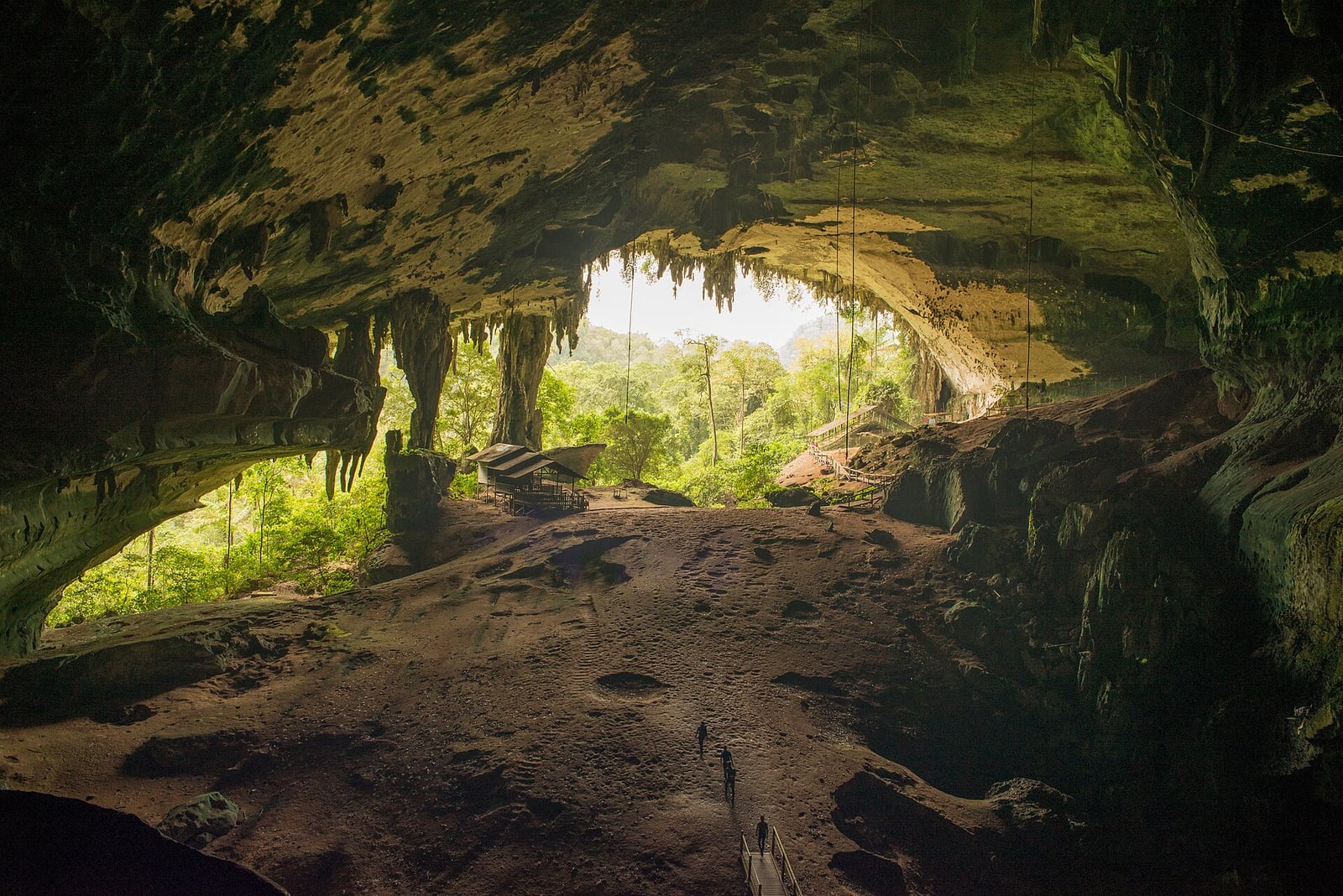
Niah Cave’s Deep Skull Shows Early Humans in Borneo
A skull found in 1958 is among the oldest modern human remains in Southeast Asia.
During the nineteenth century, naturalists in Southeast Asia began examining the vast limestone caverns of northern Borneo for paleontological and geological evidence. British naturalist Alfred Russel Wallace received reports from mining engineer Robert Coulson concerning bones found inside caves between Sarawak and Brunei. Wallace supported an exploration of the area in 1864, leading to surveys by British officials including Alfred Hart Everett, who documented dozens of caves around Mount Subis and other districts. Although early visitors recorded the impressive geography of the Mount Subis complex, systematic archaeological research did not begin until the middle of the twentieth century under the direction of the Sarawak Museum.
Tom Harrisson, the curator of the Sarawak Museum, initiated excavations at Niah Cave in October 1954 alongside Michael Tweedie and Hugh Gibb. Harrisson reasoned that the dry, sheltered interior of the cavern, combined with abundant colonies of bats and swiftlets, made it a logical shelter for prehistoric foraging groups. Initial soundings exposed stratified evidence of long-term human occupation, burial practices, and food refuse. Encouraged by these early results, the museum mounted a much larger excavation in 1957 with technical support from regional petroleum companies. Fieldworkers uncovered an extensive array of material culture, including bone tools, earthenware, stone pounders, and shell ornaments across multiple stratigraphic levels.

Keep reading in Yester
Coming soon to the App Store
Keep following the story
Sources
- The Archaeological Heritage of Niah National Park's Caves Complex (UNESCO World Heritage Centre)
- Ancient 'Deep Skull' from Borneo full of surprises (UNSW Sydney newsroom, 2016)
- The 'human revolution' in lowland tropical Southeast Asia, Barker et al. 2007 (White Rose Research Online, University of York)
- Niah Cave Deep Skull (Peter Brown, University of New England palaeoanthropology)
- Niah National Park
Image: Michael Elleray from England, United Kingdom