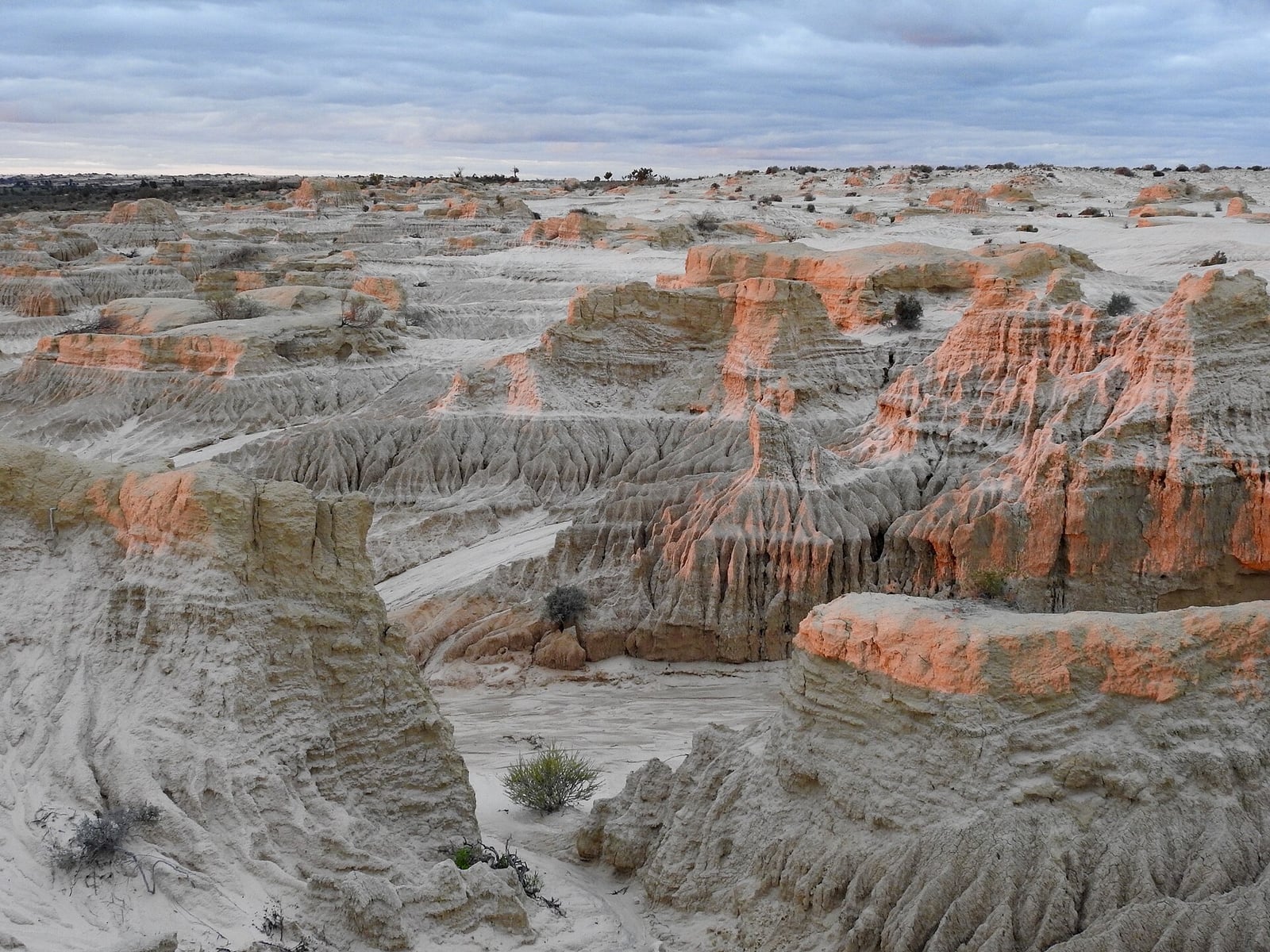
Mungo Man Is Buried with Ochre by an Ancient Lake
A burial about 40,000 years old is among the earliest known ritual burials.
In the arid expanse of south-western New South Wales, the dry basin of Lake Mungo preserves sedimentary layers spanning more than one hundred thousand years. During the Pleistocene epoch, runoff from the western slopes of the Great Dividing Range filled the lake despite cooler, drier regional climates, sustaining fish, waterbirds, and early human communities. As the climate shifted toward the last ice age, the water receded and the basin turned saline. This transition left behind alkaline soils that proved uniquely suited to preserving organic material that would otherwise have decayed.
The archaeological significance of these dunes emerged clearly between 1968 and 1974, when geomorphologist Jim Bowler identified ancient human remains exposed by shifting sands. The first find, designated Lake Mungo 1, or Mungo Woman, revealed bones that had been burned, broken, burned a second time, and coated with ochre, representing one of the earliest recorded examples of cremation. In February 1974, Bowler found a second major burial a short distance away. Designated Lake Mungo 3, or Mungo Man, these remains belonged to an adult male who had lived to approximately fifty years of age.

Keep reading in Yester
Coming soon to the App Store
Keep following the story
Sources
- New ages for human occupation and climatic change at Lake Mungo, Australia, Bowler et al. 2003 (Nature)
- Willandra Lakes Region (UNESCO World Heritage Centre)
- Ancestral Remains returned to traditional owners (Australian National University, 6 November 2015; archived)
- Mungo Man returned to ancestral home where he died 40,000 years ago (ABC News, 17 November 2017)
- NSW government says it did not authorise reburial of Mungo Man and Mungo Lady (The Guardian, 2022)
- New DNA technology confirms Aboriginal people as first Australians (ABC News, 2016)
- Lake Mungo remains
Image: Caroline Jones