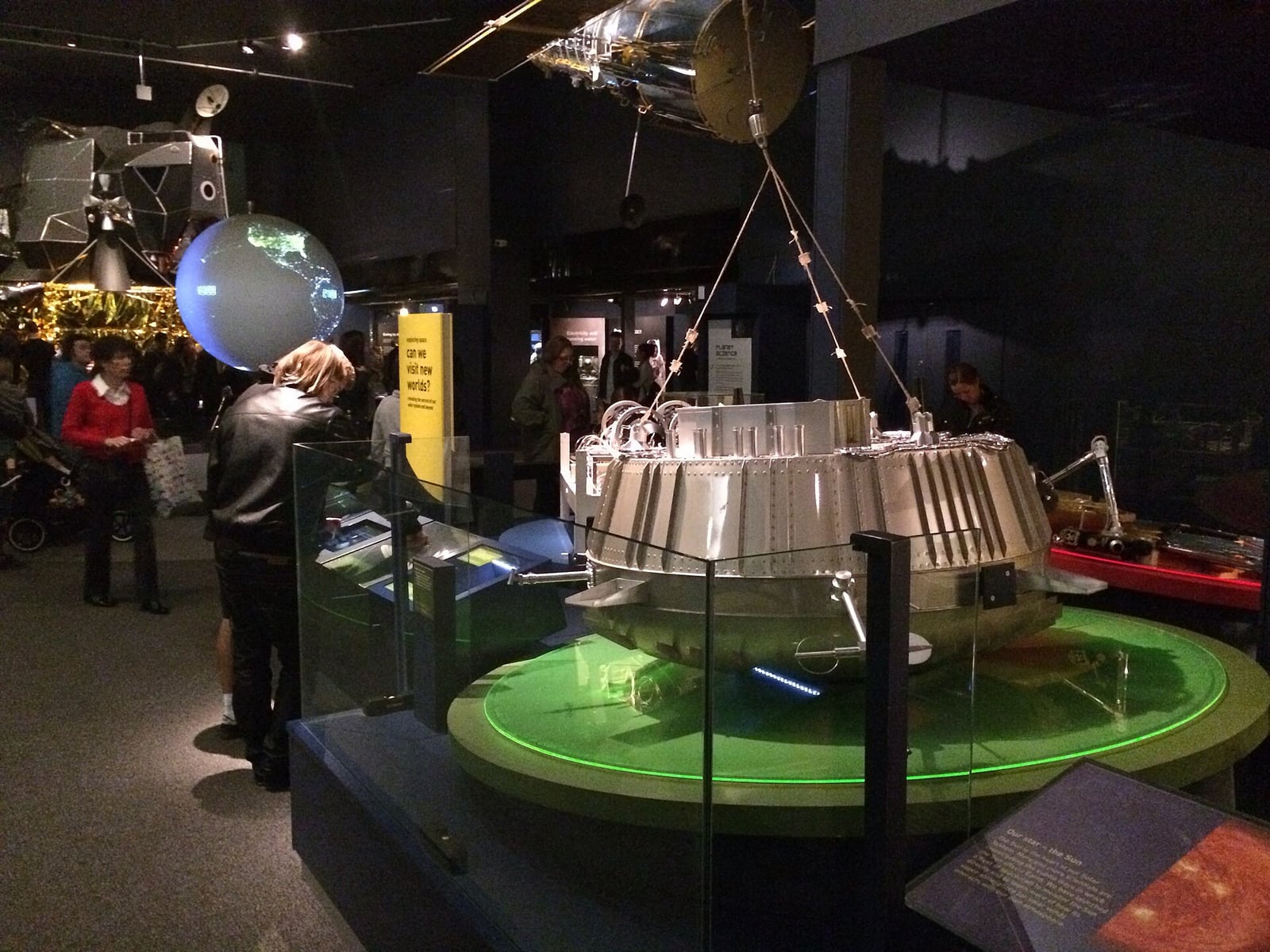
Huygens Lands on Titan
A European probe carried by Cassini touched down on a moon with lakes of liquid hydrocarbons.
On 14 January 2005, the robotic probe Huygens detached its heat shield and descended by parachute through the dense, hazy atmosphere of Titan, Saturn's largest moon. Constructed and operated by the European Space Agency, the lander had travelled across the solar system piggybacked on NASA's Cassini orbiter during a seven-year journey. After a 20-day, 4-million-kilometre coast following its release on 25 December 2004, the craft slowed its entry with parachutes to become the first human-built machine to touch down on a world in the outer solar system.
Engineers faced considerable uncertainty when preparing the lander, as observations prior to arrival could not determine whether the surface beneath the cloud cover was composed of rocky terrain, soft plains, or a liquid ocean. Huygens's primary task was to sample the atmosphere during a descent of more than two hours, and the original plan allowed only a limited window for communication with Cassini. The probe carried five batteries, although system redundancy meant only four were needed to complete a nominal mission.

Keep reading in Yester
Coming soon to the App Store
Keep following the story
Sources
- Huygens lands on Titan! (European Space Agency)
- Titan Surface Landing (European Space Agency)
- Modest hero sparks team response (European Space Agency)
- Highlights of ESA's Huygens mission (European Space Agency)
- Huygens: the missing data (Nature)
- NASA and ESA Celebrate 10 Years Since Titan Landing (NASA Jet Propulsion Laboratory)
- Huygens (spacecraft)
Image: Fermion