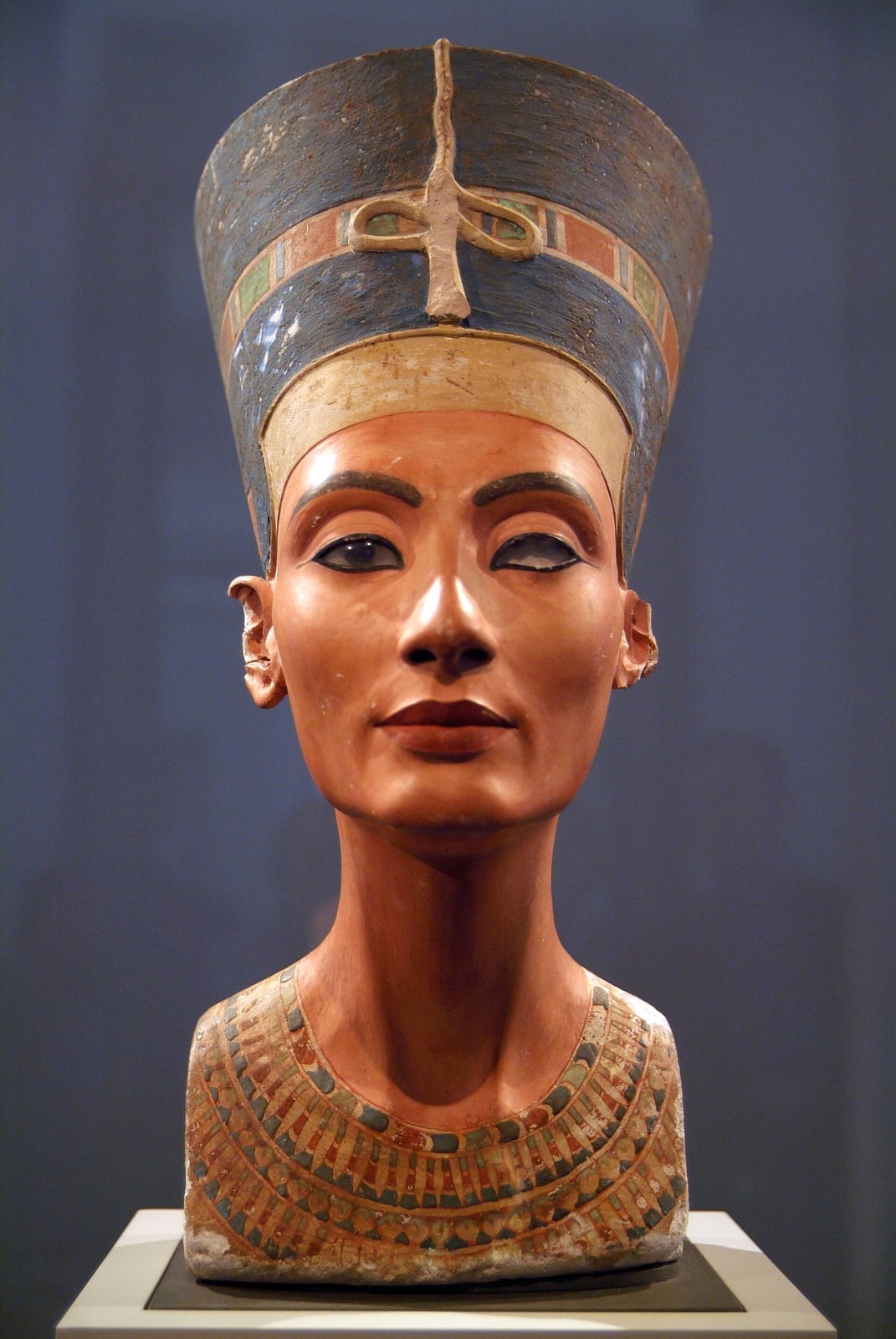
Archaeologists Uncover the Bust of Nefertiti
A painted limestone portrait became one of the most famous works of ancient art.
On 6 December 1912, an excavation team led by German archaeologist Ludwig Borchardt uncovered a painted portrait bust in the ruins of Tell-el Amarna. The expedition, financed by Prussian merchant James Simon under the auspices of the German Oriental Company, was examining the workshop complex of the ancient royal sculptor Thutmose. Among various unfinished sculptures in the studio, Borchardt found the polychrome bust of Queen Nefertiti, the chief consort of the Eighteenth Dynasty pharaoh Akhenaten. The figure, carved around 1345 BC, was preserved almost intact beneath centuries of collapsed mudbrick and sand.
Measuring 48 centimetres high and weighing roughly 20 kilograms, the sculpture consists of a carved limestone core coated with modeled stucco. Nefertiti is portrayed wearing a tall, flat-topped blue crown encircled by a golden band, with a damaged uraeus cobra positioned over her brow and a patterned collar adorning her neck. While the right eye retains an inlaid quartz iris set with beeswax and painted black, the left eye socket remained empty. Borchardt noted the missing piece immediately, and despite offering a substantial monetary reward, no inlaid quartz for the left eye was ever found on the site.

Keep reading in Yester
Coming soon to the App Store
Keep following the story
Sources
- First exhibition of the bust of Nefertiti 100 years ago (Stiftung Preussischer Kulturbesitz)
- The bust of Nefertiti, press release 24 January 2011 (Stiftung Preussischer Kulturbesitz)
- The Presentation of the bust of Nefertiti (Staatliche Museen zu Berlin, Aegyptisches Museum)
- German Archaeologists Discovered the Iconic Bust of Nefertiti... (Smithsonian Magazine)
- CT Reveals Hidden Face In Nefertiti Bust (ScienceDaily, from Radiological Society of North America)
- Nefertiti Bust
Image: Giovanni from Firenze, Italy