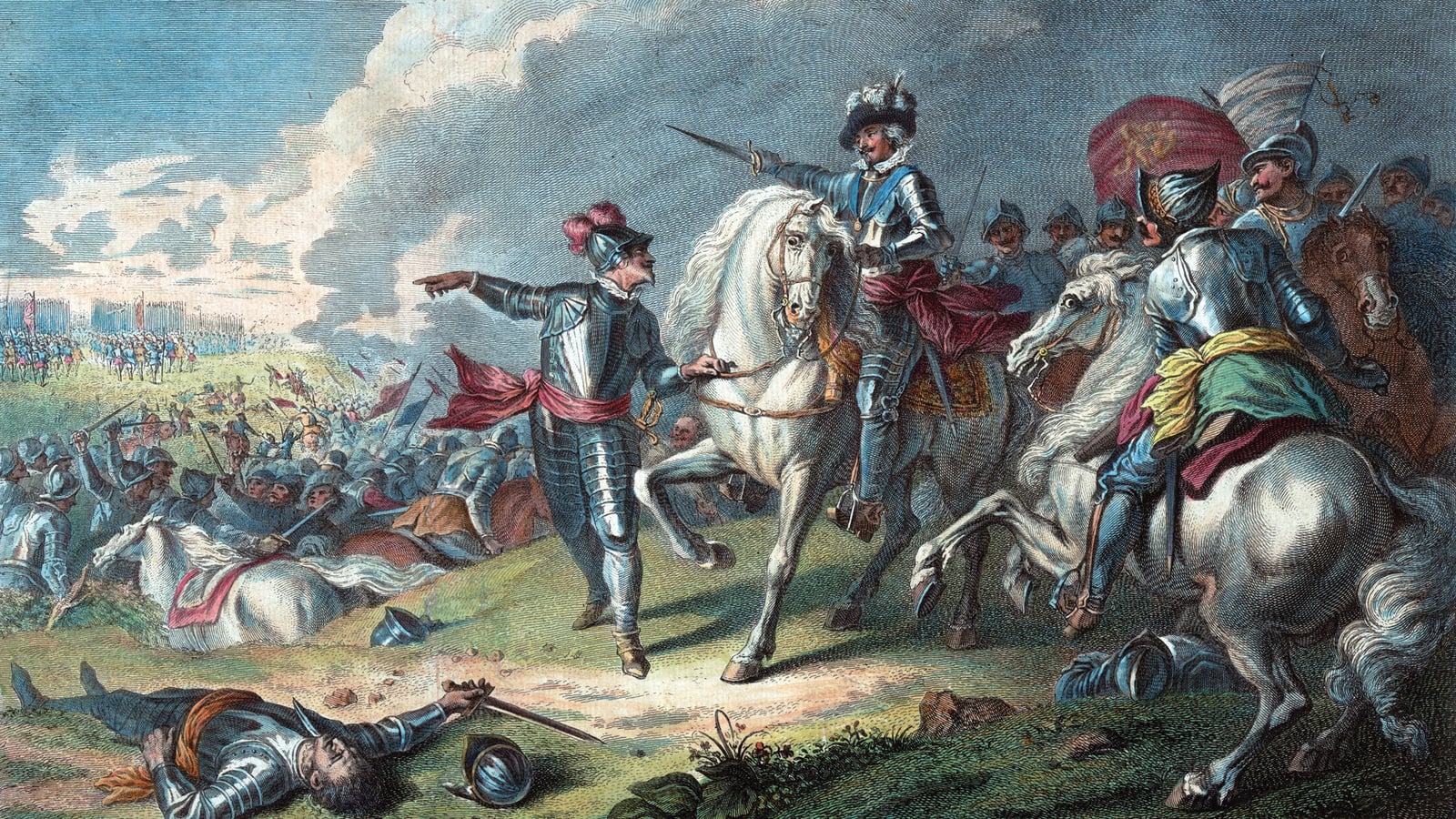
Parliament’s New Model Army Wins at Naseby
A decisive battle turned the English Civil War against the king.
On the morning of 14 June 1645, the main field armies of King Charles I and the English Parliament met near the Northamptonshire village of Naseby. Parliament had recently reorganised its military apparatus under the Self-denying Ordinance, which required members of both legislative houses to resign their commands. This reform paved the way for the New Model Army, a unified and professionally administered fighting force led by Sir Thomas Fairfax, with Philip Skippon heading the infantry and Oliver Cromwell directing the horse. After Royalist troops stormed the town of Leicester in late May, Fairfax abandoned an ineffective investment of Oxford to pursue the royal field army.
Despite being outnumbered, Charles and his advisers chose to offer battle rather than withdraw. The Royalist high command had suffered from strategic divisions throughout the spring, and Lord Goring had refused to bring his cavalry from the West Country to reinforce the central force. When Cromwell joined Fairfax with reinforcements on 13 June, the Parliamentarians assembled somewhere between about 12,000 and 14,600 men, by differing estimates. Charles and Prince Rupert commanded a force of around 10,000. Heavy early morning fog initially hid the formations from view, but after scouts surveyed the ground, both sides deployed along parallel ridges north of Naseby.

Keep reading in Yester
Coming soon to the App Store
Keep following the story
Sources
Image: Unknown author Unknown author